
Quick Answer: Is Your Child Ready for Preschool?
There is no single checklist that can determine whether every child is “ready” for preschool.
Children develop at different rates, and Massachusetts’ preschool guidance explicitly recognizes individual differences in development. The state’s guidance also emphasizes that young children learn through doing and that families are their children’s primary caregivers and educators.
Instead of asking whether your child can already read, write, count, or sit quietly for a long period, parents considering preschool in Belmont, MA should look at the whole child.
Important areas include:
- Communication
- Social interaction
- Emotional regulation
- Independence
- Following simple routines
- Curiosity
- Ability to participate in play
- Basic self-help skills
- Comfort around other children
- Ability to separate from caregivers, even if briefly
- Physical development
- Willingness to try new activities
A child does not need to master every one of these skills before starting preschool.
In fact, preschool is one of the environments where children develop many of these skills.
The goal is not to have a “perfectly prepared” child.
The goal is to find an age-appropriate, supportive preschool where your child can continue developing.
Table of Contents
- What Is Preschool Readiness?
- Why Preschool Readiness Is More Than Academic Skills
- What Age Do Children Start Preschool?
- 12 Signs Your Child May Be Ready for Preschool
- Preschool Readiness Checklist
- Communication and Language Readiness
- Social Readiness
- Emotional Readiness
- Independence and Self-Help Skills
- Following Instructions and Routines
- Attention and Participation
- Physical and Motor Skills
- Early Literacy Readiness
- Early Math Readiness
- Curiosity and Problem-Solving
- Separation Anxiety and Preschool
- What If Your Child Cries at Drop-Off?
- Does My Child Need to Be Potty Trained?
- Does My Child Need to Know the Alphabet?
- Does My Child Need to Count Before Preschool?
- What If My Child Is Shy?
- What If My Child Is Very Active?
- What If My Child Doesn’t Talk Much?
- Preparing Your Child for Preschool
- Preschool Readiness Activities at Home
- One-Month Preschool Preparation Plan
- Choosing Preschool in Belmont, MA
- What Parents Should Ask During a Preschool Tour
- Belmont, MA Preschool Considerations
- Arlington, MA Preschool Considerations
- Preschool vs. Staying Home
- When Your Child May Need Additional Support
- Preschool Readiness Mistakes Parents Should Avoid
- Preschool Readiness FAQ
- Final Preschool Readiness Checklist
- Conclusion
- SEO Metadata
- Schema Markup
Introduction: Is Your Child Ready for Preschool in Belmont, MA?
Choosing a preschool can be exciting.
It can also create a lot of questions.
Parents may wonder:
“Is my child old enough?”
“Can my child separate from me?”
“Does my child need to be potty trained?”
“Should my child know the alphabet?”
“What if my child is shy?”
“What if my child doesn’t listen?”
“What if my child still has tantrums?”
These are completely understandable concerns.
The good news is that preschool readiness isn’t about checking every box before your child’s first day.
A quality preschool in Belmont, MA should be designed to meet children where they are developmentally and help them grow from there.
Massachusetts’ official preschool learning guidance emphasizes development across multiple areas, including social-emotional development, approaches to play and learning, language, literacy, mathematics, science, physical development, and the arts.
The state’s standards for social-emotional development and approaches to play and learning also highlight initiative, curiosity, engagement, persistence, creativity, cooperative play, problem-solving, self-management, and relationship skills.
That gives parents an important perspective:
Preschool readiness is about the whole child—not just academic knowledge.
What Is Preschool Readiness?
Preschool readiness refers to the collection of developmental skills and behaviors that can help a child participate comfortably and successfully in an early learning environment.
It can include:
- Communication
- Social interaction
- Emotional awareness
- Self-regulation
- Independence
- Motor skills
- Curiosity
- Play skills
- Listening
- Following simple directions
- Participating in routines
- Basic self-care
However, readiness is not a pass-or-fail test.
A child can be strong in one area and still developing in another.
For example:
A child may be very independent but shy around other children.
Another child may have excellent language skills but struggle with separation.
Another may be socially confident but still need help with toileting.
Another may be highly curious but have difficulty sitting during group activities.
All of these children can potentially thrive in preschool with appropriate support.
Why Preschool Readiness Is More Than Academic Skills
One of the biggest mistakes parents make is assuming preschool readiness means knowing:
- ABCs
- Numbers
- Colors
- Shapes
- Writing
- Reading
These skills can certainly be introduced during early childhood.
But preschool readiness goes much deeper.
Imagine two children.
Child A
Knows the alphabet perfectly but:
- Cannot communicate needs
- Struggles to interact with peers
- Becomes extremely distressed by every transition
- Cannot participate in basic routines
Child B
Doesn’t know every letter but:
- Communicates needs
- Plays alongside other children
- Shows curiosity
- Can follow simple directions
- Attempts basic self-help tasks
- Can gradually separate from a caregiver
Child B may have a stronger foundation for entering a group preschool environment.
This is why Massachusetts’ early learning guidance focuses on interconnected developmental domains rather than a narrow academic checklist.
What Age Do Children Start Preschool?
There isn’t one universal preschool starting age for every program in Belmont.
Different preschools have different:
- Age requirements
- Enrollment dates
- School-year structures
- Program schedules
- Eligibility rules
- Classroom age groups
Some programs may accept younger preschoolers, while others may begin at age 3 or later.
Parents should therefore check the specific preschool’s current enrollment requirements rather than relying on a general age assumption.
This is particularly important when comparing preschool in Belmont, MA with programs in nearby Arlington.
12 Signs Your Child May Be Ready for Preschool
Your child doesn’t need to demonstrate every sign.
However, the following behaviors can provide useful clues.
1. Your Child Shows Interest in Other Children
Does your child watch other children?
Do they try to approach them?
Do they play alongside them?
Do they show curiosity about what other children are doing?
These can be positive signs.
Children don’t need to be highly social before preschool.
Even parallel play—playing near another child without directly interacting—can be an important developmental stage.
2. Your Child Can Communicate Basic Needs
A child entering preschool should ideally have some way to communicate needs.
This doesn’t necessarily mean speaking in complete sentences.
Communication can happen through:
- Words
- Short phrases
- Gestures
- Pointing
- Facial expressions
- Communication supports
Your child may need to communicate things like:
- “Help”
- “Water”
- “Bathroom”
- “More”
- “No”
- “I’m hurt”
- “I want this”
The exact level of communication expected will depend on age and individual development.
3. Your Child Can Follow Simple Directions
Preschool teachers may say:
- “Put the blocks away.”
- “Come sit at the table.”
- “Wash your hands.”
- “Let’s line up.”
- “Please bring me the book.”
Your child does not need to obey every instruction perfectly.
The important question is whether they can generally understand and respond to simple directions.
4. Your Child Can Participate in a Basic Routine
Preschool classrooms usually have routines.
For example:
Arrival → Play → Group Activity → Snack → Outdoor Time → Story → Cleanup → Departure
Your child doesn’t need to know this schedule in advance.
They simply need to gradually learn that activities happen in a predictable sequence.
5. Your Child Can Spend Some Time Away From You
This is one of the biggest concerns for parents.
Your child may still cry when you leave.
That does not automatically mean they are not ready.
The more important question is:
Can your child eventually become comfortable with another trusted adult?
If your child can calm down after some time with a teacher, caregiver, grandparent, or other trusted adult, that’s encouraging.
6. Your Child Shows Curiosity
Curiosity is a powerful sign of readiness.
Does your child:
- Ask questions?
- Explore?
- Investigate objects?
- Want to know how things work?
- Try new activities?
- Watch what adults are doing?
These behaviors indicate an important approach to learning.
Massachusetts’ preschool standards specifically identify curiosity, initiative, engagement, persistence, creativity, and problem-solving as important approaches to play and learning.
7. Your Child Can Engage in Play
Play is central to early childhood learning.
Your child may enjoy:
- Building blocks
- Pretend play
- Puzzles
- Drawing
- Cars
- Dolls
- Sensory activities
- Books
- Outdoor play
They don’t need to play perfectly with other children.
The ability to engage with toys, materials, or imaginative activities is an important foundation.
8. Your Child Is Beginning to Develop Self-Control
No preschooler has perfect emotional control.
Tantrums are normal during early childhood.
Instead, look for gradual development.
Can your child:
- Wait briefly?
- Stop an activity with support?
- Accept simple boundaries?
- Recover after becoming upset?
- Listen when an adult helps?
These are more realistic expectations than expecting complete emotional regulation.
9. Your Child Is Becoming More Independent
Independence might look like:
- Trying to put on shoes
- Putting toys away
- Washing hands
- Eating independently
- Carrying a backpack
- Choosing an activity
- Asking for help
Preschool can continue developing these skills.
10. Your Child Can Manage Basic Transitions With Support
Transitions are changes from one activity to another.
For example:
Playtime → Cleanup
Classroom → Playground
Snack → Story
Some children struggle with transitions.
That’s common.
But if your child can eventually transition with preparation and adult support, that’s a useful sign.
11. Your Child Can Participate in a Small Group
Can your child sit with other children for a short story?
Can they join a song?
Can they participate in a simple group activity?
They don’t need to sit perfectly still.
Young children naturally move.
The goal is simply to develop the ability to participate.
12. Your Child Is Interested in Learning New Things
Perhaps the strongest sign is curiosity.
A child doesn’t have to already know everything.
They simply need opportunities to discover.
A preschool environment should help turn:
“Why?”
into:
“Let’s find out.”
Preschool Readiness Checklist
Use this checklist as a conversation tool—not a test.
| Skill | Often | Sometimes | Not Yet |
|---|---|---|---|
| Communicates basic needs | ☐ | ☐ | ☐ |
| Understands simple directions | ☐ | ☐ | ☐ |
| Shows interest in other children | ☐ | ☐ | ☐ |
| Engages in play | ☐ | ☐ | ☐ |
| Attempts self-help tasks | ☐ | ☐ | ☐ |
| Can separate briefly from caregiver | ☐ | ☐ | ☐ |
| Participates in simple routines | ☐ | ☐ | ☐ |
| Shows curiosity | ☐ | ☐ | ☐ |
| Attempts problem-solving | ☐ | ☐ | ☐ |
| Can transition with support | ☐ | ☐ | ☐ |
| Can participate in group activities | ☐ | ☐ | ☐ |
| Begins to express emotions | ☐ | ☐ | ☐ |
Again, “Not Yet” does not mean “Not Ready.”
It simply tells you what your child may need additional support practicing.
Communication and Language Readiness
Language is one of the most important areas of preschool readiness.
Massachusetts’ preschool guidance notes the importance of language development and identifies language skills as strongly connected with academic success.
Parents can encourage language development by talking with children throughout the day.
Instead of asking only:
“Did you have fun?”
try:
“What was your favorite part of the day?”
or:
“What did you build?”
or:
“Why did you choose that color?”
These questions encourage children to explain, describe, and reason.
What If Your Child Speaks Another Language at Home?
Being multilingual is not a reason to delay preschool.
Families should communicate with the preschool about the child’s language background and ask how the program supports children who speak languages other than English.
Massachusetts’ early childhood guidance recognizes the importance of children’s language and family experiences. High-quality EEC environments are expected to be responsive to children’s experiences, culture, and language.
A child’s home language is an important part of their identity and family life.
Parents should feel comfortable discussing language needs with prospective schools.
Social Readiness for Preschool
Social readiness doesn’t mean your child needs to be outgoing.
Instead, look for emerging abilities such as:
- Playing near peers
- Sharing with support
- Taking turns
- Asking for help
- Listening
- Responding to others
- Participating in group activities
Children learn many of these behaviors through preschool itself.
Massachusetts’ preschool standards specifically emphasize relationship skills, cooperative play, social awareness, responsible decision-making, and self-management.
Emotional Readiness for Preschool
Emotional readiness is often misunderstood.
A preschool-ready child does not need to:
- Never cry
- Never get angry
- Never have tantrums
- Always follow directions
- Always share
Those expectations are unrealistic for young children.
Instead, look for developing abilities to:
- Express emotions
- Accept comfort
- Recover after frustration
- Seek adult help
- Recognize simple feelings
- Begin learning calming strategies
A supportive preschool should help children develop these skills rather than expecting them to arrive fully formed.
Independence and Self-Help Skills
Preschool teachers can help children become independent, but parents can prepare children at home.
Encourage your child to practice:
Eating
- Using utensils
- Drinking from an appropriate cup
- Opening simple containers when possible
Dressing
- Putting on shoes
- Removing a coat
- Attempting zippers
Hygiene
- Washing hands
- Using tissues
- Covering coughs with guidance
Organization
- Putting toys away
- Carrying a backpack
- Returning materials
The objective is not perfection.
It’s practice.
Does My Child Need to Be Fully Potty Trained?
There is no universal answer.
Preschool policies differ.
Some programs require children to be toilet independent, while others accommodate children who are still learning.
Therefore, ask the specific preschool in Belmont about its toileting policy before enrollment.
Important questions include:
- Do you accept children who are not fully toilet trained?
- Who assists with toileting?
- What happens after an accident?
- What supplies should parents provide?
- How do teachers maintain privacy and hygiene?
Never assume the policy based on another preschool.
Does My Child Need to Know the Alphabet?
No.
Children do not need to know the entire alphabet before entering preschool.
It can be helpful if your child recognizes some letters, especially letters in their own name, but preschool itself is a place for developing early literacy.
At home, you can make literacy enjoyable through:
- Reading books
- Singing alphabet songs
- Pointing out letters
- Drawing
- Looking at signs
- Talking about names
- Rhyming games
Avoid turning early literacy into stressful testing.
Does My Child Need to Count Before Preschool?
Children do not need advanced mathematics skills before preschool.
However, everyday activities can introduce mathematical thinking.
Try:
- Counting toys
- Comparing big and small
- Sorting colors
- Finding shapes
- Counting steps
- Building towers
- Matching socks
These simple activities build early mathematical awareness.
Preschool Readiness and Fine Motor Skills
Fine motor development supports later classroom tasks.
Children can practice through:
- Coloring
- Drawing
- Play dough
- Building blocks
- Puzzles
- Threading activities
- Stickers
- Safe scissors
- Finger painting
Don’t worry if your child’s drawings don’t look recognizable.
The process matters more than the final picture.
Preschool Readiness and Gross Motor Skills
Children also need opportunities to move.
Try:
- Running
- Jumping
- Dancing
- Throwing
- Catching
- Climbing
- Balancing
- Outdoor games
Physical development can support confidence and participation in classroom activities.
What If My Child Is Very Shy?
Being shy doesn’t mean a child isn’t ready for preschool.
Some children need time to observe before participating.
A good teacher can gradually invite a shy child into activities.
Parents can help by:
- Visiting the classroom beforehand
- Talking about what will happen
- Practicing short separations
- Arriving early
- Creating a predictable goodbye
- Avoiding pressure to “perform”
Don’t label your child negatively.
Instead of:
“She’s very shy.”
you might say:
“She likes to observe before joining new activities.”
That framing communicates confidence.
What If My Child Is Very Active?
Being energetic does not automatically mean a child isn’t preschool-ready.
Young children are naturally active.
Parents should look for a program that incorporates appropriate movement throughout the day.
Ask the preschool:
- How often do children move?
- Is there outdoor play?
- Are movement activities included?
- How are transitions handled?
- How does the teacher support highly active children?
Massachusetts’ quality early education framework emphasizes safe environments where children can play and explore and describes developmentally appropriate activities grounded in play.
What If My Child Doesn’t Like Group Activities?
That’s common.
Some children prefer individual activities.
Teachers can gradually help them participate.
For example:
Stage 1: Observe the group.
Stage 2: Sit nearby.
Stage 3: Participate briefly.
Stage 4: Join a preferred activity.
Stage 5: Participate for longer periods.
Preschool is a place to develop these skills.
What If My Child Has Separation Anxiety?
Separation anxiety can make preschool preparation emotionally difficult for both child and parent.
Your child may:
- Cry
- Hold onto you
- Refuse to enter
- Ask you not to leave
- Become upset during drop-off
This doesn’t automatically mean preschool is inappropriate.
A consistent routine can help.
Try a simple goodbye ritual:
Hug → Short phrase → Hand-off → Leave confidently
For example:
“I love you. Have a great day. I’ll see you after school.”
Avoid repeatedly returning after leaving unless the teacher recommends it.
Repeated departures and returns can sometimes make the transition harder.
What If My Child Cries Every Morning?
Talk with the teacher.
Ask:
- How long does the crying typically last?
- What helps the child calm down?
- Does the child participate after the parent leaves?
- Is the behavior improving?
- Does the child interact with teachers?
- Does the child engage in activities later?
The important information is often what happens after the goodbye.
A child who cries for five minutes and then happily plays may be having a normal transition.
A child who remains intensely distressed for extended periods may need a different transition strategy or additional support.
Preschool Readiness Activities You Can Do at Home
You don’t need expensive educational products.
Everyday life provides excellent practice.
Activity 1: Practice Cleanup
After playing:
“Let’s put the blocks back together.”
This develops:
- Following directions
- Responsibility
- Organization
- Transitions
Activity 2: Practice Turn-Taking
Play a simple game.
Say:
“My turn.”
Then:
“Your turn.”
This helps children understand basic social rules.
Activity 3: Read Every Day
Read picture books together.
Ask:
- “What do you see?”
- “What happened?”
- “How does the character feel?”
- “What do you think happens next?”
Activity 4: Pretend Preschool
Create a pretend classroom at home.
Practice:
- Arriving
- Hanging up a bag
- Sitting for a short story
- Cleaning up
- Having snack
- Saying goodbye
This can make the real experience feel more familiar.
Activity 5: Practice Asking for Help
Teach your child:
“Can you help me?”
This is one of the most useful phrases a preschooler can have.
Activity 6: Practice Choice-Making
Offer two choices:
“Do you want the red shirt or blue shirt?”
Choice-making can support independence.
A 30-Day Preschool Preparation Plan
Week 1: Independence
Focus on:
- Handwashing
- Cleanup
- Eating
- Putting belongings away
- Simple dressing
Week 2: Social Skills
Practice:
- Taking turns
- Sharing
- Asking for help
- Saying hello
- Saying goodbye
Week 3: Routines
Practice:
- Wake-up
- Getting dressed
- Breakfast
- Leaving home
- Following simple routines
Week 4: Preschool Simulation
Practice:
- Short separation
- Group story
- Cleanup
- Snack
- Activity transitions
Keep the process fun.
Choosing the Right Preschool in Belmont, MA
Once you’ve considered readiness, the next question is:
What kind of preschool environment is right for my child?
Don’t choose based solely on:
- Website appearance
- Distance
- Price
- Reviews
- Academic claims
Look at the entire program.
Massachusetts describes high-quality early education as involving warm, supportive interactions, safe and engaging environments, developmentally appropriate curriculum, play and exploration, and collaboration with families.
These are useful criteria for parents evaluating a preschool in Belmont, MA.
What to Look for in a Belmont Preschool
1. Warm Teacher-Child Relationships
Do teachers:
- Get down to children’s level?
- Listen?
- Respond?
- Encourage?
- Comfort children?
2. Developmentally Appropriate Learning
Look for:
- Play
- Books
- Art
- Music
- Movement
- Building
- Science exploration
- Early math
- Storytelling
3. Safe Environment
Ask about:
- Licensing
- Emergency procedures
- Staff qualifications
- Background checks
- Supervision
- Pickup procedures
Massachusetts EEC explains that licensed group and school-age child care programs must meet requirements related to health, safety, supervision, training, educator qualifications, ratios, and background checks.
4. Family Communication
A strong preschool should have a clear method for communicating with parents.
Ask:
- How are daily updates provided?
- How are concerns communicated?
- Are parent conferences available?
- Can parents contact teachers?
Belmont, MA: Why Local Fit Matters
Belmont families have access to different types of early childhood and preschool options.
Belmont Public Schools’ Pre-K program, for example, serves both children with special needs and typically developing children, with tuition-based enrollment for eligible typically developing children through an integrated classroom model. The town’s FY2026 Warrant Committee report notes that the program used a lottery for applicants and had 75 students enrolled as of October 1, 2024.
That information illustrates an important point for parents:
Availability and eligibility can vary by program.
A parent shouldn’t wait until the last moment to investigate enrollment requirements.
If you’re specifically searching for preschool in Belmont, MA, make a list of several programs and contact them directly about:
- Current age requirements
- Enrollment periods
- Availability
- Tuition
- Schedule
- Classroom structure
- Eligibility
- Waiting lists
What About Preschool Near Arlington, MA?
Families living close to the Belmont-Arlington area may reasonably consider programs in both communities.
Arlington has its own early childhood offerings.
For example, Arlington Recreation’s Kid Care Preschool has described a licensed preschool program for children approximately ages 2.9–5, with programming designed around children’s curiosity and artistic, scientific, sensory, verbal, and written expression.
Families should check the current program information directly because schedules, fees, enrollment rules, and availability can change.
For parents searching preschool near Arlington, MA, comparing nearby Belmont programs can also make sense when:
- A parent works in Belmont
- The family lives near the town boundary
- A particular schedule is better
- A child’s sibling attends nearby
- Transportation is easier
Belmont vs. Arlington Preschool: What Should Parents Compare?
Don’t simply ask:
“Which town has better preschools?”
Instead compare individual programs.
| Factor | Belmont | Arlington |
|---|---|---|
| Location | Depends on neighborhood | Depends on neighborhood |
| Program type | Public/private/community options | Public/community/private options |
| Schedule | Varies by provider | Varies by provider |
| Tuition | Program-specific | Program-specific |
| Eligibility | Program-specific | Program-specific |
| Curriculum | Program-specific | Program-specific |
| Availability | Changes by program | Changes by program |
| Transportation | Family-specific | Family-specific |
The best preschool is the one that offers the strongest combination of:
Quality + Safety + Fit + Schedule + Availability + Family Needs
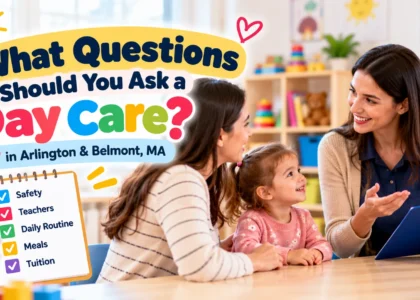
What Questions Should Parents Ask a Preschool in Belmont, MA?
Before enrolling, ask at least these questions.
About the program
- What age groups do you accept?
- What is your daily schedule?
- How much free play is included?
- How much outdoor time do children receive?
- What curriculum do you use?
About teachers
- What qualifications do teachers have?
- How long have teachers worked here?
- What ongoing training do educators receive?
About classroom life
- How do you handle challenging behavior?
- How do you help shy children?
- How do you handle separation anxiety?
- How do you support children with different developmental needs?
About practical matters
- What are your hours?
- What is tuition?
- What does tuition include?
- What is your sick-child policy?
- What are your toileting requirements?
- How does pickup work?
- What happens in an emergency?
- Do you have a waitlist?
What Should You Observe During a Preschool Tour?
Don’t just listen to the administrator.
Watch the classroom.
Observe the children
Are they:
- Engaged?
- Curious?
- Comfortable?
- Exploring?
- Interacting?
Observe teachers
Are teachers:
- Listening?
- Talking?
- Encouraging?
- Helping?
- Supervising?
Observe the environment
Does it have:
- Books?
- Art materials?
- Building materials?
- Pretend-play materials?
- Age-appropriate toys?
- Safe spaces?
- Outdoor opportunities?
Massachusetts’ high-quality early education framework emphasizes environments where children can safely explore, play, and engage in developmentally appropriate learning experiences.
Red Flags When Choosing Preschool
Be cautious if you notice:
- Unclear licensing information
- Staff unwilling to answer questions
- Unsafe classroom conditions
- Very little interaction between teachers and children
- Excessive academic pressure
- No meaningful play
- Lack of outdoor activity
- Poor communication
- High unexplained staff turnover
- No clear emergency procedures
- Unclear enrollment policies
One observation doesn’t necessarily prove a program is poor.
Ask questions.
Look at the bigger picture.
Preschool Readiness Mistakes Parents Should Avoid
Mistake 1: Comparing Your Child With Other Children
Children develop differently.
Massachusetts explicitly recognizes individual differences in child development.
Mistake 2: Trying to Teach Everything Before Preschool
You don’t need to turn your home into a classroom.
Read.
Talk.
Play.
Explore.
That is enough.
Mistake 3: Treating Readiness Like a Test
Preschool readiness isn’t:
“Pass = Ready.”
“Fail = Not Ready.”
Development is continuous.
Mistake 4: Ignoring Emotional Readiness
Academic skills aren’t everything.
A child needs opportunities to develop relationships, self-management, curiosity, persistence, and cooperation.
These are explicitly reflected in Massachusetts’ preschool social-emotional and approaches-to-learning standards.
Mistake 5: Choosing a Preschool Only Because It Is Close
Convenience matters.
But so do:
- Teachers
- Safety
- Curriculum
- Environment
- Child fit
- Communication
When Should Parents Consider Additional Developmental Guidance?
If you’re concerned that your child is significantly struggling with communication, movement, social interaction, self-care, hearing, vision, or other areas, don’t simply assume the child will “grow out of it.”
Talk with:
- Your pediatrician
- Your child’s current caregiver
- The prospective preschool
- Appropriate early childhood professionals
Massachusetts provides developmental guidance for parents and caregivers designed to help families understand children’s growth and support healthy development.
The purpose is not to label a child.
It is to make sure children receive appropriate support as early as possible.
Preschool Readiness for Children With Different Learning Needs
Every child deserves an environment where they can participate meaningfully.
When touring a preschool, parents can ask:
- How do you individualize activities?
- How do teachers communicate developmental concerns?
- How do you support children with disabilities?
- How do you work with families?
- What outside specialists can collaborate with the school?
- How are classroom activities adapted?
Massachusetts’ early education system includes resources addressing children with disabilities and emphasizes inclusive, supportive environments.
Parents should be comfortable discussing their child’s needs openly before enrollment.
Is Your Child Ready? A Simple Five-Question Test
Instead of asking whether your child can already do everything independently, ask:
1. Can my child communicate basic needs?
If yes, that’s encouraging.
2. Can my child engage with play or activities?
If yes, that’s encouraging.
3. Can my child gradually become comfortable with another trusted adult?
If yes, that’s encouraging.
4. Can my child follow some simple routines with support?
If yes, that’s encouraging.
5. Does my child show curiosity about people or the environment?
If yes, that’s encouraging.
If the answer to several is “not yet,” that doesn’t necessarily mean your child cannot attend preschool.
It may simply mean you should discuss your child’s needs with prospective programs before enrolling.
The Most Important Thing Parents Should Remember
Your child does not need to walk into preschool already behaving like a kindergarten student.
Preschool is part of the learning process.
The purpose of early childhood education is to give children opportunities to:
- Play
- Explore
- Communicate
- Make friends
- Develop independence
- Solve problems
- Understand emotions
- Build confidence
- Discover interests
- Become enthusiastic learners
Massachusetts’ official framework describes high-quality early education as developmentally appropriate, play-oriented, responsive to individual needs, and built around warm interactions and family partnerships.
That is a much better definition of readiness than knowing a certain number of letters or numbers.
Frequently Asked Questions About Preschool Readiness in Belmont, MA
1. How do I know if my child is ready for preschool in Belmont, MA?
Look at your child’s overall development rather than one specific academic skill. Communication, social interaction, emotional development, independence, play, curiosity, simple routines, and the ability to gradually separate from caregivers are useful areas to consider.
2. What age should a child start preschool in Belmont, MA?
The appropriate starting age depends on the individual preschool. Programs can have different age requirements, enrollment dates, and classroom structures, so parents should contact each Belmont preschool directly for current eligibility information.
3. Does my child need to know the alphabet before preschool?
No. Children do not need to master the alphabet before starting preschool. Early literacy develops through books, conversations, songs, drawing, storytelling, and age-appropriate classroom activities.
4. Does my child need to count before preschool?
No. Basic counting can be useful, but preschool itself is an environment where children develop early mathematical concepts such as counting, sorting, patterns, shapes, comparison, and quantity.
5. Does my child need to be potty trained before preschool?
It depends on the program. Preschools have different toileting policies, so parents should ask the specific Belmont program before enrollment.
6. What if my child cries when I leave?
Some children cry during preschool transitions. A child may still be ready even if separation is difficult initially. Ask teachers how they support transitions and how your child behaves after you leave.
7. What if my child is shy?
Shyness does not automatically mean a child is unready. Some children need more time to observe before participating. A supportive preschool can gradually encourage social participation.
8. What if my child is very active?
High energy is common in young children. Look for a preschool that includes movement, outdoor play, hands-on activities, and age-appropriate transitions.
9. What if my child doesn’t like group activities?
That’s okay. Children can gradually develop group participation. Ask prospective schools how they support children who prefer individual or small-group activities.
10. What are the most important preschool readiness skills?
Important areas include communication, social interaction, emotional regulation, independence, listening, following routines, play, curiosity, problem-solving, motor development, and early learning behaviors.
11. Should I teach my child to read before preschool?
Formal reading is not a prerequisite for preschool. Reading books together and developing a positive relationship with language and stories are excellent ways to prepare.
12. How can I prepare my child for preschool?
Practice simple routines, independence, cleanup, handwashing, turn-taking, asking for help, short separations, listening to stories, and transitioning between activities.
13. Is preschool readiness the same for every child?
No. Children develop at different rates. Massachusetts’ preschool guidance explicitly recognizes individual differences in development.
14. What should I look for in a preschool in Belmont, MA?
Look at teacher-child interactions, safety, licensing, curriculum, play opportunities, outdoor time, classroom environment, family communication, schedule, tuition, and how the program supports individual children.
15. Can I consider preschools in Arlington, MA if I live in Belmont?
Yes. Families near the Belmont-Arlington area can compare programs in both communities. Location, transportation, eligibility, schedule, tuition, and program fit should all be considered.
16. What should I ask during a preschool tour?
Ask about age requirements, daily schedule, curriculum, teacher qualifications, classroom ratios, outdoor play, toileting, behavior guidance, safety, emergency procedures, tuition, enrollment, and communication with families.
17. What does Massachusetts say about preschool learning?
Massachusetts provides preschool learning guidance covering social-emotional development, approaches to play and learning, language and literacy, mathematics, science, physical development, and the arts.
18. Is play important for preschool readiness?
Yes. Massachusetts’ quality early education framework emphasizes developmentally appropriate activities grounded in play and opportunities for children to play and explore.
19. What if I am worried about my child’s development?
Discuss your concerns with your pediatrician and appropriate early childhood professionals. Massachusetts also provides developmental guidance for families and caregivers.
20. What is the biggest sign that a child is ready for preschool?
There is no single sign. A combination of emerging communication, social, emotional, self-help, play, curiosity, and routine-following skills is more useful than any single academic milestone.
Preschool Readiness Checklist for Belmont Parents
Before your child’s first day, consider whether your child is beginning to:
Communication
- ☐ Express basic needs
- ☐ Ask for help
- ☐ Understand simple questions
- ☐ Communicate discomfort
Social
- ☐ Notice other children
- ☐ Play near peers
- ☐ Practice turn-taking
- ☐ Interact with adults
Emotional
- ☐ Express feelings
- ☐ Accept comfort
- ☐ Recover after frustration
- ☐ Begin learning calming strategies
Independence
- ☐ Wash hands with assistance
- ☐ Put toys away
- ☐ Eat with some independence
- ☐ Attempt dressing tasks
- ☐ Carry simple belongings
Learning
- ☐ Show curiosity
- ☐ Explore new materials
- ☐ Participate in play
- ☐ Listen to short stories
- ☐ Try simple problem-solving
Routine
- ☐ Follow simple directions
- ☐ Transition with support
- ☐ Participate briefly in group activities
- ☐ Understand simple classroom expectations
Remember:
The checklist is a guide, not an entrance exam.
Final Conclusion: Is Your Child Ready for Preschool in Belmont, MA?
If you’re searching for preschool in Belmont, MA, it’s natural to wonder whether your child is ready.
But preschool readiness should not be reduced to a list of academic milestones.
Your child doesn’t need to know every letter.
They don’t need to count perfectly.
They don’t need to sit quietly for an hour.
They don’t need to share every toy.
They don’t need to stop having tantrums.
They don’t need to be completely independent.
Instead, look at the bigger picture.
Is your child beginning to communicate?
Are they curious?
Do they engage in play?
Can they participate in simple routines?
Are they developing independence?
Can they gradually build relationships with trusted adults?
Are they beginning to interact with other children?
Are they learning to express emotions?
If several of these skills are emerging, your child may be developing the foundations needed to participate in a preschool environment.
And remember that preschool itself is part of the preparation.
A high-quality program doesn’t simply expect children to arrive ready.
It helps children become more ready through relationships, play, exploration, routines, creativity, communication, and developmentally appropriate learning.
For families in Belmont, the best next step is to research several preschools in Belmont, MA, visit them, ask questions, compare their approach to early childhood education, and determine which environment feels appropriate for your child’s individual needs.
Families near Arlington can also compare preschool options in Arlington, MA when location and commuting make that practical.
The right preschool isn’t necessarily the one with the most impressive brochure.
It is the one where your child can feel:
Safe.
Supported.
Curious.
Connected.
Confident.
And most importantly:
Ready to keep learning.