

Summary
Choosing a day care is one of the most important decisions parents make during their child’s early years. Whether you are searching for infant care, toddler care, preschool, or a full-day child care program in Arlington, Massachusetts, or Belmont, Massachusetts, you need more than a convenient location and attractive classroom. You need a program that prioritizes safety, supports development, communicates openly with families, and fits your child’s individual needs.
The best way to evaluate a day care is to ask clear, practical questions before enrolling. These questions should cover licensing, teacher qualifications, staff-to-child ratios, emergency procedures, cleanliness, daily routines, meals, naps, learning activities, discipline, tuition, enrollment policies, and communication with parents.
A tour is also an opportunity to observe what happens beyond the answers. Notice whether educators interact warmly with children, whether children have access to age-appropriate activities, whether the environment appears safe, and whether staff members welcome questions.
Parents looking for day care in Arlington and Belmont should also verify each program’s current licensing information and policies rather than relying exclusively on online reviews or advertisements. Massachusetts provides an official Child Care Search tool for locating licensed programs and reviewing available provider information. The state also explains how families can check a program’s licensing history and contact the Department of Early Education and Care when further clarification is needed. Source: Massachusetts EEC.
This guide provides a detailed checklist to help families compare child care options, conduct meaningful tours, understand important policies, and make an informed decision.
Introduction: Why Asking the Right Day Care Questions Matters
Finding the right child care arrangement can feel overwhelming. Parents may be balancing work schedules, commuting, family responsibilities, enrollment deadlines, tuition, and the emotional challenge of leaving their child with someone new.
In Arlington and Belmont, families may encounter different types of programs, including center-based child care, family child care homes, infant and toddler programs, preschool classrooms, and before- or after-school care. These options can differ considerably in their schedules, educational approaches, age groups, staff structures, and costs.
A day care may look attractive online but operate differently from what your family expects. For example, a program may offer an educational curriculum but have limited outdoor time. Another may provide a nurturing home-like environment but not offer the hours needed by working parents. A third may have an appealing tuition rate but charge separately for meals, extended hours, or enrollment.
That is why asking the right questions matters.
A thorough conversation can help you understand:
- Whether the program is appropriately licensed or otherwise legally authorized for its type of care.
- Whether its operating hours match your family’s schedule.
- How educators supervise children throughout the day.
- How the program handles illness, allergies, injuries, and emergencies.
- Whether activities support age-appropriate learning and development.
- How teachers respond to crying, conflict, challenging behavior, and separation anxiety.
- What tuition includes and which additional charges may apply.
- How the program communicates with parents about everyday experiences and important incidents.
- Whether the environment feels welcoming and appropriate for your child.
The purpose is not to interrogate the director or expect every program to operate identically. Instead, use your questions to understand the program’s approach, ask for examples, and determine whether it matches your family’s needs.
The central principle is simple: choose child care based on safety, quality, fit, transparency, and your child’s needs—not solely on convenience, price, or appearance.
1. What Should You Check Before Visiting a Day Care?
Before scheduling a tour, do some initial research. This can save time and help you prepare more specific questions.
Verify the program’s licensing status
Ask for the program’s full legal or registered name, street address, and relevant licensing details. Then use the Massachusetts Child Care Search tool to investigate its listing.
Massachusetts distinguishes among different program types, including family child care, group child care, school-age programs, and other categories. Do not assume that every child care arrangement follows the same licensing framework.
If a program does not appear in the search results, do not automatically conclude that it is operating illegally. Contact the appropriate Massachusetts Department of Early Education and Care (EEC) regional licensing office to clarify its status and applicable requirements. The state specifically recommends contacting EEC when families need help confirming a program’s licensing status or history.
Ask the provider:
- What is your program’s registered name?
- What type of child care program do you operate?
- What license or approval applies to this program?
- Is the authorization current?
- Are there any restrictions or conditions parents should understand?
- Where can I review available inspection or compliance information?
Licensing is an essential starting point, but it is not the only measure of quality. Families should also assess supervision, relationships, learning opportunities, communication, and day-to-day practices.
Review available inspection and compliance information
Ask whether inspection reports, corrective actions, or other relevant records are available for review. Check the official state listing and contact EEC if you need help interpreting the information.
Rather than relying on a general statement such as “We have always been safe,” ask the director how the program addresses concerns identified during inspections, what corrective steps were taken when necessary, and how safety practices are maintained.
Read the handbook before committing
Request a parent handbook, enrollment packet, or written policy guide. These documents should explain important procedures, including:
- Opening and closing times.
- Arrival and departure procedures.
- Authorized pickup arrangements.
- Illness and exclusion policies.
- Medication administration.
- Emergency communication.
- Tuition and payment deadlines.
- Holidays and closures.
- Late pickup fees.
- Withdrawal and refund policies.
- Parent communication.
- Behavior guidance.
- Clothing, supplies, and food requirements.
A program that provides clear written policies makes it easier for families to understand expectations before enrollment.
2. Essential Questions to Ask Every Day Care During a Tour
If you have limited time, start with these questions. They cover the most important issues for most families.
- Is the program currently licensed or otherwise appropriately authorized for its type of care?
- What age groups do you serve?
- How many children are enrolled in my child’s classroom?
- What are the educator-to-child ratios, and how is supervision maintained throughout the day?
- What qualifications and training do teachers have?
- How do you screen and prepare employees before they work with children?
- What are your procedures for emergencies, injuries, and medical concerns?
- How do you manage food allergies, medications, and special health needs?
- What does a typical day look like for my child’s age group?
- How much time do children spend playing outdoors?
- What meals and snacks are provided, if any?
- How do you support naps, toileting, and other age-specific needs?
- How do you help children who experience separation anxiety?
- How do teachers communicate with parents?
- What is the total cost, including deposits, supplies, meals, and additional fees?
- What are your attendance, vacation, absence, and withdrawal policies?
- Do you currently have an opening for my child’s age and preferred schedule?
- Can I review the handbook and relevant licensing information before enrolling?
Do not feel obligated to decide immediately after the tour. If a provider cannot answer a question during the visit, ask when and how you can receive a clear answer.
3. Questions About Licensing, Safety, and Supervision
Safety should be one of the first subjects you discuss with a prospective day care. A clean-looking room is encouraging, but families also need to understand how children are supervised and how risks are managed.
Questions about licensing and compliance
Ask:
- What is the current licensing status of the program?
- Which ages and types of care does the authorization cover?
- Can I review available inspection information?
- How are staff informed about applicable health and safety requirements?
- How are concerns raised by parents documented and addressed?
Confirm details independently where possible. The Massachusetts EEC licensing guide explains how families can search for programs and seek information about licensing history, noncompliance findings, and restrictions.
Questions about supervision
Ask:
- How many children will be in my child’s classroom?
- How many educators are normally present?
- What happens when a teacher takes a break or steps away?
- How do you supervise children during outdoor play, bathroom visits, meals, and transitions?
- How do you account for every child when moving between rooms or going outside?
- How do you manage visitors and contractors?
- How are children supervised during opening and closing periods?
Ask the director to explain how staffing works during a normal day, not just when the classroom is fully staffed for a tour.
Staffing arrangements can vary by age group, program type, and applicable regulations. Verify the requirements relevant to the specific program instead of assuming one ratio applies to every child care setting.
Questions about physical safety
Ask:
- How do you secure entrances and exits?
- Who is allowed to enter the building?
- How do you verify the identity and authorization of a pickup person?
- How often are indoor and outdoor areas checked for hazards?
- How do you store cleaning supplies, medications, and other potentially dangerous items?
- How do you maintain safe sleep arrangements for infants?
- What precautions do you take around playground equipment?
- How do you supervise water-related activities, if offered?
During the tour, look for age-appropriate equipment, clear walkways, safe storage, and spaces that allow educators to see and supervise children.
Questions about emergencies
Ask:
- What is your procedure for a fire, severe weather event, or other emergency?
- How do you contact parents during an emergency?
- Where would children go if the building had to be evacuated?
- How do you document and communicate injuries?
- Who is trained to provide first aid and CPR?
- How do you handle a medical emergency when a parent cannot be reached immediately?
- How often do staff review emergency procedures?
- What happens if a child becomes separated from the group or an unauthorized person attempts pickup?
Ask for a practical explanation of the process. You want to understand who makes decisions, how children are supervised, and how parents receive information.
Questions about child protection and staff screening
Ask:
- What screening and background-check requirements apply to staff and other adults with access to children?
- How do you train employees on child protection and appropriate professional boundaries?
- How can parents report a concern confidentially?
- How does management investigate complaints?
- What happens when a staff member is suspected of violating a safety policy?
A trustworthy program should explain its procedures clearly and respectfully.
4. Questions About Teachers, Experience, and Qualifications
Children build relationships with the adults who care for them. Warm, responsive, and consistent educators can help children feel secure and participate in learning.
Ask:
- What education and experience do the lead teachers have?
- What training is required for assistant teachers?
- What training do staff receive in child development?
- Which employees have current first-aid and CPR training relevant to their responsibilities?
- What ongoing professional development do educators complete?
- How do you introduce new teachers to children and families?
- How do you support teachers when a child needs additional attention?
- What is your approach to staff retention and continuity of care?
- How do you communicate when a child’s primary teacher is absent?
Massachusetts maintains information about educator registration and qualifications through its early education systems. Families can learn more through the Massachusetts EEC Professional Qualifications Registry information, while recognizing that registration information is not a substitute for evaluating the overall program.
What should you observe?
Watch how teachers interact with children during the tour.
Do they get down to a child’s level when speaking? Do they respond when children ask questions? Do they encourage exploration without allowing unsafe behavior? Do they seem patient when children are upset?
Ask for examples of how educators support children who are shy, highly active, frustrated, or still learning to communicate.
A director’s description of the program is useful, but seeing everyday interactions gives you additional information.
5. Questions About Daily Routines and Learning Activities
A day care should provide more than supervision. Its daily routine should be appropriate for the ages, needs, and development of the children it serves.
Ask:
- What does a typical day look like?
- How do you balance free play and teacher-guided activities?
- What kinds of books, art materials, building toys, and sensory activities are available?
- How do you support language, communication, and early literacy?
- What opportunities do children have to explore music, movement, science, and nature?
- How much time is available for outdoor play?
- How do you adapt activities for children with different abilities and interests?
- How do you handle transitions between activities?
- How do you share information about children’s progress?
- How do you help children develop independence and social skills?
Why play matters
Young children learn through exploration, movement, conversation, imagination, repetition, and interaction with other people. A quality program should provide opportunities for both child-led play and intentional learning experiences.
Ask how teachers encourage curiosity rather than expecting young children to sit still for long periods or complete activities designed for older children.
Ask about screen use
If screens are used, ask:
- Are televisions, tablets, or computers part of the routine?
- How often are they used?
- What purpose do they serve?
- Are they used for passive entertainment or a specific educational activity?
- What alternatives are available?
The answer should be consistent with the children’s ages and the program’s educational philosophy.
6. Questions About Infant Day Care
Parents of infants often need detailed information about feeding, sleep, soothing, hygiene, and communication.
Ask:
- How do you follow each infant’s feeding schedule?
- Can I provide expressed breast milk or formula according to the program’s policy?
- How are bottles labeled, stored, prepared, and handled?
- How do you communicate changes in feeding?
- What safe sleep practices do you follow?
- How do you respond when an infant cries?
- How often are diapers checked and changed?
- How do you maintain hygiene during feeding and diaper changes?
- How are infant developmental milestones observed and shared with families?
- How do you support transitions when an infant moves to a different classroom?
Safe sleep and individualized care
Ask the provider to explain its current safe sleep procedures and how staff follow applicable requirements. Do not rely on a general statement that infants are always comfortable.
Discuss any specific medical instructions with the child’s health care professional and ask the program what documentation and care arrangements it can accommodate.
Communication for infant families
Ask whether the program shares daily information about feeding, sleep, diapers, mood, and notable activities. Find out whether communication occurs through an app, written log, phone call, or another method.
You should understand how the program will tell you about changes in routine and significant concerns.
7. Questions About Toddler Day Care
Toddlers are developing language, independence, mobility, and emotional regulation. They need close supervision and opportunities to practice new skills.
Ask:
- How do you help toddlers settle into the classroom?
- What do you do when a toddler has a tantrum?
- How do you handle biting, pushing, or grabbing?
- How do you encourage children to communicate their needs?
- How do you support early toilet learning?
- What happens when a toddler refuses food or a nap?
- How do you organize active play and quiet activities?
- How do you supervise toddlers who move at different speeds?
- How do you support emerging independence without compromising safety?
- How do you share information about behavioral patterns with parents?
Ask about behavior guidance
Toddlers may cry, resist transitions, grab toys, or struggle to express feelings. These behaviors require developmentally appropriate responses.
Ask how teachers help children identify feelings, practice taking turns, communicate, and recover from frustration.
Find out whether the program prohibits humiliating, frightening, or physically punitive discipline and how it addresses repeated behavior concerns.
Ask about toilet learning
If your child is beginning toilet learning, ask:
- Is toilet learning supported?
- How do teachers coordinate with parents?
- What supplies should families provide?
- How do you handle accidents?
- How do you maintain privacy and hygiene?
- What happens if a child is not ready?
Avoid choosing a program solely because it promises rapid toilet training. A child’s readiness and comfort should remain central.
8. Questions About Preschool Day Care
Preschool programs may emphasize social development, early literacy, problem-solving, creative expression, independence, and school readiness.
Ask:
- What is your approach to preschool learning?
- How do you support early reading and language development?
- How do you introduce numbers, shapes, patterns, and basic scientific ideas?
- How much time do children spend playing with peers?
- How do you help children resolve disagreements?
- How do you encourage independence with belongings, meals, and classroom routines?
- How do you communicate progress to parents?
- What is your approach to kindergarten readiness?
- How do you support children who need additional help?
- What transition support is available when children leave the program?
Understand the difference between day care and a school-based preschool
A full-day child care program may combine supervision, meals, rest, play, and educational activities across a working day. A preschool may offer a shorter schedule or a more structured educational program. Some programs combine both approaches.
Do not assume that every preschool provides full-day care, before-school care, after-school care, or coverage during school holidays.
Confirm the actual schedule and services directly with the provider.
9. Questions About Meals, Snacks, and Nutrition
Food arrangements can affect your child’s comfort, allergies, health, and daily routine.
Ask:
- Are meals and snacks included in tuition?
- If food is provided, what does a typical menu look like?
- Can parents review menus in advance?
- Can children bring food from home?
- How do you manage food allergies?
- How are dietary restrictions communicated to staff?
- What procedures reduce the risk of cross-contact with allergens?
- How do teachers support children who are selective eaters?
- How are choking hazards considered for younger children?
- How do you supervise meals and snacks?
- Is drinking water available throughout the day?
If your child has a diagnosed allergy or a medical dietary requirement, discuss the necessary documentation and individualized plan before enrollment. Ask who is responsible for following the plan and what happens during meals, special events, and classroom celebrations.
Do not assume that a program can accommodate every dietary need. Obtain a clear explanation of what it can safely provide.
10. Questions About Naps, Rest, and Sleep
Rest needs vary by age and by child. Ask how the program handles both scheduled rest and individual differences.
Useful questions include:
- What time do children usually rest?
- How long is the rest period?
- What happens if my child does not fall asleep?
- Are quiet activities available for children who remain awake?
- What bedding or comfort items may families provide?
- How are sleep spaces cleaned?
- How are children supervised during rest?
- How do you communicate unusual changes in sleep?
- What safe sleep procedures apply to infants?
For infants, ask specifically about safe sleep practices. For toddlers and preschoolers, ask how teachers create a calm environment without forcing a child to sleep.
If your child has a particular sleep routine or medical need, discuss it in advance.
11. Questions About Illness, Medication, and Health Policies
A clear health policy helps protect children, staff, and families.
Ask:
- What symptoms require a child to stay home?
- When can a child return after an illness?
- How do you notify parents about contagious illnesses?
- What happens if a child develops a fever or other symptoms during the day?
- How quickly are parents expected to arrange pickup?
- Can staff administer prescribed medication?
- What authorization and documentation are required?
- How are medications stored and secured?
- How do you manage inhalers, emergency medication, or other individualized health needs?
- How are injuries documented and communicated?
- What health forms must be submitted before the first day?
Policies should be explained in writing. Confirm how the program handles urgent situations and whether parents must provide updated health information.
Questions about immunization and health records
Ask which health records, medical forms, and immunization documents are required for your child’s program and age group. Confirm the applicable requirements with the provider and, where appropriate, the child’s health care professional.
Do not rely on assumptions based on another child care center’s requirements.
12. Questions About Communication With Parents
Good communication helps families understand their child’s experience and respond consistently to changing needs.
Ask:
- How do you share daily updates?
- Will I receive information about meals, naps, activities, and mood?
- How quickly do you respond to parent messages?
- Who should I contact with a routine question?
- Who should I contact in an emergency?
- How do you report injuries or significant incidents?
- How often do you schedule parent-teacher conversations?
- How do you share developmental observations?
- Can parents raise concerns privately?
- How are families informed about staffing or policy changes?
Ask what a normal update includes
A daily update does not need to describe every minute of your child’s day. It should provide the information that matters for the child’s age and needs.
For an infant, feeding and sleep information may be especially important. For a preschooler, parents may value updates about social interactions, activities, language, and emerging interests.
Ask what information the program can reliably provide and how it balances communication with supervising children.
13. Questions About Separation Anxiety and Emotional Support
Starting day care can be an emotional transition for both children and parents. Some children settle quickly, while others need more time and reassurance.
Ask:
- How do you help children who cry at drop-off?
- Can parents arrange a gradual transition when appropriate?
- Are comfort items permitted?
- How do teachers build relationships with new children?
- How do you communicate about a difficult first week?
- What happens if my child remains distressed for an extended period?
- How do you support shy children or children who need time to warm up?
- How do you handle transitions after weekends, holidays, or absences?
A thoughtful program should explain how it responds to distress rather than promising that every child will settle immediately.
Ask how staff distinguish between ordinary adjustment and concerns that may require a conversation with parents or additional support.
14. Questions About Discipline, Behavior, and Inclusion
Children have different temperaments, communication styles, sensory preferences, and developmental needs. Ask how the program supports children as individuals.
Questions to consider:
- What behavior guidance methods do teachers use?
- How do you respond to conflict between children?
- What happens if a child repeatedly bites, hits, or disrupts activities?
- How do you teach children to share and take turns?
- How do you support children who have difficulty with transitions?
- How do you accommodate disabilities or developmental differences?
- How do you work with families when a child needs additional support?
- How do you protect a child’s dignity during challenging moments?
- How do you communicate behavior concerns without blaming or shaming a child?
Ask for a specific example of how a teacher would respond to a common situation, such as two toddlers wanting the same toy.
Look for answers that emphasize supervision, teaching, calm communication, and developmentally appropriate boundaries.
15. Questions About Outdoor Play and Physical Activity
Outdoor time can provide opportunities for movement, exploration, social interaction, and contact with nature.
Ask:
- Do children have access to an outdoor play area?
- How often do they go outside?
- What happens when the weather is unsuitable?
- Is the outdoor space appropriate for the ages served?
- How do teachers supervise outdoor play?
- What clothing and footwear should parents provide?
- How do you manage sun protection?
- What procedures apply during very hot, cold, or otherwise hazardous weather?
- Are walks or off-site activities included?
- What permissions are required for excursions?
During the tour, observe the condition of play equipment, the visibility of the play area, and whether staff can supervise children effectively.
If outdoor access is important to your family, ask for the actual schedule rather than relying on a general statement that outdoor play is available.
16. Questions About Tuition, Fees, and Financial Assistance
Cost is a major consideration when comparing day care options in Arlington and Belmont. However, the monthly tuition figure alone may not represent the full cost.
Ask for a written breakdown that includes:
- Registration or application fees.
- Enrollment deposits.
- Weekly or monthly tuition.
- Part-time and full-time options.
- Meals and snacks.
- Supplies, diapers, wipes, or bedding.
- Extended hours.
- Late pickup fees.
- Holiday and closure policies.
- Fees for field trips or special activities.
- Payment processing charges, if any.
- Refunds and withdrawal terms.
- Tuition during family vacations or child absences.
- Annual rate increases.
Questions about payment policies
Ask:
- When is tuition due?
- What payment methods are accepted?
- Is there a late payment charge?
- Is the deposit refundable?
- How much notice is required to withdraw?
- Is tuition charged during holidays or planned closures?
- Are families charged when a child is absent?
- Are sibling discounts available?
- Are scholarships or other assistance options available?
- Can the program explain the complete first-month cost?
Do not assume that two programs with similar advertised tuition will have similar total expenses. Compare the same schedule, age group, and included services.
Ask about child care financial assistance
Massachusetts provides information about child care financial assistance and related family resources. Eligibility, provider participation, and application procedures can vary.
Ask the provider whether it accepts the type of assistance you may qualify for, and verify the current rules through the relevant state resources.
Build a realistic comparison
For each program, record:
| Cost item | Program A | Program B | Program C |
|---|---|---|---|
| Tuition for your schedule | |||
| Registration or application fee | |||
| Deposit | |||
| Meals and snacks | |||
| Supplies | |||
| Extended care | |||
| Late pickup fees | |||
| Holiday and absence policy | |||
| Total estimated cost |
Use actual written figures from each provider. Do not compare a part-time preschool price with full-day infant care as though the services were equivalent.
17. Questions About Hours, Holidays, and Scheduling
A program can be excellent for your child but unsuitable for your family if the schedule does not match your daily responsibilities.
Ask:
- What are your regular opening and closing times?
- Do you offer full-day and part-day schedules?
- Is care available on a fixed number of days each week?
- Are early drop-off or extended pickup options available?
- Which holidays are observed?
- When does the program close for staff training or maintenance?
- How are weather-related closures communicated?
- Does the program follow a school calendar?
- Is summer care available?
- Can schedules change during the year?
- What is the policy for late arrival and early pickup?
For families commuting to or from Arlington, Belmont, Cambridge, Boston, or other nearby communities, allow time for traffic, parking, and unexpected delays.
Ask about the latest permitted pickup time and the consequences of repeated late arrivals. These details matter when coordinating work and family schedules.
18. Questions About Enrollment, Waitlists, and Availability
An appealing program may not have an opening for your child’s age or preferred start date.
Ask:
- Do you currently have openings for my child’s age?
- What is the earliest possible start date?
- Is there a waitlist?
- How is the waitlist managed?
- Is a deposit required to hold a place?
- What happens if the expected opening is delayed?
- Which documents are required for enrollment?
- Is there an orientation or transition visit?
- Can families visit again before the first day?
- How far in advance should parents apply?
- Can an enrollment offer be withdrawn if paperwork is incomplete?
- What happens if our family circumstances change before the start date?
Request important deadlines in writing. Do not assume that completing an inquiry form guarantees a place.
Before paying a deposit, understand whether it is refundable, transferable, or applied toward tuition.
19. Questions About Pickup, Drop-Off, and Transportation
Daily handovers are an important part of child care safety and family communication.
Ask:
- Where should parents drop off and collect children?
- Is there designated parking or a safe stopping area?
- How do staff confirm that a child has arrived?
- What identification is required for pickup?
- How do you manage changes to authorized pickup arrangements?
- Can another caregiver or relative collect my child?
- What happens if an authorized person is delayed?
- Are children transported to another location?
- Are walking trips or excursions part of the program?
- What permission forms and safety procedures apply to transportation?
If your child will be transported, ask about the vehicle, supervision, applicable restraints, driver qualifications, attendance checks, and procedures for delays or emergencies.
Confirm the provider’s exact arrangements rather than relying on assumptions about transportation.
20. Questions About Family Involvement and Program Culture
A positive relationship between families and educators can make the child care experience more consistent.
Ask:
- How can parents participate in classroom activities?
- Are family events or conferences offered?
- How are family traditions and cultural backgrounds respected?
- Can parents share information about a child’s interests or routines?
- How do you communicate changes in classroom practices?
- Are parents encouraged to raise questions?
- What is the process for resolving a disagreement?
- How do you gather feedback from families?
- How do you help new families become familiar with the community?
Notice whether staff listen carefully to your questions. A respectful conversation should allow parents to express concerns without feeling pressured to enroll.
21. Questions to Ask a Day Care in Arlington, MA
When looking for day care in Arlington, Massachusetts, start by identifying the type of program you need: infant care, toddler care, preschool, full-day care, part-day care, or school-age care.
Then ask questions that reflect your family’s daily routine and the specific program’s offerings.
Arlington-specific questions
- Is the program located in Arlington, Massachusetts, and what is the exact address?
- Is it convenient for our commute and regular pickup route?
- What age groups and schedules are currently offered?
- What are the program’s current licensing details?
- How does the program handle school holidays and summer schedules?
- Is parking, drop-off, or pickup convenient for our family?
- What is the enrollment timeline for the upcoming term?
- Are meals, supplies, and extended hours included in tuition?
- What outdoor spaces are used?
- How does the program communicate weather-related closures?
Check local resources carefully
Arlington has multiple types of early childhood and child care offerings, and they do not all serve the same ages or provide the same schedules.
For example, the official Menotomy Preschool website describes an integrated preschool serving children from age three through kindergarten-entry age. The district also explains that Menotomy Preschool is not a traditional full-service day care and does not provide before- or after-school child care. Families should check its current eligibility, schedule, and application information directly.
The Arlington Public Schools registration page provides information about district registration and preschool pathways. These school-based options are different from independently operated child care centers, so check whether a program meets your required hours and type of care.
For general licensed child care searches, use the Massachusetts Child Care Search tool.
What should Arlington parents compare?
When comparing Arlington programs, focus on:
- The commute and daily drop-off arrangement.
- Current openings for the child’s age.
- Hours that fit the family’s work schedule.
- The complete cost of care.
- Licensing and available compliance information.
- Staff stability and supervision.
- Outdoor play and daily learning.
- Communication and emergency policies.
Do not choose a program based on the town name alone. Compare its actual services, suitability, and policies.
22. Questions to Ask a Day Care in Belmont, MA
Families looking for day care in Belmont, Massachusetts, should use the same careful evaluation process while checking local program details independently.
Belmont-specific questions
- Is the program in Belmont, MA, and is the location practical for our routine?
- Which ages does it serve?
- Does it provide full-day care, part-day care, or a school-year schedule?
- Are there openings for our preferred start date?
- How does the program handle holidays, staff development days, and summer?
- What is the complete cost for the schedule we need?
- Are meals, snacks, and supplies included?
- What are the drop-off and pickup procedures?
- What outdoor and indoor activities are offered?
- What is the process for enrollment, orientation, and transition?
Understand school-based preschool options
Belmont Public Schools provides information about its preschool program. The program’s eligibility, schedule, services, and tuition are specific to that school-based offering and should not be assumed to apply to other Belmont providers.
If you are considering a public preschool or specialized early childhood program, ask whether it meets your family’s need for a full working day, whether extended care is available, and what eligibility or registration requirements apply.
A preschool program and a full-day day care center may serve different purposes. Confirm the actual hours, services, and enrollment process before comparing them.
What should Belmont parents compare?
Parents should consider:
- Whether the schedule covers the entire period of care they need.
- Whether the program is suitable for the child’s age and developmental stage.
- Whether staffing and supervision are explained clearly.
- Whether the provider shares current policies and licensing information.
- Whether tuition and additional fees are transparent.
- Whether the daily routine supports the child’s needs.
- Whether pickup arrangements fit the family’s schedule.
- Whether teachers communicate respectfully and consistently.
For independent licensed child care options, begin with the statewide Massachusetts Child Care Search tool.
23. How to Compare Day Care Centers in Arlington and Belmont
After visiting several programs, compare them using the same criteria. This reduces the risk of making a decision based on one memorable feature, such as a beautiful playground or an especially friendly tour.
Use a parent evaluation scorecard
Rate each category from 1 to 5, where 1 means significant concerns remain and 5 means the program meets your expectations very well. This is a personal decision-making aid, not an official rating.
| Evaluation category | Program A | Program B | Program C |
|---|---|---|---|
| Licensing and available compliance information | |||
| Safety and supervision | |||
| Teacher qualifications and stability | |||
| Warmth of teacher-child interactions | |||
| Age-appropriate activities | |||
| Meals and health policies | |||
| Communication with parents | |||
| Schedule and convenience | |||
| Tuition transparency | |||
| Fit with the child’s needs |
Use notes alongside the scores. A single low score in a critical safety category should not be ignored simply because a program scores highly elsewhere.
Questions to discuss after each visit
- Did the director answer our questions clearly?
- Were the policies available in writing?
- Did staff interact respectfully with children?
- Did the program seem organized without feeling unnecessarily rigid?
- Did the environment appear appropriate for the age group?
- Did we understand the full cost?
- Did we feel comfortable asking follow-up questions?
- What information still needs to be verified?
If you are unsure, request a second visit or a follow-up conversation before making a decision.
24. Warning Signs to Take Seriously During a Day Care Tour
No single minor issue necessarily determines a program’s quality, but certain patterns deserve careful attention.
Possible warning signs
- The provider refuses to clarify its licensing or authorization status.
- Staff cannot explain basic supervision or emergency procedures.
- The program avoids reasonable questions about fees or written policies.
- Children appear to be left without appropriate supervision.
- Staff routinely speak to children in humiliating, threatening, or disrespectful ways.
- The program cannot explain how it handles allergies or urgent health concerns.
- Pickup authorization procedures are unclear.
- Staff dismiss reasonable questions about injuries or incidents.
- There are obvious, unresolved safety hazards.
- Parents are pressured to pay immediately without clear written terms.
- The provider makes unrealistic promises about behavior, learning, or toilet training.
- Important policies differ from what staff previously explained.
If you notice a serious safety concern, do not ignore it because the program is convenient or has attractive facilities. Seek clarification and, when appropriate, contact the relevant licensing authority.
What if the tour feels rushed?
Ask whether you can schedule a longer visit or speak to the director at a quieter time. A rushed tour may reflect scheduling constraints rather than poor quality, but you should still obtain the information necessary to make an informed decision.
25. Questions Parents Often Forget to Ask
Some of the most important questions concern what happens when the day does not go according to plan.
Remember to ask:
- What happens if my child needs to be picked up early?
- How do you handle a staff shortage?
- Who supervises children when a teacher is absent?
- What happens if the program closes unexpectedly?
- Can tuition increase during the enrollment period?
- How much notice is required before withdrawing?
- Is the deposit refundable under any circumstances?
- What happens if my child needs additional support after enrollment?
- Can parents review incident-reporting procedures?
- How do you manage changes in a child’s classroom?
- What is the process for resolving a parent complaint?
- How do you notify families about policy changes?
- What happens if a family needs to change its weekly schedule?
- How are lost belongings handled?
- What should we do if our child is distressed after several weeks?
Write down the answers. These details may not come up naturally during a standard tour.
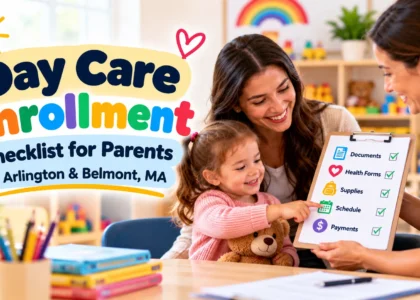
26. A Practical Day Care Tour Checklist for Parents
Save or print this checklist and take it with you.
Before the visit
- Confirm the program’s name and address.
- Check its listing in the Massachusetts Child Care Search tool.
- Review available licensing and compliance information.
- Confirm the age groups served.
- Ask whether the program has openings.
- Confirm the tour date and time.
- Prepare questions about your child’s individual needs.
- Ask for tuition information and the parent handbook.
During the visit
- Ask about licensing and supervision.
- Ask about staff qualifications and training.
- Observe teacher-child interactions.
- Review indoor and outdoor spaces.
- Ask about emergencies and injury reporting.
- Discuss meals, allergies, medication, and illness.
- Ask about naps, toileting, and age-specific routines.
- Review daily activities and outdoor time.
- Ask about parent communication.
- Confirm hours, closures, and pickup procedures.
- Discuss enrollment and waitlist policies.
- Request a written breakdown of all fees.
After the visit
- Compare the program with at least one alternative when practical.
- Review the written policies.
- Verify any information that was unclear.
- Discuss remaining concerns with the director.
- Confirm the full cost and start date in writing.
- Keep copies of enrollment documents and agreements.
- Make sure the program fits the child’s needs and the family’s schedule.
27. How to Prepare Your Child After Choosing a Day Care
Once you have selected a program, ask what the provider recommends before the first day.
Questions include:
- Can my child visit the classroom before starting?
- Is a gradual transition available?
- What should we tell our child about the new routine?
- Which comfort items are permitted?
- What clothing and supplies should we bring?
- Should we practice the drop-off routine?
- How will staff update us during the first few days?
- Who should we contact if we have concerns after the start date?
At home, talk about the new experience in a calm and positive way. Keep explanations simple and age-appropriate. If possible, establish predictable morning routines and allow enough time for an unhurried goodbye.
Avoid promising that the child will never feel upset. It is more helpful to explain that teachers will help them and that you will return at the agreed time.
Parents can also read a related guide on how to prepare a child for starting day care in Arlington and Belmont, MA. Replace the sample URL with the actual published page.
28. Frequently Asked Questions About Questions to Ask a Day Care in Arlington and Belmont, MA
1. What questions should I ask a day care before enrolling my child?
Start with licensing, supervision, staff qualifications, emergency procedures, daily routines, health policies, communication, tuition, operating hours, and enrollment requirements. Ask follow-up questions whenever an answer is unclear, and request written policies for important matters.
2. How do I find a licensed day care in Arlington, MA?
Use the Massachusetts Child Care Search tool to search by provider name, town, ZIP code, and program type. Review available information and contact EEC if you need clarification about a program’s licensing status or history.
3. How do I find a licensed day care in Belmont, MA?
Search the official Massachusetts child care directory using Belmont, MA, the provider’s name, or the relevant ZIP code. Confirm that the program serves your child’s age group and provides the schedule you need.
4. Should I visit a day care before enrolling?
Yes, when a visit is available. A tour allows you to observe the environment, ask about supervision, understand routines, meet staff, and evaluate whether the program suits your child. Ask whether a follow-up visit is possible if you need more time.
5. What are the most important safety questions to ask a day care?
Ask about licensing, staff screening, supervision, emergency procedures, authorized pickup, injury reporting, medication storage, allergies, safe sleep where relevant, and how staff respond to unexpected situations. Request clear explanations of the procedures that matter most to your child.
6. How can I check a day care’s licensing history in Massachusetts?
Start with the official Massachusetts child care directory. It provides program information and may include inspection or compliance details. You can also contact the Department of Early Education and Care for clarification about licensing history, noncompliance findings, or restrictions.
7. What should I ask about day care teacher qualifications?
Ask about education, relevant experience, training, first-aid and CPR coverage, professional development, staff screening, and how the program maintains consistent care when a teacher is absent.
8. What should I ask about staff-to-child ratios?
Ask how many children and educators are normally present in your child’s classroom, how staffing changes during breaks and transitions, and which requirements apply to the specific age group and program type. Verify the relevant requirements rather than assuming one ratio applies everywhere.
9. What should I ask when choosing infant day care?
Ask about feeding, bottle handling, safe sleep, diaper changes, soothing, hygiene, supervision, emergency procedures, and daily parent updates. Explain your infant’s individual routine and ask how the program accommodates it.
10. What should I ask when choosing toddler day care?
Ask how the program handles tantrums, transitions, biting, sharing, toilet learning, naps, meals, and separation anxiety. Look for patient, age-appropriate approaches that support independence and emotional development.
11. What should I ask a preschool before enrollment?
Ask about the curriculum, play opportunities, early literacy, social development, outdoor time, teacher qualifications, progress updates, inclusion, and kindergarten transitions. Confirm whether the schedule is full-day or part-day.
12. How do I know whether a day care is safe?
No single observation can establish safety. Review available licensing information, ask about supervision and emergency procedures, observe interactions, inspect the environment, and evaluate whether staff can clearly explain their policies.
13. What should I ask about meals and snacks?
Ask whether meals are included, what foods are served, whether children can bring food from home, how allergies are managed, how dietary restrictions are accommodated, and how meals are supervised.
14. What should I ask about allergies?
Explain the child’s allergy and ask what documentation is required, how staff prevent exposure, where emergency medication is stored, who is trained to respond, and how the plan is communicated to all relevant staff.
15. What should I ask about naps and rest time?
Ask when rest occurs, how long it lasts, what happens if a child does not sleep, what bedding is provided, and how children are supervised. For infants, discuss safe sleep procedures specifically.
16. What should I ask about illness policies?
Ask which symptoms require a child to stay home, when the child may return, how parents are notified about contagious illness, and what happens if symptoms develop during the day.
17. What should I ask about tuition and extra fees?
Request a written breakdown of tuition, deposits, registration fees, supplies, meals, extended hours, late pickup, holidays, absences, and withdrawal charges. Compare total costs for equivalent schedules rather than comparing headline prices alone.
18. Are day care deposits always refundable?
No. Deposit terms vary by provider. Ask whether the deposit is refundable, whether it is applied to tuition, what happens if your start date changes, and which circumstances affect refunds. Read the written agreement before paying.
19. How early should I apply for day care in Arlington or Belmont?
There is no single timeline that applies to every provider or age group. Contact programs early, ask about openings and waitlists, and confirm the application calendar for your preferred start date.
20. What should I ask about a day care waitlist?
Ask how the list is managed, whether a deposit is required, how often openings are updated, whether your position can change, and what happens if a place does not become available by your desired start date.
21. How can I tell whether teachers interact well with children?
Observe whether teachers respond to children, communicate respectfully, supervise actively, encourage exploration, and support children through frustration. Ask for examples of how staff handle conflict and emotional distress.
22. What should I ask about discipline?
Ask how teachers respond to challenging behavior, teach social skills, handle conflict, and communicate concerns to parents. Look for clear, respectful, developmentally appropriate practices that protect children’s dignity.
23. What should I ask about outdoor play?
Ask how often children go outside, how spaces are supervised, what happens during unsuitable weather, what clothing is needed, and whether excursions or walks are included.
24. What should I ask about parent communication?
Ask how daily updates are shared, who handles questions, how quickly staff respond, how injuries are reported, and whether parent-teacher meetings are offered.
25. What should I ask about separation anxiety?
Ask how teachers support distressed children, whether gradual transitions are possible, what comfort items are permitted, and how staff communicate about adjustment. Discuss your child’s temperament and routines before the first day.
26. Are school-based preschool programs the same as full-day day care?
Not necessarily. A school-based preschool may offer a particular educational schedule or eligibility structure without providing extended child care. Confirm hours, holiday coverage, before- or after-school services, and enrollment rules directly.
27. What local resources can help me compare day care programs?
Massachusetts EEC’s child care directory is a key starting point. Families can also review relevant town and school district websites for information about school-based preschool and other public programs. Always confirm current details directly with each provider.
28. Should I choose the cheapest day care?
Not based on price alone. Compare safety, supervision, staff experience, schedule, learning environment, communication, and total cost. The best choice is the program that appropriately meets your child’s needs and your family’s circumstances.
29. What are warning signs during a day care tour?
Potential concerns include unclear licensing status, evasive answers about safety, poor supervision, disrespectful interactions, unexplained fees, and reluctance to provide written policies. Investigate serious concerns before enrolling.
30. How many day care programs should I visit?
There is no fixed number. Visit enough programs to understand your options and make a meaningful comparison. Even two or three well-evaluated choices can help you identify differences in policies, schedules, and overall fit.
31. What documents should I request before enrolling?
Ask for the parent handbook, tuition schedule, enrollment agreement, health and emergency forms, illness policy, pickup authorization procedures, medication policy, and relevant licensing information. The exact paperwork will depend on the program and applicable requirements.
32. Can I ask for a second day care tour?
Yes. Ask whether the provider can arrange another visit or answer remaining questions by phone or email. A second conversation can be especially useful when you need clarification about staffing, schedules, tuition, or your child’s individual needs.
33. What should I do if a day care will not answer important questions?
Ask for clarification and request the relevant policies in writing. If you remain concerned about safety, licensing, or compliance, consider another program and contact the appropriate Massachusetts authority when necessary.
34. What is the best way to compare day care centers in Arlington and Belmont?
Use the same checklist for each program. Compare licensing information, supervision, staff, daily activities, health policies, communication, schedules, tuition, and your child’s needs. Record both scores and observations.
35. Can this checklist guarantee that I will choose the best day care?
No checklist can guarantee a perfect outcome. However, asking thoughtful questions, observing the environment, verifying available information, and comparing programs systematically can help you make a more informed decision.
Conclusion: Ask Questions, Observe Carefully, and Choose With Confidence
Choosing a day care in Arlington or Belmont, Massachusetts, is about finding a safe, supportive environment that fits your child’s developmental needs and your family’s daily life.
Before enrolling, ask about licensing, supervision, staff qualifications, emergency procedures, health and allergy policies, meals, naps, learning activities, emotional support, parent communication, tuition, and enrollment requirements. Visit the program when possible, observe how educators interact with children, and request written answers to important questions.
Parents in Arlington should confirm whether a school-based preschool or another local program offers the hours and services they need. Families in Belmont should make the same distinction when comparing public preschool options with full-day child care. In both towns, the Massachusetts Child Care Search tool is a useful starting point for researching licensed providers.
Most importantly, do not let an attractive classroom, a low advertised price, or pressure to enroll replace careful evaluation. A good decision comes from understanding the program, verifying essential information, and determining whether the environment is appropriate for your child.
Your next step: Prepare the tour checklist, shortlist programs that meet your schedule and budget, ask the same core questions at each visit, and compare the answers before signing an enrollment agreement.