

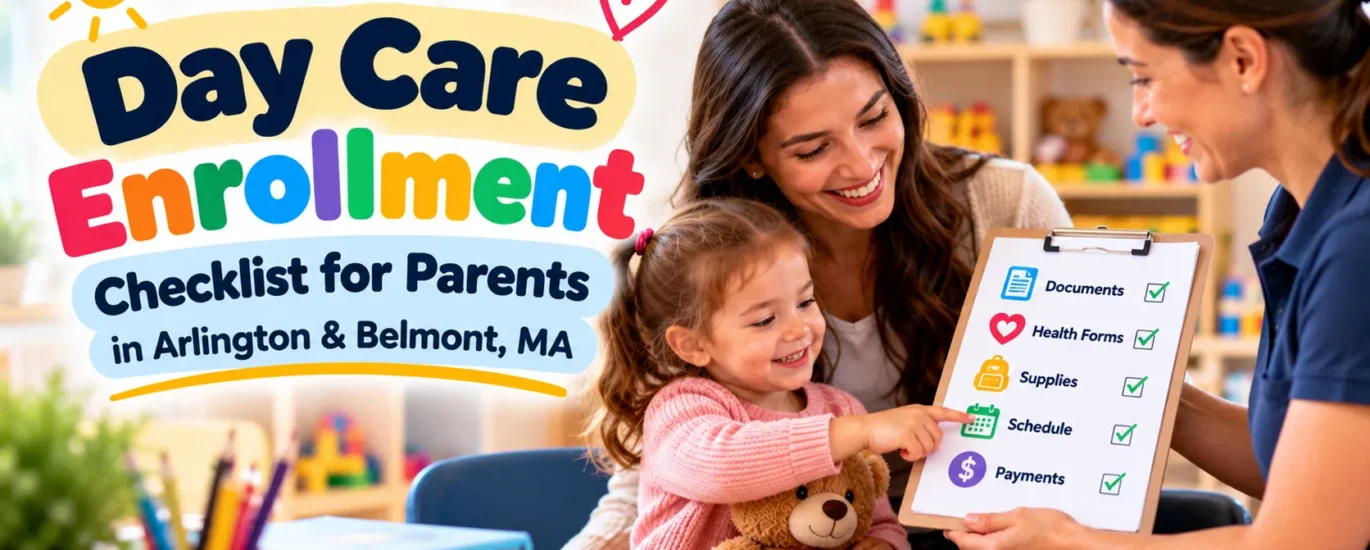
Summary: Day Care Enrollment Checklist for Parents
Enrolling a child in day care involves more than completing a registration form. Parents need to choose an appropriate program, verify its licensing or authorization status, understand the schedule and tuition, submit required documents, share health and emergency information, and prepare their child for the transition.
Families in Arlington, MA, and Belmont, MA, may be considering a licensed child care center, family child care home, preschool, or school-based early education program. Each type of program can have different ages served, hours, enrollment procedures, calendars, and requirements.
A well-organized enrollment checklist helps parents avoid missing important steps. Before confirming enrollment, ask the provider for its official document list and parent handbook. Requirements may vary according to the child’s age, program type, health needs, and applicable regulations.
The most important items to prepare include:
- Child and parent contact information
- Emergency contacts and authorized pickup details
- Health information, allergy details, and required records
- Feeding, sleep, and care instructions for infants
- Completed enrollment forms and signed agreements
- Tuition, registration fees, deposits, and payment arrangements
- Required clothing, diapers, food, and other supplies
- Transportation and pickup plans
- A backup plan for illness, closures, and emergencies
- A gradual, supportive plan for the child’s transition
Parents should also review Massachusetts’ official child care search resources. The Massachusetts Department of Early Education and Care (EEC) provides a geographic search tool for licensed child care programs and explains how families can obtain information about a program’s licensing history. Official Massachusetts child care search guide.
For families in Arlington, the town’s public school district provides separate registration information for its preschool and K–12 programs. Belmont Public Schools also publishes its own preschool and school enrollment information. School-based enrollment is not necessarily the same as enrollment in a private or community child care program.
This guide provides a step-by-step day care enrollment checklist, local guidance for Arlington and Belmont families, questions to ask before signing an agreement, budgeting advice, first-day preparation, and frequently asked questions.
The goal is to help parents complete enrollment confidently while choosing a safe, nurturing, age-appropriate arrangement that fits their child’s needs and family schedule.
Introduction
Choosing day care is one of the most important practical decisions many families make during their child’s early years. Parents want their child to feel safe, build relationships with caring adults, explore new activities, and develop confidence. At the same time, families need a program that fits their work schedule, budget, transportation arrangements, and long-term plans.
The enrollment process can feel overwhelming, particularly for first-time parents. A provider may request multiple forms, health records, emergency contacts, payment information, and signed policies. Parents may also need to arrange a tour, confirm a start date, prepare supplies, and decide how to introduce their child to the new environment.
Families searching for day care in Arlington and Belmont, Massachusetts, should also understand that not every child care program has the same enrollment process. A licensed center, family child care home, private preschool, public school preschool, and before- or after-school program may have different eligibility requirements, calendars, hours, and documentation.
For example, a school-based preschool session may operate only in the morning or afternoon. A working family that needs full-day care may therefore need another arrangement outside the preschool schedule. Likewise, a program that accepts toddlers may not have an opening for infants, even if it appears to offer child care generally.
The best approach is to complete enrollment in stages:
- Identify the kind of care your family needs.
- Research suitable programs and verify relevant licensing information.
- Visit the program and ask questions.
- Confirm availability, hours, calendar, and costs.
- Obtain the official enrollment checklist.
- Complete forms and provide the requested information.
- Prepare your child’s supplies and daily routine.
- Confirm the first-day plan and emergency arrangements.
This article explains each stage in detail so parents can make a well-informed decision and avoid common enrollment mistakes.
1. What Is a Day Care Enrollment Checklist?
A day care enrollment checklist is a practical list of tasks, documents, questions, and arrangements that parents should review before their child begins attending a child care program.
It helps families organize the administrative side of enrollment while also preparing for the child’s daily experience.
A complete checklist typically covers five areas:
| Area | What parents should prepare |
|---|---|
| Program selection | Program type, licensing information, schedule, location, age eligibility, and availability |
| Documents | Registration forms, emergency contacts, required health records, and signed policies |
| Financial arrangements | Tuition, deposits, registration fees, billing dates, and financial assistance inquiries |
| Child preparation | Supplies, clothing, feeding or sleep instructions, comfort items, and transition planning |
| Family logistics | Transportation, pickup authorization, backup care, communication, and emergency plans |
A checklist is not a substitute for the provider’s official requirements. It is a way to ensure you ask the right questions and complete the necessary steps.
Important: Always request the current enrollment checklist directly from the program. Do not assume that a list from another provider, website, or previous year includes every required document.
2. The Complete Day Care Enrollment Checklist
Use this master checklist as your starting point. Mark the items that apply to your child’s age and chosen program.
A. Before choosing a program
- Decide whether you need full-day care, part-day care, preschool, or a combination.
- Identify the days of the week and hours you need.
- Confirm the age group served by the program.
- Search for suitable programs in Arlington or Belmont.
- Review licensing or authorization information where applicable.
- Ask whether the program has availability for your preferred start date.
- Schedule a visit or orientation if offered.
- Request the current parent handbook.
- Review the daily schedule and school-year calendar.
- Ask about tuition, fees, deposits, and payment dates.
- Understand the withdrawal and refund policies.
- Ask how new children are supported during the transition.
- Compare the complete arrangement with your family’s needs.
B. Documents and forms
- Child’s registration or enrollment form
- Parent or guardian contact details
- Emergency contact information
- Authorized pickup list
- Required health information
- Immunization or health records requested by the program
- Allergy and dietary information
- Medication forms and instructions, if applicable
- Feeding instructions for infants, if applicable
- Relevant sleep or care instructions
- Signed parent handbook acknowledgment
- Signed enrollment agreement or contract
- Tuition and billing authorization, if required
- Any additional forms identified by the provider
C. Financial preparation
- Confirm tuition for the exact schedule.
- Ask whether a registration fee is charged.
- Confirm the deposit amount and refund conditions.
- Understand the billing cycle.
- Ask whether payment is due during holidays or planned closures.
- Check late-pickup charges.
- Ask about fees for meals, supplies, or special activities.
- Confirm the policy for absences and illness.
- Calculate any additional before-care or after-care costs.
- Explore financial assistance if your family may qualify.
- Keep copies of receipts and the signed agreement.
D. Child’s supplies
- Extra clothing
- Weather-appropriate outerwear
- Diapers and wipes, if needed
- Required food or lunch, if applicable
- Approved water bottle or cup, if required
- Rest items permitted by the program
- Approved comfort item, if permitted
- Clearly labeled belongings
- Any program-specific items
- Medication and instructions, if required and approved
E. Daily logistics
- Confirm the drop-off time.
- Confirm the pickup deadline.
- Plan the route and travel time.
- Understand the arrival and departure procedure.
- Confirm who is authorized to collect the child.
- Learn how to report an absence.
- Save the program’s contact information.
- Understand the illness and emergency procedures.
- Create a backup plan for unexpected schedule changes.
- Confirm what happens during school vacations and summer.
F. Before the first day
- Explain the new routine to your child.
- Practice the morning routine when possible.
- Pack the required supplies.
- Finish outstanding paperwork.
- Review the goodbye and pickup plan.
- Share relevant care instructions with the provider.
- Confirm the first-day arrival arrangements.
- Make sure the provider knows how to contact you.
3. Step One: Decide What Type of Child Care You Need
Before completing registration forms, determine which type of program fits your family.
Licensed child care center
A center-based program generally operates in a non-residential setting and may offer care for infants, toddlers, preschoolers, or school-age children. The age groups, hours, classroom arrangements, and enrollment requirements vary by provider.
Ask whether the program offers the schedule you need for your child’s age group.
Family child care
Family child care takes place in a provider’s home. Massachusetts EEC describes family child care as a form of care in a home setting where the caregiver is not related to the children.
Family child care can be a suitable option for some families, but you should evaluate the provider’s license, environment, routines, policies, and capacity just as carefully as you would evaluate a center.
Preschool
Preschool generally focuses on early learning and development for children in the preschool age range. Some programs provide a short morning or afternoon session, while others combine preschool with longer child care hours.
Do not assume that every preschool provides full-day coverage.
School-based preschool
Public school districts may operate preschool programs with their own eligibility, registration, schedule, and placement procedures. These can differ from private child care enrollment.
For example, Arlington Public Schools provides information about its preschool and school registration through its official registration page. Belmont Public Schools provides its own preschool information at Belmont Public Schools Preschool.
Check the relevant district website for current procedures and deadlines.
Before-school, after-school, and school-vacation care
Families with school-age children may need coverage outside regular school hours. These programs can have separate registration requirements, calendars, transportation arrangements, and fee structures.
Ask whether vacation care and summer programs require separate applications.
4. Step Two: Find and Verify Suitable Child Care Programs
A program’s website can help you understand its philosophy and services, but parents should verify important details before enrolling.
Use Massachusetts’ official child care search
Massachusetts EEC provides a searchable directory of licensed child care programs. You can search by geographic area and program type.
Start here:
The state explains that families may contact EEC to learn about a program’s licensing history, including non-compliance findings and current restrictions on a license.
If a program does not appear in the search results, do not automatically conclude that it is unlicensed. Contact the relevant EEC office to clarify the program’s status and the type of oversight that applies.
What should you verify?
Before enrolling, confirm:
- The program’s name and location
- The type of program and ages served
- Current licensing or authorization information, as applicable
- Whether the program has an opening
- The requested start date
- Hours and days offered
- The calendar and closure schedule
- Tuition and additional fees
- The process for tours and enrollment
- The person to contact with questions
Why licensing information matters
Licensing is an important part of evaluating child care, but it should not be the only factor in your decision.
Parents should also observe the environment, review the policies, ask about supervision and staff communication, and consider whether the program matches their child’s needs.
Massachusetts EEC’s Guide to Choosing Child Care recommends considering the child’s temperament, health, interests, behavior, and family schedule when choosing a program.
5. Step Three: Visit the Program and Ask Questions
A visit gives parents an opportunity to understand the environment and see how the program operates.
Ask whether visits are available and whether you can observe the classroom or meet the staff who will work with your child.
Questions about the environment
- Is the space suitable for the age group?
- Are toys and materials age-appropriate?
- Does the environment appear clean and organized?
- Are indoor and outdoor activities included in the routine?
- How are children supervised?
- How are transitions between activities handled?
- How does the program respond to children’s individual needs?
Questions about staff and communication
- Who will be my child’s primary caregiver or teacher?
- How does the program communicate with parents?
- How are concerns or incidents reported?
- How are new children supported during adjustment?
- What training or qualifications are required for staff?
- How can parents arrange a meeting if concerns arise?
Questions about daily care
- What is the typical daily schedule?
- How are meals and snacks handled?
- How are rest and naps organized?
- What is the approach to behavior guidance?
- How does the program handle allergies?
- What happens when a child becomes ill?
- What supplies must families provide?
Questions about logistics
- What are the earliest drop-off and latest pickup times?
- Is there a late-pickup fee?
- How do parents report absences?
- What happens during holidays and vacations?
- Is summer care available?
- Can the schedule change after enrollment?
- What notice is required to withdraw?
Write down the answers so you can compare programs accurately.
6. Step Four: Understand the Enrollment Documents
The paperwork required for enrollment depends on the provider, the child’s age, and applicable rules. Obtain the current list directly from the program.
Child registration form
This form commonly collects information needed to identify the child and set up the enrollment record.
Check that the child’s name, date of birth, and parent or guardian details are correct.
Parent and guardian contact information
Provide current telephone numbers, email addresses, and any other information the program requests. Ask how to update the record if your contact details change.
Emergency contacts
Emergency contacts should be people who can be reached when parents or guardians are unavailable.
Confirm that each contact knows they have been listed and understands what the program may need them to do.
Authorized pickup list
Specify which adults are permitted to collect the child, following the provider’s procedures.
Ask how to make a temporary change to the list and what identification is required at pickup.
Health information and records
The provider may request health records, immunization information, allergy details, medication instructions, or other information according to the child’s age, program type, and applicable rules.
Ask which records are required, whether a specific form must be used, and when the documents are due.
Parent handbook acknowledgment
The handbook may explain arrival, departure, illness, medication, meals, rest, fees, closures, behavior guidance, and communication.
Read it before signing. If a policy is unclear, ask the provider to explain it.
Enrollment agreement
The agreement should clearly describe the schedule, tuition, fees, billing cycle, withdrawal requirements, and other important conditions.
Keep a copy of the signed agreement and any related payment receipts.
Financial and billing forms
If payment is made electronically, confirm the amount, frequency, due dates, and how changes or refunds are handled.
Do not assume that a deposit is refundable or that tuition is prorated during absences. Ask for the written policy.
7. Health, Immunization, Allergy, and Medication Checklist
Health information helps the program understand your child’s needs and follow its procedures. Requirements vary, so confirm exactly what the provider needs.
Health records
Ask whether the program requires a health form, physical examination record, immunization record, or other documentation.
Do not rely on a general online checklist as a substitute for the program’s current instructions.
Allergies and dietary restrictions
Tell the provider about known food, medication, environmental, or other allergies that are relevant to your child’s care.
Ask how the program manages food allergies, prevents accidental exposure, communicates with staff, and responds to an emergency.
Provide any required action plan or documentation through the provider’s approved process.
Medication
If medication may be needed during care, ask about:
- Whether the program can administer it
- Required written authorization
- Packaging and labeling requirements
- Storage procedures
- Who may administer it
- How administration is documented
- What happens if the medication is expired or unavailable
Never assume a provider can administer a medication simply because it is prescribed.
Illness policy
Ask which symptoms require a child to stay home, how parents are notified if a child becomes ill, and what conditions must be met before returning.
Understand the policy for fever, vomiting, diarrhea, contagious illnesses, and other relevant symptoms. Follow current provider guidance and advice from your child’s health professional.
Emergency procedures
Ask how the program responds to injuries, allergic reactions, urgent medical needs, and other emergencies.
Confirm that your contact details and the authorized pickup information are current.
8. Infant Day Care Enrollment Checklist
Infant enrollment often involves additional discussions about feeding, sleep, soothing, and daily care.
Before the first day, ask the program for its infant-specific requirements.
Feeding information
- Discuss the feeding routine.
- Confirm how bottles or food must be labeled.
- Ask about storage and handling procedures.
- Provide required feeding instructions.
- Explain any relevant allergies or dietary restrictions.
- Ask how feeding updates are shared with parents.
Sleep information
- Ask about the program’s safe-sleep procedures.
- Explain the infant’s usual sleep cues.
- Ask what information the program records about naps.
- Confirm which sleep-related items, if any, are permitted.
- Provide relevant care instructions through the approved process.
Daily supplies
- Diapers and wipes, if required
- Extra clothing
- Approved feeding supplies
- Labeled personal items
- Any additional items listed by the provider
Communication
- Ask how updates are shared during the day.
- Confirm how the provider contacts parents about illness or concerns.
- Discuss how changes to the infant’s routine will be communicated.
- Provide current emergency contacts.
For infants, clear communication between parents and caregivers is particularly important. Explain what you know about your baby’s routine, while understanding that feeding and sleep patterns may change in a new environment.
9. Toddler Day Care Enrollment Checklist
Toddlers may be learning to communicate their needs, manage transitions, use the toilet, and participate in group routines.
Ask the program what it expects from children in your child’s age group.
Before enrollment
- Confirm that the program accepts your child’s age group.
- Ask about the daily schedule.
- Discuss meals, snacks, and dietary needs.
- Ask about toilet-training policies.
- Discuss rest and nap arrangements.
- Ask how caregivers support separation anxiety.
- Share relevant communication or developmental information.
- Confirm which supplies are required.
Before the first day
- Practice the morning routine.
- Label clothing and supplies.
- Explain the drop-off and pickup routine.
- Practice simple requests for help.
- Discuss any comfort item the program permits.
- Confirm who will collect the child.
Children do not need to master every self-help skill before starting care. The goal is to communicate expectations and work with the provider to support the child’s development.
10. Preschool Enrollment Checklist
Preschool enrollment can involve additional questions about eligibility, the academic calendar, classroom placement, and the length of the session.
Confirm the program type
Ask whether the preschool is private, school-based, or part of another child care arrangement.
The word “preschool” does not automatically mean full-day care.
Confirm age eligibility
Ask about the minimum and maximum ages, birthday cutoffs, and any other eligibility requirements.
Review the schedule
Confirm the exact days and hours, the start and end dates, school vacations, and summer arrangements.
Ask about classroom placement
Find out how children are assigned to classrooms and whether the program offers orientation or visits.
Understand the curriculum and daily routine
Ask how the program balances play, early learning, outdoor activity, rest, social interaction, and individual support.
Confirm the required paperwork
Ask for the current preschool enrollment forms and the deadlines for submitting them.
If your child may need additional support
If you have concerns about your child’s development or believe the child may need special education services, contact the appropriate school district or early childhood team to ask about screening, evaluation, and eligibility procedures.
Do not assume the same process applies to every private child care program and public school preschool.
11. Day Care Enrollment in Arlington, MA
Families looking for child care in Arlington should confirm the enrollment process with the specific provider they intend to use.
Arlington includes different types of early education and care arrangements. Parents should distinguish between a private or community child care program and a public school enrollment process.
Arlington enrollment checklist
- Identify programs that serve your child’s age.
- Confirm the location and current availability.
- Review the program’s licensing information, where applicable.
- Ask for a tour or orientation.
- Confirm the daily schedule and calendar.
- Request the official enrollment forms.
- Ask which health records are required.
- Confirm tuition, deposits, and other fees.
- Review illness, medication, and emergency procedures.
- Confirm authorized pickup arrangements.
- Ask about the child’s transition into the classroom.
- Keep copies of the signed agreement and payment records.
Arlington Public Schools registration
Arlington Public Schools provides registration information for its public school programs, including preschool and K–12 enrollment.
Visit the district’s official Registration page for the current process and links to the relevant programs.
School registration and private day care enrollment are different processes. Families should follow the instructions for the particular program they are applying to.
Questions Arlington parents should ask
- Is there an opening for my child’s age and preferred start date?
- What are the exact drop-off and pickup times?
- Is the program full-day, part-day, or both?
- Does it operate year-round or follow a school-year calendar?
- Which forms must be completed before attendance begins?
- What is the total cost, including fees?
- How does the program support children who are new to group care?
- What is the process for communicating concerns?
These questions help parents make a practical plan that accounts for the entire care schedule.
12. Day Care Enrollment in Belmont, MA
Families in Belmont should first identify whether they need a private child care program, family child care, preschool, or a school-based program.
The enrollment process and eligibility requirements can differ significantly among these options.
Belmont enrollment checklist
- Identify the type of care needed.
- Confirm the child’s age eligibility.
- Verify current availability.
- Review licensing information, where applicable.
- Confirm the schedule and school-year calendar.
- Request the official forms and document list.
- Ask about tuition, fees, and payment policies.
- Confirm the pickup and emergency procedures.
- Ask about orientation or transition support.
- Keep a copy of the completed enrollment documents.
Belmont Public Schools Preschool
Belmont Public Schools publishes information about its Integrated Preschool Program, including program details and enrollment information.
Review the district’s official Preschool page for the current program description, schedules, eligibility, and contact information.
The district describes an integrated classroom model for children ages three to five, including children who require special education programming and typically developing neighborhood peers in designated peer-model places.
Parents should contact the district to confirm the current enrollment process and eligibility for their child.
Belmont Public Schools K–12 registration
For families enrolling a school-age child, the district has a separate Grades K–12 Registration page.
The district’s registration instructions may include pre-registration followed by additional enrollment steps. Follow the current official process rather than relying on a generic child care checklist.
Questions Belmont parents should ask
- Is my child eligible for the program?
- What are the exact program hours?
- Is the schedule part-day or full-day?
- Which documents are required?
- What are the enrollment deadlines?
- Is there an orientation or classroom visit?
- How are new children supported?
- Does the calendar include summer care?
- What additional arrangements are needed if the program does not cover the full workday?
A school-based preschool session may not cover a parent’s entire working day. Calculate the remaining care hours before committing to the schedule.
13. Day Care Tuition, Fees, and Financial Planning
Enrollment is also a financial commitment. Before accepting a place, ask the provider for a written breakdown of all costs.
Costs to confirm
| Cost | Questions to ask |
|---|---|
| Tuition | What is the price for the exact schedule and age group? |
| Registration fee | Is there a one-time application or registration charge? |
| Deposit | Is it refundable? Under what conditions? |
| Meals | Are meals and snacks included? |
| Supplies | Must families provide diapers, wipes, food, or classroom items? |
| Extended care | What are the charges for earlier drop-off or later pickup? |
| Absences | Is tuition still due when the child is sick or away? |
| Closures | Is tuition charged during holidays or planned closures? |
| Late pickup | What is the fee and how is it calculated? |
| Withdrawal | How much notice is required? |
| Summer care | Is separate enrollment or payment required? |
Calculate the total cost
Do not compare programs using tuition alone.
A more complete calculation is:
Total child care cost = tuition + mandatory fees + supplies + additional care + transportation + backup care.
Compare the cost over the same period, such as a month or full year. An annual school-year preschool fee cannot be compared directly with a monthly year-round child care fee without accounting for the different schedules.
Ask about payment policies
Before paying a deposit, ask:
- When is the deposit due?
- Does it count toward tuition?
- Under what circumstances is it refundable?
- What happens if the start date changes?
- What is the policy if the family withdraws?
- Are there charges during planned closures?
- How are billing errors or payment disputes handled?
Keep copies of all agreements, invoices, receipts, and written explanations.
14. Massachusetts Child Care Financial Assistance
Eligible Massachusetts families may qualify for Child Care Financial Assistance (CCFA), which helps pay for child care and out-of-school-time programs.
The state explains that assistance may cover part or all of eligible child care costs depending on family circumstances and program rules.
Start with the official Massachusetts Child Care Financial Assistance page.
MyChildCareMA family portal
Massachusetts uses the MyChildCareMA Family Portal for families applying for and managing child care benefits.
According to the state’s current guidance, families can use the portal to apply, check their status, read notices, and upload documents. If funding is not immediately available, an eligible applicant may be placed on a waitlist.
The state moved applications and waitlist management to MyChildCareMA effective May 6, 2026. Families should follow the latest instructions published by the state.
Documents for financial assistance
The documents needed depend on the applicable assistance program and family circumstances. The state may request information to establish eligibility.
Check the official instructions before gathering documents. Do not assume that the requirements are identical for every family.
Questions to ask
- Does my family meet the current eligibility rules?
- Which documents are required?
- How do I submit or update my application?
- Is funding currently available?
- If I am placed on a waitlist, how do I check my status?
- Does the provider accept the relevant assistance arrangement?
- What happens if my income, work schedule, or household circumstances change?
Applying for assistance does not guarantee immediate funding or a place at your preferred provider. Verify both the benefit process and the child care program’s availability.
15. Emergency Contacts and Authorized Pickup
Emergency contacts and pickup arrangements are among the most important details in the enrollment process.
Emergency contacts
Provide accurate information for parents or guardians and any additional emergency contacts the program requires.
Before submitting the forms:
- Check all telephone numbers.
- Confirm that the contacts are willing and able to respond.
- Explain any relevant emergency arrangements to the provider.
- Update the record whenever information changes.
Authorized pickup
List only the adults permitted to collect the child according to the provider’s policy.
Ask:
- What identification is required?
- How can an authorized person be added or removed?
- How should a temporary pickup change be communicated?
- What happens if a parent is delayed?
- How does the program handle a pickup dispute or an adult who is not on the list?
Do not rely on an informal verbal message if the provider requires a written or approved change.
Late pickup and unexpected delays
Ask what you should do if traffic, work, or another emergency delays you.
Understand the notification process, late fees, and what the provider expects when the usual pickup adult cannot arrive.
A reliable plan helps protect the child and reduces confusion for staff.
16. What to Pack for the First Day
The provider’s supply list should be your primary reference. Requirements vary by age, program, season, and schedule.
General first-day bag
- Clearly labeled bag
- Extra clothing
- Weather-appropriate outerwear
- Required food or lunch, if applicable
- Approved water bottle or cup, if required
- Any approved comfort item
- Required diapers and wipes
- Any additional items requested by the program
Infant supplies
Ask whether the provider requires bottles, feeding supplies, diapers, wipes, extra clothing, and specific labeling. Confirm storage and handling procedures.
Toddler supplies
Ask about extra clothing, diapers or training pants, wipes, outdoor gear, and any approved personal items.
Preschool supplies
Depending on the program, children may need a backpack, lunch bag, change of clothes, or outdoor clothing.
Label belongings
Label items according to the program’s instructions. Ask before sending toys, food, blankets, or valuable objects, as some items may be restricted.
Medication and health-related items
Never place medication in a child’s bag without following the provider’s policy. Ask about required forms, packaging, storage, and who is permitted to administer it.
17. Prepare Your Child Emotionally for Enrollment
Enrollment paperwork is only one part of preparing for day care. Children may also need time to become familiar with the idea of attending a new setting.
Explain the change in simple language
Tell your child what will happen using words they understand. Explain where they will go, who will care for them, and when you will return.
Avoid promising that the child will never feel sad or that every day will be perfect.
Read stories about starting care
Age-appropriate books can help children explore new routines, separation, friendship, and asking adults for help.
Practice the morning routine
If possible, practice waking up, getting dressed, eating breakfast, packing a bag, and leaving home at the planned time.
Use a consistent goodbye
Follow the provider’s procedure. A short, predictable goodbye can help the child understand the transition.
Avoid sneaking away without saying goodbye.
Share comfort strategies
Tell the caregiver what helps your child settle, communicate needs, or manage difficult transitions.
Give adjustment time
Some children become comfortable quickly, while others need longer. Crying at drop-off does not automatically mean that the program is unsuitable.
Ask the caregiver how the child settles after you leave and discuss persistent or worsening concerns.
For a more detailed preparation guide, link this section to your related article about [preparing your child for starting day care in Arlington and Belmont, MA] if that page is published on your website.
18. What to Review in the Parent Handbook
Before enrollment, read the parent handbook carefully. It should explain how the program operates and what families are expected to do.
Review the following areas.
Arrival and departure
Understand drop-off times, pickup deadlines, sign-in and sign-out procedures, and authorized pickup requirements.
Illness and medication
Review when a child must stay home, how the program contacts parents, return-to-care rules, and medication procedures.
Meals and allergies
Confirm whether meals are included, what families must provide, and how dietary restrictions are managed.
Rest and sleep
Ask about rest arrangements, especially if your child is an infant or toddler.
Behavior guidance
Understand the program’s approach to emotional regulation, conflict, and challenging behavior.
Communication
Find out how teachers share updates and how parents should raise questions or concerns.
Closures and holidays
Review planned closures, vacation periods, weather-related procedures, and summer schedules.
Fees and withdrawal
Confirm tuition, late fees, absence policies, deposits, and the notice required to withdraw.
Emergencies
Understand how the program responds to emergencies and how parents will be contacted.
If any policy is unclear, ask for an explanation before signing the enrollment agreement.
19. Common Enrollment Mistakes to Avoid
Mistake 1: Assuming all programs have the same requirements
A private child care center, family child care home, and public school preschool may use different forms and enrollment processes.
What to do instead: Request the current checklist from the specific program.
Mistake 2: Waiting until the last minute
Late paperwork can delay enrollment or make the first day stressful.
What to do instead: Ask for the document list as soon as a place is offered and confirm the deadline for each form.
Mistake 3: Failing to check licensing information
A website description alone does not answer every question about a program’s regulatory status.
What to do instead: Use official state resources and contact EEC if the information is unclear.
Mistake 4: Comparing tuition without comparing schedules
A short preschool session and a full-day program provide different amounts of care.
What to do instead: Calculate the total cost for the exact hours your family needs.
Mistake 5: Overlooking additional fees
Registration, deposits, supplies, meals, extended care, and late pickup can affect the total cost.
What to do instead: Ask for a written fee breakdown.
Mistake 6: Forgetting to update emergency contacts
Outdated contact information can create problems when a parent or guardian needs to be reached.
What to do instead: Review the information regularly and update it promptly.
Mistake 7: Assuming a school-based preschool covers the workday
Some school-based preschool sessions are part-day.
What to do instead: Confirm the exact hours and arrange additional care if needed.
Mistake 8: Sending items without checking the policy
Food, toys, medication, and sleep-related items may have specific rules.
What to do instead: Follow the provider’s supply list and ask before bringing unlisted items.
Mistake 9: Signing without understanding the withdrawal policy
Deposits and notice periods can affect a family’s budget.
What to do instead: Read the agreement and ask for written clarification.
Mistake 10: Treating enrollment as complete once forms are submitted
The family still needs to confirm the first day, schedule, pickup plan, supplies, and communication arrangements.
What to do instead: Use the final first-day checklist and confirm all outstanding details with the provider.
20. Final Day Care Enrollment Checklist for Parents
Use this condensed checklist during the last review before your child begins attending.
Program
- I have confirmed the provider and program type.
- I have checked the relevant licensing or authorization information.
- I know the exact schedule and calendar.
- I have confirmed the start date.
- I understand the arrival and pickup procedures.
- I have reviewed the parent handbook.
Paperwork
- All required forms are complete.
- Emergency contacts are accurate.
- Authorized pickup adults are listed.
- Required health information is submitted.
- Allergy and medication instructions are complete, if applicable.
- The enrollment agreement is signed.
- I have kept copies of important documents.
Finances
- Tuition and fees are confirmed.
- Deposit and refund conditions are understood.
- Billing dates are known.
- Additional care costs are included in the budget.
- Financial assistance has been explored if relevant.
Child’s supplies
- Required clothing is packed.
- Belongings are labeled.
- Food, diapers, or other supplies are ready if required.
- Personal items follow the provider’s policy.
- Medication is handled according to the provider’s procedures.
Family plan
- The travel route is planned.
- The morning routine is ready.
- Pickup arrangements are confirmed.
- A backup plan is available.
- The child has been told what to expect.
- The provider knows how to contact me.
First-day follow-up
- I know how to communicate with the teacher.
- I will ask for specific feedback after the first day.
- I will allow time for the child to adjust.
- I will discuss persistent concerns with the provider.
21. Frequently Asked Questions About Day Care Enrollment in Arlington & Belmont, MA
1. What documents are needed to enroll a child in day care in Massachusetts?
Requirements vary by program and applicable rules. A provider may request registration forms, emergency contacts, authorized pickup information, health or immunization records, allergy details, medication instructions, and signed policies. Ask the program for its current official checklist.
2. How do I find licensed day care in Arlington, MA?
Use the Massachusetts Department of Early Education and Care’s official licensed child care search. Search by location and program type, then confirm current availability, hours, and enrollment requirements directly with the provider.
3. How do I find licensed day care in Belmont, MA?
Use the same Massachusetts child care search to identify programs in Belmont. If you are considering a school-based preschool, review the district’s official preschool information and confirm its separate eligibility and enrollment procedures.
4. Is child care enrollment the same as preschool enrollment?
No. Child care centers, family child care homes, and school-based preschools may have different eligibility requirements, schedules, forms, and enrollment processes. Follow the instructions for the specific program.
5. Does Arlington Public Schools have a separate preschool registration process?
Arlington Public Schools publishes registration information for its preschool and other public school programs. Parents should visit the district’s official registration page for current instructions.
6. Does Belmont Public Schools offer preschool?
Belmont Public Schools publishes information about its Integrated Preschool Program, including program details and enrollment information. Parents should consult the official preschool page to confirm current eligibility, schedules, and application procedures.
7. When should I start the day care enrollment process?
Start as soon as you know when you will need care. Allow enough time to research programs, visit where possible, compare costs, complete required forms, and confirm the start date. Availability and lead times vary by provider and age group.
8. How do I know whether a day care program is licensed?
Use the official Massachusetts child care search and contact EEC if you have questions about a program’s status. A search result may provide information about the program, and EEC can help clarify licensing history or restrictions.
9. Does every day care program require the same health records?
No. Requirements can differ by program type, the child’s age, and applicable rules. Ask the provider which health forms or records are required and when they must be submitted.
10. What should I ask before paying a day care deposit?
Ask whether the deposit is refundable, whether it is applied to tuition, what happens if the start date changes, and what the withdrawal policy requires. Get the terms in writing before paying.
11. What is usually included in day care tuition?
This varies by provider. Tuition may cover care during the scheduled hours, while meals, supplies, extended care, special activities, or other items may cost extra. Request a written breakdown.
12. Can I apply for financial assistance with child care costs in Massachusetts?
Eligible families may qualify for Massachusetts Child Care Financial Assistance. Review the current rules at Massachusetts Child Care Financial Assistance and use the MyChildCareMA Family Portal for application and account information.
13. Does applying for financial assistance guarantee funding?
No. Eligibility, funding availability, waitlist status, and provider requirements are separate considerations. Follow the current state application instructions and confirm the provider’s participation.
14. What information should I provide about allergies?
Tell the provider about relevant allergies and ask which forms, action plans, or other documents are required. Discuss food handling, medication procedures, emergency responses, and how staff communicate allergy information.
15. What should I pack for the first day of day care?
Follow the provider’s supply list. Common items may include extra clothing, weather-appropriate outerwear, diapers and wipes if needed, approved food or a lunch bag, and permitted personal items. Label belongings as instructed.
16. Do I need to list authorized pickup adults?
Yes, follow the provider’s pickup authorization procedure. Make sure the list is accurate and ask how to update it or arrange a temporary change.
17. Can a family member pick up my child if they are not on the list?
Follow the program’s rules. Many providers require authorization before releasing a child to another adult. Ask how to add a person and what identification or written confirmation is required.
18. What happens if my child becomes ill during day care?
The program should have an illness and parent-contact policy. Ask which symptoms require pickup, how parents are notified, and what must happen before a child returns. Follow the provider’s current policy and relevant health guidance.
19. What should I ask about medication?
Ask whether the provider can administer the medication, what written authorization is required, how it must be labeled and stored, who can administer it, and how administration is documented.
20. Is a parent handbook important?
Yes. It explains the program’s policies, including arrival, pickup, illness, medication, meals, fees, closures, behavior guidance, and communication. Read it before signing the enrollment agreement.
21. What if the day care program does not offer the hours I need?
Consider whether another schedule or provider is available. If you are considering a part-day preschool, calculate the cost and logistics of additional care before enrolling.
22. What should I ask about the daily schedule?
Ask for exact hours, days, meals, rest periods, outdoor activities, arrival procedures, and pickup times. Confirm holidays, school vacations, and summer availability.
23. How can I prepare an infant for day care enrollment?
Share feeding, sleep, soothing, diapering, allergy, and health information. Confirm the program’s safe-sleep procedures, feeding policies, supply requirements, and parent communication process.
24. How can I prepare a toddler for day care?
Explain the new routine in simple language, practice the morning schedule, pack supplies in advance, and use a consistent goodbye. Tell caregivers about the child’s communication, comfort strategies, and relevant needs.
25. What if my child has developmental or communication needs?
Discuss your child’s needs with the provider before enrollment and ask what support or accommodations may be available. If you have developmental concerns, consult your child’s health professional and contact the appropriate local early childhood or school-based team about screening and evaluation options.
26. How do I compare two day care programs?
Compare licensing information, age eligibility, schedule, staff communication, daily routines, safety practices, tuition, fees, calendar, transportation, and how well the program fits your child’s needs. Use the same checklist for both programs.
27. What should I do if a program is not listed in the state search?
Do not automatically assume it is unlicensed. Contact the relevant EEC office to ask whether the program is licensed or whether another type of oversight applies.
28. Can I change my child’s schedule after enrollment?
Some providers allow schedule changes, while others have fixed arrangements or limited availability. Ask about the policy, notice requirements, tuition changes, and whether a new opening is needed.
29. Should I keep copies of enrollment paperwork?
Yes. Keep copies of the signed agreement, fee schedule, receipts, health forms, and written policy explanations in a secure place. Update your records when the provider changes important terms or your child’s information changes.
30. What is the most important step in a day care enrollment checklist?
The most important step is to confirm that the program is suitable for your child’s needs and that you understand its requirements before signing. Verify relevant licensing information, review the schedule and costs, complete the requested paperwork, and establish clear communication with caregivers.
Conclusion: Enroll With Confidence Using a Complete Day Care Checklist
Enrolling a child in day care in Arlington or Belmont, MA, is easier when parents approach the process systematically. Start by identifying the kind of care your family needs, researching suitable programs, and verifying important details through official sources.
Next, request the provider’s enrollment checklist and parent handbook. Complete the required forms, provide accurate emergency and pickup information, submit the health records requested by the program, and understand the payment and withdrawal policies.
Before the first day, prepare your child’s supplies, confirm the daily schedule, establish a practical morning routine, and discuss the transition with caregivers. Make sure you know how to report an absence, handle a pickup change, and respond if your child becomes ill.
Families in Arlington should distinguish between private child care enrollment and Arlington Public Schools registration. Belmont families should likewise check the requirements of the particular provider or school-based program they are considering. A preschool session may not cover the entire workday, so verify the hours and arrange additional care when needed.
Most importantly, remember that enrollment is not simply an administrative process. It is the beginning of a relationship between your family and the people who will care for your child. Clear communication, realistic expectations, and careful preparation can help establish a positive foundation.
Use this checklist as a planning tool, confirm the current requirements directly with your provider, and keep the official documents and contact information organized. That way, you can spend less time worrying about paperwork and more time helping your child prepare for a new experience.