
Quick Answer: Preschool or Day Care?
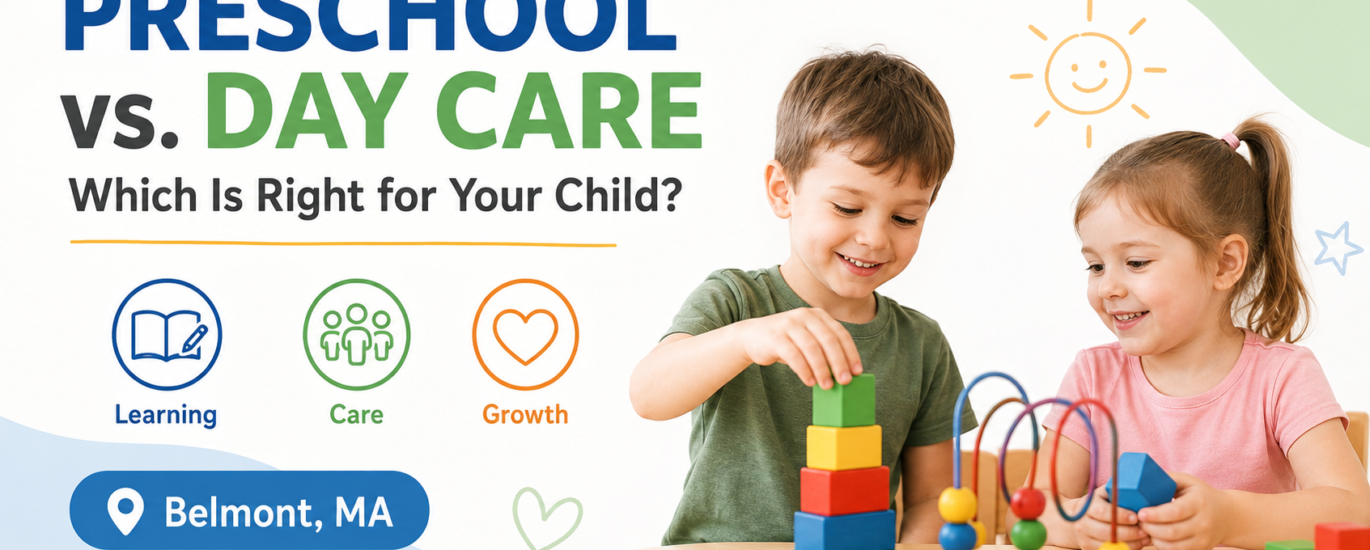
If you’re a parent searching for preschool in Belmont, MA, you may be wondering whether a traditional preschool is better than a day care program.
The answer is: neither is automatically better.
The right choice depends on your child’s age, developmental needs, personality, your family’s schedule, the amount of childcare you need, your educational priorities, and the quality of the individual program.
In general:
- Preschool tends to place greater emphasis on early childhood education, development, social-emotional learning, early literacy, early mathematics, play, and preparation for kindergarten.
- Day care tends to place greater emphasis on providing dependable childcare and supervision, but quality day care can also offer substantial early learning, play, social development, and preschool programming.
- Combined preschool/day care programs can offer both early education and full-day childcare, making them particularly attractive to working families.
Massachusetts’ Department of Early Education and Care (EEC) licenses or approves different types of early education and care programs and establishes requirements related to areas such as health, safety, supervision, educator training, background checks, and educator-to-child ratios.
Massachusetts also provides research-based learning standards and curriculum guidelines intended to support children’s social, emotional, and academic development.
For parents in Belmont, therefore, the most important question isn’t simply:
“Should I choose preschool or daycare?”
It is:
“Which program gives my child the right combination of care, learning, relationships, safety, development, schedule, and support?”
Introduction
Choosing an early childhood program is a major decision for parents.
During the preschool years, children are developing rapidly. They are learning how to communicate, build relationships, manage emotions, solve problems, become more independent, and understand the world around them.
At the same time, parents have practical responsibilities.
You may need childcare while you work.
You may need early drop-off.
You may need full-day care.
You may need a program that operates throughout much of the year.
Or you may primarily be looking for an educational environment that helps your child develop confidence and foundational skills before kindergarten.
This is why the search for preschool in Belmont, MA can quickly become confusing.
A parent may find:
- Preschools
- Day care centers
- Family child care programs
- Nursery schools
- Pre-K programs
- Early learning centers
- Child development centers
- Montessori programs
- Play-based programs
- Full-day preschool
- Part-time preschool
- Preschool/daycare combination programs
And although these names sound different, the actual services can overlap considerably.
A preschool may provide extended care.
A daycare may offer a structured preschool curriculum.
A childcare center may serve infants, toddlers, and preschoolers under one program.
A nursery school may operate only a few mornings each week.
Therefore, parents should compare the actual experience provided to the child, not just the name on the building.
This comprehensive guide explains the differences between preschool and day care in Belmont, MA, what parents should look for, how to compare programs, what questions to ask during a tour, and why families searching in Belmont may also want to consider suitable programs in nearby Arlington.
What Is Preschool?
Preschool is an early childhood education program designed for children before they enter kindergarten.
The exact age range depends on the individual provider.
Some programs may accept children around age three, while others may offer programs for older preschoolers approaching kindergarten.
A preschool typically focuses on developmentally appropriate learning through:
- Play
- Exploration
- Conversation
- Storytelling
- Art
- Music
- Movement
- Hands-on activities
- Early literacy
- Early mathematics
- Science exploration
- Social interaction
- Teacher-guided experiences
Massachusetts provides specific Guidelines for Preschool Learning Experiences, which are intended to help educators and program administrators plan and evaluate curriculum for preschool and kindergarten-aged children. The state’s guidelines emphasize principles such as individual differences in development, the importance of child development knowledge, language development, interconnected developmental domains, and the idea that young children learn by doing.
That means a strong preschool should not simply try to make young children sit at desks and complete worksheets.
Young children learn through active participation.
What Is Day Care?
Day care, or daycare, generally refers to childcare provided during the day while parents or guardians work, study, or handle other responsibilities.
Depending on the provider, day care may serve:
- Infants
- Toddlers
- Preschoolers
- School-age children
A day care program may provide:
- Supervision
- Meals
- Snacks
- Nap/rest periods
- Outdoor play
- Indoor play
- Art
- Music
- Stories
- Social interaction
- Developmental activities
- Early learning
In Massachusetts, group and school-age childcare programs are licensed by the Department of Early Education and Care. EEC explains that licensed programs must meet requirements concerning health, safety, supervision, training, educator-to-child ratios, and background record checks.
Therefore, day care should not automatically be viewed as simply babysitting.
A quality day care environment can be a meaningful early learning environment.
Preschool vs. Day Care: The Main Difference
The simplest distinction is the primary purpose of the program.
| Factor | Preschool | Day Care |
|---|---|---|
| Primary focus | Early education and development | Childcare + development |
| Typical age | Usually preschool-age children | Can include infants through preschool/older children |
| Early learning | Central part of program | Often integrated into daily care |
| Social development | Major focus | Major focus |
| Play | Essential | Essential |
| Kindergarten preparation | Often emphasized | May be incorporated |
| Full-day options | Some programs | Common |
| Extended hours | Depends on provider | Often available |
| Infant care | Less common | Common |
| Flexible childcare | Depends on provider | Often stronger |
| Curriculum | Often explicitly defined | Varies significantly |
| Nap/rest | Depends on age/program | Common for younger children |
| Year-round care | Varies | Often available |
| Best fit | Families emphasizing early education | Families needing dependable childcare |
This is a general comparison, not a rule.
There are excellent day care programs with strong preschool curricula and excellent preschools that provide full-day care.
Is Preschool Better Than Day Care?
No.
This is one of the most important things parents should understand.
There is no universal winner.
A high-quality preschool can be an excellent choice for one child.
A high-quality daycare can be the better choice for another.
For example:
Family A
The parents work from home and need only a morning program.
They may prefer a part-time preschool.
Family B
Both parents work full-time and need childcare from 8 AM to 5:30 PM.
A full-day daycare or preschool/daycare combination may be more practical.
Family C
Their child is younger and not yet ready for a traditional preschool environment.
A toddler-focused daycare may be more appropriate.
Family D
Their child is approaching kindergarten and the family wants a structured early-learning environment.
A preschool with a strong kindergarten-readiness focus may be a good fit.
The best program is the one that meets the actual needs of the child and family.
Is Day Care Only Babysitting?
Absolutely not.
The quality of a day care program depends on its staff, environment, curriculum, routines, supervision, and philosophy.
A high-quality day care can give children opportunities to:
- Build friendships
- Develop language
- Practice independence
- Explore materials
- Participate in group activities
- Develop motor skills
- Listen to stories
- Create art
- Explore nature
- Practice early mathematics
- Develop emotional regulation
- Learn classroom routines
Massachusetts’ EEC learning standards and curriculum guidelines are designed to support children’s social, emotional, and academic development.
So when evaluating day care in Belmont, MA, don’t ask only:
“How long can my child stay?”
Ask:
“What will my child experience while they’re there?”
Can a Day Care Also Be a Preschool?
Yes.
This is where the terminology becomes particularly confusing.
A childcare center may accept a child as an infant, move the child into a toddler classroom, and eventually place the child in a preschool classroom.
The program may provide:
Infant Care → Toddler Care → Preschool → Pre-K
This can offer families continuity.
Instead of changing providers every few years, children may remain in one familiar environment.
For some children, that consistency can be valuable.
Can Preschool Provide Full-Day Childcare?
Yes, depending on the provider.
Some preschools operate:
- Half day
- School day
- Full day
- Extended day
- Full year
- School-year only
Never assume that a preschool is automatically part-time.
Ask the program about:
- Opening time
- Closing time
- Before-care
- After-care
- Summer care
- School vacation coverage
- Holiday closures
Preschool vs. Day Care for Infants
If your child is an infant, day care is generally the more relevant category to investigate.
Many preschools focus on children who are already in the preschool age range.
When looking for infant day care in Belmont, MA, pay particular attention to:
- Infant teacher qualifications
- Safe sleep procedures
- Feeding procedures
- Diapering
- Staffing ratios
- Supervision
- Communication with parents
- Individual routines
- Developmentally appropriate activities
Do not select an infant program simply because it also has a highly rated preschool classroom.
Infants have different needs.
Preschool vs. Day Care for Toddlers
Toddlers are in an important transitional stage.
They are becoming increasingly independent but still need significant adult support.
A good toddler program should provide:
- Safe exploration
- Language-rich interactions
- Movement
- Sensory experiences
- Social interaction
- Consistent routines
- Opportunities for independence
- Responsive caregivers
Ask:
“How does your program handle toddler transitions and challenging behavior?”
The answer can tell you a great deal about the program’s philosophy.
Preschool for 3-Year-Olds
Three-year-olds may be ready for more structured group experiences.
A preschool program may introduce:
- Story circles
- Art projects
- Early math
- Letter awareness
- Songs
- Science exploration
- Dramatic play
- Group games
- Outdoor activities
But children should still have plenty of opportunities for play and exploration.
Massachusetts’ preschool learning guidance emphasizes that young children learn by doing and recognizes individual differences in development.
Preschool for 4-Year-Olds
Four-year-olds may be increasingly ready for activities that support:
- Early literacy
- Phonological awareness
- Vocabulary
- Number concepts
- Patterns
- Shapes
- Writing development
- Social problem-solving
- Independence
- Group participation
The goal should not be to turn preschool into elementary school.
Instead, children should develop the foundational skills and learning behaviors that support future school success.
What Does a Typical Preschool Day Look Like?
Every preschool is different, but a typical day could include:
1. Arrival
Children greet teachers and classmates.
They may:
- Put away backpacks
- Hang coats
- Wash hands
- Choose an activity
2. Morning meeting
Teachers may introduce:
- Stories
- Songs
- Classroom routines
- Activities
- Discussion topics
3. Learning centers
Children may explore:
- Blocks
- Books
- Art
- Puzzles
- Dramatic play
- Manipulatives
4. Teacher-guided activity
The class might explore:
- Math
- Literacy
- Science
- Art
- Music
5. Outdoor play
Children get opportunities to:
- Run
- Climb
- Explore
- Play games
- Develop gross motor skills
6. Snack/lunch
Children practice:
- Self-help skills
- Conversation
- Social routines
7. Rest
Depending on age and program.
8. Afternoon learning and play
The day may end with:
- Storytime
- Art
- Music
- Outdoor play
- Free choice
- Small-group activities
What Does a Typical Day Care Day Look Like?
A full-day daycare schedule may look like:
Morning arrival → Breakfast/snack → Free play → Learning activity → Outdoor play → Lunch → Nap/rest → Snack → Learning/play → Outdoor activity → Pickup
This may look very similar to a preschool schedule.
That is why parents should compare the actual program rather than relying on terminology.
Curriculum: What Should Parents Look For?
Curriculum is one of the biggest areas where parents should ask questions.
Ask:
“What does your curriculum look like?”
Then ask:
“Can you show me an example of what children actually do during a typical week?”
A quality program should be able to explain its educational approach.
Massachusetts EEC provides research-based learning standards and curriculum guidelines to help educators support children’s development.
Early Literacy in Preschool
Early literacy is much more than memorizing letters.
Children can develop literacy through:
- Books
- Storytelling
- Songs
- Rhymes
- Conversation
- Vocabulary
- Letter recognition
- Sound awareness
- Drawing
- Early writing
Teachers may encourage children to:
- Retell stories
- Describe pictures
- Recognize their names
- Talk about characters
- Ask questions
- Create their own stories
Early Mathematics
Preschool mathematics can include:
- Counting
- Sorting
- Matching
- Shapes
- Patterns
- Measurement
- Comparing quantities
- Number recognition
- Spatial concepts
For example:
A teacher might ask:
“How many blocks do we need?”
This turns everyday play into mathematical learning.
Science and Discovery
Preschool science doesn’t require complicated experiments.
Children can explore:
- Weather
- Plants
- Animals
- Water
- Shadows
- Seasons
- Nature
- Movement
- Magnets
- Simple cause-and-effect relationships
The goal is to develop curiosity.
Children should be encouraged to:
- Ask questions
- Observe
- Predict
- Explore
- Describe
- Compare
Art and Creativity
Look for opportunities involving:
- Drawing
- Painting
- Cutting
- Gluing
- Clay
- Collage
- Music
- Dance
- Dramatic play
Creativity can support:
- Fine motor development
- Communication
- Imagination
- Confidence
- Problem-solving
Social-Emotional Learning
Social-emotional development is one of the most important parts of early childhood education.
Children need opportunities to learn:
- How to identify emotions
- How to communicate needs
- How to cooperate
- How to share
- How to take turns
- How to handle frustration
- How to solve simple conflicts
- How to build relationships
Massachusetts includes social-emotional development and approaches to play and learning within its early learning standards framework.
Why Play Is Important
Parents sometimes visit a preschool and wonder:
“Why aren’t the children doing more academic work?”
Because play itself can be a powerful learning experience.
Consider a pretend restaurant.
Children might:
- Take orders
- Count pretend money
- Talk to customers
- Read menus
- Share materials
- Negotiate roles
That activity supports:
Language + Mathematics + Social Skills + Creativity + Problem-Solving
Massachusetts’ preschool guidance recognizes that young children learn through active experiences and doing.
Teacher Quality Matters More Than the Sign Outside
A beautiful building doesn’t guarantee a good preschool.
A sophisticated curriculum doesn’t guarantee a good daycare.
The people interacting with your child every day matter enormously.
During your visit, watch how teachers:
- Speak to children
- Respond to questions
- Handle conflicts
- Encourage participation
- Comfort upset children
- Set boundaries
- Encourage independence
Ask yourself:
“Would I feel comfortable leaving my child with this teacher?”
Teacher Qualifications
Ask:
- What qualifications do teachers have?
- What early childhood education training do they have?
- How long have they worked in early education?
- What professional development do they receive?
- Are staff trained in CPR and First Aid?
Massachusetts EEC licensing requirements include educator training and background record check requirements, while licensed group and school-age programs must meet applicable supervision and ratio requirements.
Educator-to-Child Ratios
Ask:
“What is the educator-to-child ratio for my child’s classroom?”
Also ask:
“What happens if a teacher is absent?”
A classroom can feel completely different depending on staffing levels.
Massachusetts EEC states that licensed group and school-age programs must maintain appropriate educator-to-child ratios.
Safety Should Be a Top Priority
Ask about:
- Emergency procedures
- Fire drills
- Evacuation
- Authorized pickup
- Visitor access
- Playground supervision
- Medication
- Allergies
- Illness
- Incident reports
- Emergency communication
Massachusetts’ licensing system is designed to establish baseline requirements for health, safety, supervision, training, and related areas.
How to Verify Childcare Licensing in Belmont, MA
Massachusetts provides an online Child Care Search tool that lets families search for licensed childcare providers geographically. Belmont and Arlington are both available in the location search.
Parents can use the tool to research programs.
EEC also notes that some licensed programs may choose not to appear in the online search. If you cannot find a program you’re considering, EEC recommends contacting the appropriate regional office to confirm whether it is licensed. EEC can also provide information about license history, non-compliance findings, and current restrictions.
This makes the official Massachusetts search tool an important part of your research.
Belmont, MA Preschool Options: Understand the Local Landscape
Families researching preschool in Belmont, MA should know that Belmont has multiple types of early childhood options, including private/community programs and public-school early childhood programming.
For example, Belmont Public Schools operates an Integrated Preschool Program for children ages 3–5 who require special education programming, with typically developing neighborhood children also enrolled as peer models. The district states that its preschool curriculum aligns with Massachusetts State Early Childhood Program Learning Standards and focuses on language-rich, developmentally appropriate activities supporting communication, social, emotional, cognitive, and motor development.
This is an important example of why parents should research the specific purpose and eligibility requirements of each program rather than assuming that every preschool serves the same population.
The Belmont Public Schools page also explains that typically developing Belmont children may be considered for peer-model positions, subject to eligibility, screening, and available space.
Public Preschool vs. Private Preschool in Belmont
Families may encounter both public-school-affiliated and private/community preschool options.
A public-school program may have:
- District involvement
- Special education services
- Integrated classrooms
- Specific eligibility requirements
- School-year schedules
A private/community preschool may offer:
- Different educational philosophies
- Different schedules
- Full-day options
- Extended care
- Different enrollment procedures
The important thing is to compare the actual services and requirements.
Belmont Preschool Schedule Considerations
Do not assume that every preschool provides full-day care.
For example, the Belmont Public Schools Integrated Preschool page currently lists several part-day schedules for its 2026–2027 program, illustrating why parents need to check the exact schedule of the program they’re considering.
If you work full-time, ask:
- Is the program full-day?
- Is before-care available?
- Is after-care available?
- What happens after preschool ends?
- Is there summer coverage?
A great educational program may still be impractical if it doesn’t meet your childcare schedule.
Day Care in Belmont, MA: What Parents Should Compare
When evaluating day care in Belmont, MA, compare:
Hours
What time does the program open and close?
Age groups
Does it serve infants, toddlers, and preschoolers?
Staffing
Who will care for your child?
Ratios
How many children are assigned to each educator?
Curriculum
What learning activities are provided?
Meals
Are food and snacks included?
Nap
How is rest handled?
Outdoor play
How often do children go outside?
Communication
How do parents receive updates?
Tuition
What is the complete cost?
Cost: Preschool vs. Day Care in Belmont
One of the biggest mistakes parents make is comparing only monthly tuition.
The true cost depends on:
- Number of days
- Hours
- Age
- Full-day vs. part-day
- Extended care
- Meals
- Registration fees
- Deposits
- Summer care
- Vacation coverage
- Additional activities
A part-time preschool may have a lower total tuition than a full-day daycare simply because fewer hours are provided.
Therefore, compare:
Total annual cost ÷ total hours of care
when trying to understand the value of different schedules.
Questions About Tuition to Ask
Before enrolling, ask:
- What is the tuition?
- Is tuition weekly, monthly, or annual?
- Is there a registration fee?
- Is there a deposit?
- Is the deposit refundable?
- Are meals included?
- Is extended care extra?
- Are there late pickup fees?
- What happens during holidays?
- What is the withdrawal/refund policy?
- Are there sibling discounts?
- Are financial assistance options available?
Never compare programs based on tuition alone.
Full-Day Preschool vs. Full-Day Day Care
For working parents, this can be one of the most important comparisons.
Full-day preschool
May combine:
Early education + structured classroom learning + childcare
Full-day daycare
May combine:
Childcare + routines + play + developmental activities + early education
The difference depends on the individual provider.
Ask for a sample daily schedule.
Preschool vs. Day Care for Working Parents
If you work from 9 AM to 5 PM, a program operating from 9 AM to noon may not solve your childcare problem.
Consider your entire day:
Wake-up → Breakfast → Drop-off → Commute → Work → Pickup → Home
A program with slightly less impressive marketing but a schedule that fits your family may be the better choice.
Location Matters: Belmont vs. Arlington
Families looking for preschool in Belmont, MA should also consider whether Arlington is practical for their daily routine.
Arlington may make sense if:
- You work there.
- You commute through Arlington.
- You live near the Belmont-Arlington border.
- A family member lives there.
- A suitable program has availability there.
- The schedule is a better fit.
The same applies to families searching for day care in Belmont, MA.
Don’t limit your search geographically if a nearby town can make your daily routine significantly easier.
Preschool in Arlington, MA as an Alternative
Arlington has its own early childhood options.
For example, the Arlington Recreation Department currently lists a licensed Kid Care Preschool for children approximately ages 2.9–5, with programming designed around children’s curiosity and artistic, scientific, sensory, verbal, and written expression.
The point isn’t that one particular program is automatically the right choice.
The important lesson is that parents comparing Belmont and Arlington should investigate:
- Age eligibility
- Schedule
- Tuition
- Curriculum
- Licensing
- Availability
- Location
- Extended care
before making a decision.
Belmont vs. Arlington: How to Compare Programs
Create a simple comparison chart.
| Category | Belmont Program | Arlington Program |
|---|---|---|
| Distance from home | ___ | ___ |
| Distance from work | ___ | ___ |
| Opening time | ___ | ___ |
| Closing time | ___ | ___ |
| Full-day option | ___ | ___ |
| Curriculum | ___ | ___ |
| Class size | ___ | ___ |
| Teacher-child ratio | ___ | ___ |
| Outdoor play | ___ | ___ |
| Meals | ___ | ___ |
| Nap/rest | ___ | ___ |
| Tuition | ___ | ___ |
| Extended care | ___ | ___ |
| Summer care | ___ | ___ |
| Availability | ___ | ___ |
| Overall fit | ___ | ___ |
This turns an emotional decision into a more objective comparison.
How to Choose the Best Preschool in Belmont, MA
If your primary goal is finding preschool in Belmont, MA, follow this process.
Step 1: Determine Your Child’s Age
Different programs serve different age groups.
Step 2: Determine Your Required Hours
Decide whether you need:
- Part-day
- School-day
- Full-day
- Extended-day
- Year-round
Step 3: Determine Your Priorities
Choose what’s most important:
- Play-based learning
- Academic preparation
- Social-emotional development
- Outdoor play
- Arts
- Language
- Montessori
- Nature
- Small classes
Step 4: Make a Shortlist
Include both Belmont and practical nearby options.
Step 5: Verify Licensing
Use Massachusetts EEC resources.
Step 6: Schedule Tours
Never make your final decision based only on a website.
Step 7: Observe
Watch teachers and children.
Step 8: Ask Questions
Use the checklist below.
Step 9: Compare Costs
Look at the complete financial commitment.
Step 10: Choose the Best Overall Fit
Don’t choose based on one impressive feature.
25 Questions to Ask Before Enrolling
Program
- What ages do you serve?
- Is the program licensed?
- How long has the program operated?
- What is your educational philosophy?
Teachers
- What qualifications do teachers have?
- How much experience do they have?
- How frequently do teachers receive training?
- What is staff turnover like?
Classroom
- What is the educator-to-child ratio?
- How large are classrooms?
- How much free play is provided?
- How much teacher-guided learning is provided?
Curriculum
- What curriculum or learning framework do you use?
- How do you support early literacy?
- How do you support early math?
- How do you support social-emotional development?
Daily routine
- What does a typical day look like?
- How much outdoor time do children receive?
- Is nap/rest offered?
- Are meals and snacks provided?
Safety
- How are emergencies handled?
- What is your illness policy?
- How do you manage allergies and medication?
Parents
- How do you communicate with families?
- What happens if I have a concern about my child’s development?
What to Observe During a Preschool Tour
A tour is more valuable when you know what to look for.
Observe the children.
Do they appear:
- Comfortable?
- Engaged?
- Curious?
- Active?
- Supported?
Observe teachers.
Are they:
- At children’s eye level?
- Listening?
- Talking?
- Encouraging?
- Redirecting calmly?
Observe the classroom.
Look for:
- Books
- Blocks
- Art materials
- Puzzles
- Dramatic-play materials
- Age-appropriate toys
- Children’s work
Observe transitions.
Ask:
“How do you move children from one activity to another?”
Transitions can tell you a lot about classroom management.
Red Flags Parents Should Not Ignore
1. Unclear licensing information
The program cannot explain its licensing status.
2. Teachers rarely interact with children
Children are left to occupy themselves for long periods without meaningful adult engagement.
3. Poor supervision
Staff cannot clearly explain how children are monitored.
4. No clear daily schedule
The program cannot describe what children do.
5. No clear behavior policy
Staff cannot explain how challenging behavior is addressed.
6. Poor communication
Parents receive little information about their child’s experience.
7. Unsafe environment
Visible safety concerns should never be dismissed.
8. High staff turnover
Ask what causes frequent staffing changes.
9. Excessive academic pressure
Young children should have developmentally appropriate opportunities to learn through play and active experiences.
10. Pressure to enroll immediately
A quality provider should be willing to answer reasonable questions.
Positive Signs of a High-Quality Preschool
Look for:
- Warm teacher-child interactions
- Consistent routines
- Safe classrooms
- Appropriate supervision
- Engaging learning materials
- Outdoor play
- Art
- Books
- Dramatic play
- Social-emotional learning
- Age-appropriate expectations
- Strong parent communication
- Developmentally appropriate learning
- Teachers who genuinely enjoy interacting with children
How Preschool Supports Kindergarten Readiness
Parents often think kindergarten readiness means:
ABC + 123 + writing
But readiness is much broader.
A child entering kindergarten may benefit from being able to:
- Listen
- Communicate
- Follow routines
- Ask for help
- Participate in groups
- Manage simple frustrations
- Interact with peers
- Explore independently
- Follow directions
- Persist with challenging tasks
Massachusetts’ preschool and kindergarten learning guidance emphasizes development across interconnected domains and recognizes that children have individual developmental differences.
Early Literacy and Kindergarten Readiness
Children can develop foundational literacy through:
- Storytime
- Rhyming
- Conversation
- Songs
- Letter exploration
- Name recognition
- Drawing
- Writing attempts
A good preschool doesn’t necessarily rush children into formal reading.
It builds the foundation.
Early Math and Kindergarten Readiness
Children can practice:
- Counting
- Sorting
- Matching
- Patterns
- Shapes
- Quantity
- Measurement
- Spatial relationships
Again, these skills can emerge through everyday play.
Social Skills and Kindergarten Readiness
Children may need to learn:
- How to wait
- How to take turns
- How to share
- How to listen
- How to ask questions
- How to communicate with teachers
- How to cooperate
These skills can be just as important as academic knowledge.
Independence and Kindergarten Readiness
Look for programs that encourage children to gradually become independent with:
- Putting away belongings
- Washing hands
- Eating
- Cleaning up
- Making simple choices
- Asking for help
- Following routines
The goal is not to expect adult-level independence.
It is to give children opportunities to practice.
Behavior Management: What Parents Should Ask
Ask:
“What happens when a child has a tantrum?”
“What happens if a child hits or bites?”
“How do you handle persistent challenging behavior?”
“How do you communicate these incidents to parents?”
A good answer should demonstrate an understanding of child development.
Look for:
- Redirection
- Clear boundaries
- Calm responses
- Emotional support
- Consistent expectations
- Teaching appropriate alternatives
Parent Communication
Ask how parents receive information.
Possible methods include:
- Mobile apps
- Phone
- Daily reports
- Parent conferences
- In-person conversations
But technology isn’t the important part.
Responsiveness is.
Parents should feel comfortable asking questions.
Meals and Snacks
If meals are provided, ask:
- What’s included?
- Are menus available?
- How are allergies managed?
- Can parents provide food?
- How are dietary restrictions handled?
If your child has allergies or specific dietary needs, discuss them before enrollment.
Nap and Rest
Younger children may still need daytime rest.
Ask:
- Is nap time provided?
- How long is rest?
- What happens if my child doesn’t sleep?
- Is quiet activity available?
A program should have a clear approach.
Outdoor Play
Ask:
“How often do children go outside?”
and:
“What happens when the weather doesn’t cooperate?”
Look for opportunities for:
- Running
- Climbing
- Balancing
- Exploring
- Nature observation
- Group games
Screen Time
Ask:
- Is screen time used?
- How frequently?
- Why is it used?
- Is it educational?
- Is it teacher-directed?
- Does it replace active play?
Parents should understand the role technology plays in the classroom.
What About Montessori Preschool?
Some parents searching for preschool in Belmont, MA may specifically want Montessori education.
If so, ask:
- Is the program genuinely Montessori?
- What Montessori training do teachers have?
- How is the classroom structured?
- How much child-directed activity is provided?
- What ages are combined?
- How is progress documented?
Don’t choose a program simply because “Montessori” appears in its name.
Understand the actual classroom model.
What About Play-Based Preschool?
A play-based preschool may emphasize:
- Exploration
- Choice
- Pretend play
- Hands-on learning
- Social interaction
- Teacher-guided activities
This can be an excellent fit for children who learn best through active exploration.
Ask how teachers intentionally connect play to learning.
What About Academic Preschool?
Some programs place stronger emphasis on:
- Letters
- Numbers
- Writing
- Early reading
- Structured lessons
Parents should ask how academic activities are balanced with:
- Movement
- Play
- Social interaction
- Creativity
- Outdoor time
The goal should be developmentally appropriate learning.
Should You Choose the Closest Preschool?
Not necessarily.
Location is important, but don’t sacrifice:
- Safety
- Teacher quality
- Curriculum
- Schedule
- Communication
- Overall fit
A program that is five minutes farther away may be much better suited to your family.
Should You Choose a Preschool Near Work or Home?
Consider both.
Near home
Advantages:
- Easier mornings
- Easier emergency pickup
- Convenient for local activities
Near work
Advantages:
- Easier midday emergencies
- Potentially simpler commute
- Convenient if your workplace changes your travel route
The right choice depends on your daily routine.
When Preschool May Be the Better Choice
Preschool may be a strong option if:
- Your child is preschool age.
- Early education is a major priority.
- You want a structured classroom.
- You want strong kindergarten preparation.
- You prefer a particular educational philosophy.
- You don’t require extensive childcare hours.
When Day Care May Be the Better Choice
Daycare may be preferable if:
- You need full-day care.
- Your child is younger.
- You need extended hours.
- You need year-round care.
- You need infant/toddler care.
- You want childcare and early education under one roof.
When a Combined Preschool + Day Care Is Ideal
For many families, a combined program offers the best of both worlds.
It can provide:
Care + Learning + Play + Social Development + Full-Day Coverage
Potential advantages include:
- One location
- Consistent teachers
- Familiar environment
- Easier transportation
- Fewer transitions
- Full-day schedule
But parents should still evaluate the preschool component carefully.
Should You Move Your Child From Day Care to Preschool?
Not automatically.
If your current daycare has a strong preschool classroom, your child may not need to move.
Ask:
“What changes when my child moves into the preschool classroom?”
Find out whether the program adds:
- More structured learning
- Early literacy
- Early math
- Group activities
- Kindergarten preparation
- Greater independence
If the existing program meets your child’s needs, continuity may be valuable.
Should You Move Your Child to a New Preschool?
A move may make sense if:
- Your current program doesn’t offer preschool.
- The curriculum isn’t meeting your expectations.
- You need a different schedule.
- Your child needs a different classroom environment.
- You want a specific educational philosophy.
- The current program doesn’t provide adequate kindergarten preparation.
But remember that transitions take time.
How to Help a Child Transition to Preschool
If you decide to change programs:
Visit beforehand
Let your child see the:
- Classroom
- Teacher
- Playground
- Bathroom
- Entrance
Explain the routine
Tell them:
“We’ll come in, say goodbye, and you’ll spend time with your teacher.”
Practice independence
Practice:
- Putting away belongings
- Washing hands
- Asking for help
- Saying goodbye
Keep mornings predictable
Consistency can make the transition easier.
A Simple Preschool vs. Day Care Decision Framework
Ask yourself these seven questions.
1. How old is my child?
Age affects the type of program that makes sense.
2. How many hours of care do I need?
This may determine whether part-time preschool is practical.
3. What does my child need?
Think about:
- Social interaction
- Movement
- Structure
- Independence
- Language
- Emotional support
4. What do I value educationally?
Think about:
- Play
- Academics
- Arts
- Outdoor learning
- Social-emotional development
5. What can I afford?
Calculate the complete cost.
6. What location works?
Consider Belmont and nearby Arlington if practical.
7. How did I feel during the tour?
Your observations matter.
Preschool vs. Day Care Checklist
Preschool may be right if:
☐ My child is preschool age
☐ I prioritize early education
☐ I want a classroom environment
☐ Kindergarten readiness matters
☐ The schedule fits our family
☐ I like the program’s educational philosophy
Day care may be right if:
☐ I need full-day care
☐ I need extended hours
☐ My child is younger
☐ I need year-round care
☐ I want childcare and learning together
☐ I need a flexible schedule
Combined program may be right if:
☐ I need full-day care
☐ I want structured preschool learning
☐ I want one provider
☐ I want continuity
☐ I need extended hours
Frequently Asked Questions About Preschool and Day Care in Belmont, MA
1. What is the difference between preschool and day care in Belmont, MA?
Preschool generally emphasizes early childhood education, development, social-emotional learning, and school readiness. Day care primarily provides childcare and supervision but can also offer substantial early learning and preschool programming.
2. Is preschool better than daycare?
No. Neither is automatically better. The best choice depends on your child’s age, developmental needs, your family’s schedule, budget, and educational priorities.
3. Can daycare provide preschool education?
Yes. Many childcare providers have preschool classrooms or integrate preschool learning into their full-day programs.
4. Can preschool provide full-day care?
Yes, depending on the provider. Some preschools offer full-day or extended-day schedules, while others are part-time.
5. What age do children start preschool in Belmont, MA?
Age requirements vary by program. Parents should check each provider’s eligibility rules. Belmont Public Schools’ integrated preschool, for example, serves children ages 3–5 under its specific program structure.
6. What age should a child start daycare?
Daycare can serve children from infancy through preschool and beyond, depending on the provider. Parents should choose an age-appropriate program based on their child’s needs.
7. How do I find licensed childcare in Belmont, MA?
Use the Massachusetts EEC Child Care Search tool to locate licensed childcare providers geographically.
8. What if I cannot find a daycare in the Massachusetts online search?
EEC notes that some licensed programs may not appear in the search tool. Families can contact the appropriate EEC office to confirm a program’s licensing status and ask about licensing history or compliance information.
9. What should I look for in a preschool in Belmont, MA?
Look for caring teachers, appropriate supervision, developmentally appropriate learning, play, social-emotional support, outdoor activity, a safe environment, good communication, suitable hours, and transparent policies.
10. What should I look for in day care in Belmont, MA?
Consider licensing, teacher qualifications, educator-to-child ratios, safety, daily routines, meals, naps, outdoor play, curriculum, communication, hours, tuition, and availability.
11. Does preschool prepare children for kindergarten?
A quality preschool can support communication, early literacy, early mathematics, social-emotional development, independence, problem-solving, and participation in group routines.
12. Does daycare prepare children for kindergarten?
It can. Daycare programs with strong preschool curricula can provide many developmental experiences that support kindergarten readiness.
13. Is full-day preschool better for working parents?
It may be more convenient if you need childcare throughout the workday. However, parents should compare actual hours and extended-care policies.
14. Is part-time preschool enough?
For some children and families, yes. The right schedule depends on childcare requirements and the individual child’s needs.
15. How much does preschool cost in Belmont, MA?
Costs vary significantly depending on the provider, schedule, age, services, and enrollment structure. Request a current tuition and fee schedule from each program.
16. How much does daycare cost in Belmont, MA?
There is no single price for daycare in Belmont. Costs vary based on age, schedule, provider, hours, and services.
17. Should I consider Arlington if I live in Belmont?
Yes, if Arlington fits your commute and family routine. Parents can compare suitable licensed programs in both communities.
18. Is a daycare with a preschool classroom a good option?
It can be. A combined program may provide full-day childcare while also supporting early learning, social development, and kindergarten readiness.
19. Should I change daycare when my child reaches preschool age?
Not necessarily. If the existing provider offers a strong preschool curriculum and meets your child’s needs, staying may provide continuity.
20. What is the most important thing to look for during a preschool tour?
Pay close attention to teacher-child interactions. Observe whether teachers are warm, responsive, attentive, respectful, and engaged with children.
21. What questions should I ask about preschool curriculum?
Ask what children learn, how learning is delivered, how much play is provided, how teachers support early literacy and math, and how the program supports social-emotional development.
22. What should I ask about teacher-to-child ratios?
Ask for the ratio in your child’s specific classroom and what happens when a teacher is absent.
23. Should preschool be academic?
Preschool should provide learning opportunities, but early childhood education should remain developmentally appropriate. Massachusetts’ guidance emphasizes active learning, individual developmental differences, and learning through doing.
24. Why is play important in preschool?
Play allows children to practice language, social skills, creativity, problem-solving, motor skills, and early academic concepts in meaningful contexts.
25. How do I know whether a preschool is right for my child?
Tour the program, observe teachers and children, review the schedule and policies, ask detailed questions, verify licensing, compare costs, and consider whether the environment matches your child’s personality and developmental needs.
Final Preschool vs. Day Care Comparison
| Your Main Priority | Potentially Best Fit |
|---|---|
| Infant care | Day care |
| Toddler care | Day care |
| Full-day childcare | Day care or combined program |
| Extended hours | Day care or combined program |
| Early education | Preschool |
| Kindergarten preparation | Preschool or strong preschool/daycare program |
| Social development | Both |
| Play-based learning | Both |
| Early literacy | Both |
| Early math | Both |
| Arts and creativity | Both |
| Outdoor play | Both |
| Year-round care | Day care/combined program |
| Continuity from infancy to preschool | Day care/combined program |
| Specialized preschool philosophy | Preschool |
| Full-day early education | Full-day preschool/combined program |
Conclusion: Choosing the Right Preschool or Day Care in Belmont, MA
Choosing between preschool and day care in Belmont, MA isn’t about finding a universal winner.
It’s about finding the environment where your child can thrive.
A good preschool can provide a strong foundation in:
- Early literacy
- Early mathematics
- Communication
- Creativity
- Social-emotional development
- Problem-solving
- Independence
- Kindergarten readiness
A good day care can provide:
- Reliable childcare
- Consistent routines
- Social interaction
- Play
- Developmentally appropriate activities
- Early learning
- Full-day coverage
- Support for working families
And a high-quality combined preschool/daycare program can offer both.
For families researching preschool in Belmont, MA, Massachusetts’ official resources provide an excellent starting point for understanding licensed early education and care programs. EEC’s Child Care Search allows families to search geographically, while EEC’s licensing framework establishes requirements for areas such as health, safety, supervision, training, ratios, and background checks.
Massachusetts’ early learning standards also provide useful context when evaluating curriculum because they emphasize children’s social, emotional, and academic development and recognize that children learn through active experiences.
Belmont families also have local public-school early childhood programming to investigate. Belmont Public Schools’ Integrated Preschool Program, for example, serves children ages 3–5 within an integrated model and states that its curriculum aligns with Massachusetts early childhood learning standards.
And if Arlington is part of your daily commute, comparing appropriate preschool and day care options in Arlington, MA can expand your choices without necessarily making your routine more complicated.
Ultimately, don’t choose based solely on:
“Preschool” vs. “Daycare.”
Choose based on:
Safety + Teachers + Relationships + Learning + Play + Schedule + Communication + Cost + Location + Your Child’s Needs.
The right early childhood program should be more than a place where your child spends several hours each day.
It should be an environment where your child feels safe, valued, curious, supported, confident, and excited to learn.