
Summary
Starting preschool is a major milestone for children and parents. For some children, it is their first regular experience away from home. For others, it is the next step after toddler care, daycare, play school, or family-based care.
If you are searching for Preschool in Arlington, MA, preparation should go beyond buying a backpack and labeling clothing. A successful preschool transition involves helping your child develop everyday independence, communication skills, social confidence, emotional regulation, curiosity, and comfort with routines.
The good news is that children do not need to be academically “perfect” before preschool. In fact, Massachusetts early-learning guidance emphasizes developmentally appropriate learning, individual differences, learning through doing, language development, interconnected developmental domains, and strong family involvement.
For Arlington families, preparation can also mean understanding the differences between preschool, pre-K, nursery school, daycare, and integrated public-school programs. Arlington Public Schools currently describes itself as serving students from preschool through Grade 12 and operates an integrated preschool program.
Families considering programs in nearby Belmont, MA should also understand that program eligibility, age requirements, schedules, admissions processes, and program models can differ. For example, Belmont Public Schools’ Integrated Preschool Program is designed for children ages 3–5 and combines children requiring special education programming with typically developing neighborhood peers.
This guide explains how to prepare your child for preschool, what skills matter most, what parents should practice at home, how to choose a preschool in Arlington, MA, what questions to ask during a tour, and how families in Arlington and Belmont can approach the transition with confidence.
Introduction: Preparing Your Child for Preschool
The transition to preschool can be exciting, emotional, and sometimes confusing.
Parents often ask:
- Is my child ready for preschool?
- Should my child already know letters and numbers?
- Should my child be fully potty trained?
- How can I reduce separation anxiety?
- What should my child be able to do independently?
- How can I prepare my child socially?
- What should I look for in a preschool in Arlington, MA?
- Is preschool different from daycare?
- Should I consider a preschool near Belmont, MA?
- How early should I start preparing?
The most important thing to understand is that preschool readiness is not a single skill.
A child can know the alphabet but struggle to separate from a parent.
Another child may not recognize every letter but may confidently communicate needs, interact with peers, follow routines, and explore new activities.
Both children can be developing appropriately.
Massachusetts preschool guidance recognizes that young children have individual developmental differences and that learning takes place through active experiences. The state’s guidance also identifies families as primary caregivers and educators of young children.
Therefore, preparing for preschool should focus on the whole child, not simply academic preparation.
What Does Preschool Readiness Really Mean?
Preschool readiness generally refers to a combination of developmental abilities that help children participate comfortably in a group learning environment.
These abilities can include:
- Social skills
- Emotional regulation
- Communication
- Listening
- Following simple directions
- Independence
- Self-help skills
- Motor development
- Curiosity
- Attention and engagement
- Problem-solving
- Early literacy
- Early mathematics
- Comfort with routines
- Ability to transition between activities
These skills do not need to be mastered before the first day.
A good preschool environment should continue developing them.
Massachusetts standards for preschool and kindergarten specifically address areas such as self-knowledge, relationships, self-management, initiative, curiosity, persistence, creativity, cooperative play, problem-solving, and responsible decision-making.
That means parents should think less about “Does my child know enough?” and more about:
“Does my child have opportunities to practice learning, communicating, playing, exploring, and becoming independent?”
Why Preparing for Preschool Matters
Preparation can make the transition smoother for both the child and the family.
A child who has practiced basic routines at home may find the classroom environment easier to understand.
For example, practicing:
- putting toys away
- washing hands
- eating independently
- putting on a jacket
- waiting briefly
- asking for help
- sitting for a short story
- taking turns
- saying goodbye
- following simple instructions
can build confidence.
Preparation does not mean turning your home into a classroom.
Instead, everyday family routines can become opportunities for learning.
Massachusetts guidance describes high-quality early education as including developmentally appropriate, hands-on experiences, play-based routines, multiple ways to engage children, clear learning goals, appropriate assessment, and partnerships with families.
1. Start With Emotional Preparation
One of the most important parts of preschool preparation is emotional readiness.
Your child may feel:
- excited
- nervous
- curious
- shy
- confused
- enthusiastic
- worried about separation
- eager to make friends
All of these reactions can occur during a transition.
Parents can help by talking positively and realistically about preschool.
Instead of saying:
“You won’t be scared at school.”
try:
“You might miss me when I leave. Your teacher will be there to help you, and I’ll come back after school.”
This acknowledges the child’s feelings without creating fear.
2. Practice Short Separations Before Preschool
If your child has rarely been away from you, start practicing gradually.
For example:
Step 1
Leave your child with a trusted family member for a short period.
Step 2
Increase the duration gradually.
Step 3
Practice saying goodbye without repeatedly returning.
Step 4
Allow your child to experience a successful reunion.
Step 5
Talk about what happened afterward.
The goal is not to eliminate every emotion.
The goal is to help the child learn:
“My parent leaves, I am safe, and my parent comes back.”
3. Create a Consistent Goodbye Routine
A predictable goodbye can help reduce uncertainty.
Your routine might be:
- Hug
- Say a short goodbye
- Tell your child when you will return
- Give the teacher a quick handoff
- Leave calmly
Avoid repeatedly extending the goodbye because your child is crying.
Long goodbyes can sometimes make the transition more difficult.
Ask the preschool about its preferred arrival procedure because every program may handle drop-off differently.
4. Talk About Preschool Before the First Day
Children often feel more comfortable when they know what to expect.
Talk about:
- teachers
- classrooms
- toys
- books
- outdoor play
- snack time
- bathroom routines
- friends
- music
- art
- stories
- clean-up
- arrival
- pickup
Use simple language.
For example:
“When we get to school, we’ll walk into your classroom. Your teacher will greet you. You’ll have time to play, and then you’ll do activities with your class.”
5. Read Books About Starting School
Books are excellent tools for preschool preparation.
Choose age-appropriate stories about:
- starting school
- making friends
- saying goodbye
- meeting teachers
- classroom routines
- trying new activities
- feeling nervous
- becoming independent
After reading, ask open-ended questions:
- “How did the child feel?”
- “What happened when the parent left?”
- “What could the child do?”
- “What do you think your classroom might be like?”
This encourages conversation rather than simply memorizing information.
6. Practice Following Simple Directions
Preschool classrooms involve many transitions.
Teachers may say:
- “Please put the blocks away.”
- “Come sit on the rug.”
- “Wash your hands.”
- “Choose a book.”
- “Line up.”
- “Please bring your cup.”
- “Let’s clean up.”
You can practice at home through playful activities.
Try two-step instructions:
“Put the car in the basket and bring me your shoes.”
Later:
“Put the book on the shelf, wash your hands, and come to the table.”
Do not turn this into a test.
Make it part of normal family life.
7. Build Independence at Home
One of the most useful things parents can do before preschool is encourage children to do appropriate tasks independently.
Depending on age and development, children can practice:
- putting toys away
- washing hands
- using utensils
- drinking from a cup
- opening simple containers
- putting on shoes
- removing a jacket
- carrying a backpack
- throwing away trash
- choosing between two outfits
- cleaning up after an activity
The objective is not perfection.
The objective is:
“I can try.”
8. Help Your Child Learn to Ask for Help
Children should understand that asking for help is acceptable.
Practice phrases such as:
- “Can you help me?”
- “I need help.”
- “I don’t know how.”
- “Can you show me?”
- “I need the bathroom.”
- “I’m finished.”
- “I’m thirsty.”
- “I’m hurt.”
Communication can be more valuable than expecting a child to independently solve every problem.
9. Encourage Communication Skills
Language is an important part of preschool participation.
Your child should have opportunities to practice:
- expressing needs
- answering questions
- asking questions
- describing experiences
- naming familiar objects
- talking about feelings
- listening to stories
- participating in conversations
Massachusetts preschool guidance identifies language skills as particularly important to later academic success.
Parents can support language development simply by talking with children.
Instead of asking only yes/no questions, ask:
“What did you build?”
“Why did you choose that block?”
“What do you think will happen next?”
“How could we make it taller?”
10. Prepare Your Child for Group Activities
Preschool is a group environment.
Your child may need to:
- listen while another child talks
- sit briefly for a story
- wait for a turn
- share materials
- participate in group songs
- follow classroom routines
- move from one activity to another
You can practice through family activities.
Try:
Family Story Time
Read a short book together.
Board Games
Practice taking turns.
Cooking
Give your child a simple role.
Building
Take turns adding blocks.
Music
Play a song and stop/start together.
These activities develop social and listening skills naturally.
11. Teach Turn-Taking
Young children are still learning social expectations.
Practice:
“Your turn.”
“My turn.”
“Let’s take turns.”
“Can I have a turn when you’re finished?”
Do not expect immediate perfect sharing.
Instead, demonstrate and repeat.
12. Practice Playing With Other Children
Before preschool begins, give your child opportunities to interact with peers.
Possible settings include:
- playgrounds
- library programs
- community activities
- playgroups
- family gatherings
- children’s classes
- neighborhood activities
The goal is not to make your child outgoing.
A quieter child can participate successfully too.
The goal is to provide opportunities to practice social interaction.
13. Help Your Child Recognize Feelings
Preschoolers benefit from having words for emotions.
Teach simple words:
- happy
- sad
- angry
- worried
- excited
- tired
- frustrated
- scared
- calm
When your child experiences an emotion, label it:
“You look frustrated because the tower fell.”
Then help with a strategy:
“Let’s take a breath and try again.”
This helps children connect feelings with communication.
14. Practice Simple Self-Regulation
Young children are not expected to regulate emotions like adults.
Instead, they gradually learn strategies.
Practice:
Breathing
“Smell the flower, blow the candle.”
Quiet Time
Create a comfortable place to calm down.
Movement
Jump, stretch, or walk.
Sensory Activities
Play with water, clay, sand, or other safe materials.
Words
Teach:
“I need a break.”
15. Establish a Preschool-Friendly Morning Routine
A predictable morning can reduce stress.
A simple routine might be:
Wake up → Bathroom → Get dressed → Breakfast → Brush teeth → Shoes → Backpack → Preschool
Practice the routine before school starts.
Do not wait until the first morning.
16. Practice Getting Dressed
Children do not necessarily need to dress completely independently.
However, practice:
- putting arms through sleeves
- pulling up pants
- putting on shoes
- removing a coat
- hanging up a jacket
- identifying their belongings
Choose practical clothing for preschool.
Avoid unnecessarily complicated buttons, belts, or difficult fasteners when possible.
17. Encourage Independent Eating
Depending on your preschool’s policies, children may need to eat snacks or lunch with increasing independence.
Practice:
- using a spoon
- using a fork
- drinking from an appropriate cup
- opening simple food containers
- sitting during meals
- cleaning up after eating
Ask the preschool what containers and foods are practical.
18. Prepare for Bathroom Independence
Toilet learning varies considerably between children.
Do not compare your child with another child.
Ask your chosen preschool about its toilet-training policy before enrollment.
Find out:
- Whether children must be toilet trained
- How accidents are handled
- Whether teachers assist with toileting
- What clothing is recommended
- What supplies parents should provide
A child who is still developing bathroom independence may need additional support depending on the program.
19. Teach Your Child to Recognize Their Belongings
Label appropriate belongings with your child’s name.
Practice identifying:
- backpack
- jacket
- shoes
- lunch container
- water bottle
- comfort item, if permitted
This can help children develop ownership and responsibility.
20. Introduce Basic Preschool Vocabulary
You can introduce common words naturally:
- teacher
- classroom
- friend
- playground
- circle time
- snack
- lunch
- bathroom
- backpack
- clean up
- story
- art
- music
- blocks
- nap/rest
- pickup
Don’t turn this into memorization.
Use the words during play.
21. Read Every Day
Daily reading is one of the simplest ways to prepare for preschool.
Reading supports:
- vocabulary
- listening
- comprehension
- attention
- imagination
- conversation
- early literacy
- bonding
Ask your child to:
- identify characters
- predict what happens next
- describe pictures
- retell parts of the story
- point out familiar objects
The objective is enjoyment plus interaction.
22. Introduce Letters Without Pressure
Children may naturally become interested in letters.
You can point out:
- the first letter of their name
- letters on signs
- letters on food packaging
- letters in books
For example:
“Look, that’s the first letter in your name.”
This is different from forcing children to complete worksheets.
23. Practice Early Math Through Everyday Life
Preschool mathematics can be playful.
Try:
- counting toys
- sorting socks
- comparing big and small objects
- identifying shapes
- counting steps
- setting the table
- grouping objects
- comparing more and fewer
- building patterns
Massachusetts preschool guidance includes number concepts, counting, quantity, comparison, shapes, spatial relationships, sorting, and classification among important preschool mathematical experiences.
24. Develop Fine Motor Skills
Fine motor control supports activities such as:
- drawing
- coloring
- cutting
- building
- manipulating puzzles
- turning pages
- using classroom materials
At home, offer:
- crayons
- washable markers
- play dough
- large puzzles
- blocks
- stickers
- child-safe scissors
- simple crafts
Do not expect perfect handwriting before preschool.
25. Encourage Gross Motor Development
Children need opportunities to move.
Activities include:
- running
- jumping
- climbing
- balancing
- throwing
- catching
- dancing
- hopping
Outdoor play can also help children practice social interaction and confidence.
26. Let Your Child Experience Open-Ended Play
Open-ended play allows children to decide what to do with materials.
Examples include:
- blocks
- pretend kitchens
- dolls
- cars
- cardboard boxes
- art supplies
- water play
- sensory materials
A child might turn a cardboard box into:
- a house
- a car
- a rocket
- a store
- a train
This type of play encourages imagination and problem-solving.
Massachusetts guidance describes high-quality curriculum as including hands-on, open-ended experiences and play-based routines.
27. Encourage Curiosity Instead of Giving Every Answer
When your child asks:
“Why is the sky blue?”
You do not always need to provide a complete scientific explanation.
Try:
“What do you think?”
Then explore the question together.
Curiosity is valuable.
Massachusetts social-emotional and approaches-to-play-and-learning standards explicitly include initiative, curiosity, engagement, persistence, creativity, cooperative play, and problem-solving.
28. Teach Your Child That Mistakes Are Normal
Preschool involves experimentation.
Children may:
- spill something
- break a block structure
- forget instructions
- make a mistake during an activity
- struggle with a puzzle
- have a disagreement
Teach:
“Mistakes help us learn.”
This creates a healthier attitude toward learning.
29. Visit the Preschool Before the First Day
If possible, visit the preschool before enrollment or before the first day.
During the visit, notice:
- classroom organization
- teacher-child interactions
- safety
- cleanliness
- outdoor space
- learning materials
- books
- sensory activities
- dramatic play
- art materials
- child-sized furniture
- arrival procedures
Most importantly, observe how adults speak to children.
Massachusetts describes high-quality early education environments as those with warm, supportive, stimulating interactions and safe opportunities for children to play and explore.
30. What Should Parents Look for in a Preschool in Arlington, MA?
Choosing a preschool involves more than location.
Consider:
Safety
Ask about:
- supervision
- secure entrances
- emergency procedures
- authorized pickup
- medication procedures
- outdoor safety
Teachers
Ask about:
- qualifications
- experience
- professional development
- teacher turnover
- teacher-child interaction
Curriculum
Ask:
- Is learning play-based?
- How are activities planned?
- How are individual differences supported?
- How are children’s interests incorporated?
Communication
Ask:
- How do teachers communicate with parents?
- Are there conferences?
- How are concerns addressed?
- Are families given regular updates?
Daily Schedule
Ask about:
- arrival
- outdoor play
- meals
- snacks
- bathroom
- rest
- group activities
- free play
- pickup
Preschool Licensing in Massachusetts
Families researching Preschool in Arlington, MA should understand Massachusetts child-care licensing.
The Massachusetts Department of Early Education and Care provides a geographic search tool for licensed family, group, and school-age child-care programs. Parents can also contact EEC regarding licensing history, non-compliance findings, or current restrictions.
Massachusetts identifies center-based programs as one category of early education and care, while family child-care programs operate in providers’ homes.
Before selecting a program, parents should verify the program’s current licensing and enrollment information rather than relying only on third-party listings.
Understanding Arlington, MA Preschool Options
Arlington families have several types of early-childhood options to investigate.
These can include:
- public preschool
- private preschool
- nursery school
- center-based early education
- daycare with preschool programming
- family child care
- Montessori-style programs
- bilingual programs
- integrated preschool programs
Arlington Public Schools states that it provides education from preschool through Grade 12 and has an integrated preschool.
The Arlington Public Schools website also publishes preschool-related school information, including Menotomy Preschool schedules. Its current published school information lists preschool student hours and identifies Menotomy Preschool at 14 Mill Brook Drive.
Because schedules, enrollment requirements, tuition, and availability can change, families should confirm current information directly with the program before making decisions.
Preschool in Arlington, MA: What About Belmont Families?
Some families searching for Preschool in Arlington, MA may also live near Belmont or compare preschool options between the two communities.
This makes geographic relevance important.
A family should consider:
- commute
- school location
- work schedule
- transportation
- pickup time
- program hours
- eligibility
- tuition
- curriculum
- classroom environment
- child-specific needs
Belmont Public Schools operates an Integrated Preschool Program for children ages 3–5. Its published program information states that classrooms can include children receiving special education programming and typically developing neighborhood peers. The curriculum is aligned with Massachusetts Early Childhood Program Learning Standards and includes language-rich activities supporting communication, social, emotional, cognitive, and motor development.
This illustrates why parents should compare programs based on their actual model rather than simply choosing the closest location.
Arlington vs. Belmont Preschool Search: What Parents Should Compare
| Factor | Arlington, MA | Belmont, MA |
|---|---|---|
| Public preschool options | Available | Available |
| Private preschool options | Multiple types | Multiple types |
| Integrated preschool | Available through Arlington Public Schools | Available through Belmont Public Schools |
| Child age requirements | Program-specific | Program-specific |
| Tuition | Program-specific | Program-specific |
| Schedule | Program-specific | Program-specific |
| Transportation | Family/program dependent | Family/program dependent |
| Admissions | Program-specific | Program-specific |
| Curriculum | Varies by program | Varies by program |
| Licensing | Verify current status | Verify current status |
The key point is that Arlington and Belmont are not interchangeable keywords. A strong local SEO page should provide genuinely useful information about each location rather than copying the same text and replacing one city name with another.
A Preschool Readiness Checklist for Arlington Parents
Use this checklist several weeks before preschool begins.
Emotional Readiness
- My child has practiced short separations.
- We have discussed preschool positively.
- My child understands that parents return after school.
- We have practiced saying goodbye.
Communication
- My child can communicate basic needs.
- My child can ask for help.
- My child can express basic feelings.
- My child participates in simple conversations.
Independence
- My child practices hand washing.
- My child attempts to dress independently.
- My child helps clean up.
- My child practices eating independently.
Social Skills
- My child has opportunities to play with other children.
- We practice turn-taking.
- We practice listening.
- We talk about feelings and conflict.
Learning
- We read regularly.
- My child has access to open-ended toys.
- We practice counting naturally.
- We encourage curiosity.
- We encourage drawing and creative activities.
Logistics
- Preschool paperwork is complete.
- Emergency contacts are updated.
- Required medical information is submitted.
- Clothing is labeled.
- Backpack is ready.
- Pickup arrangements are clear.
One Month Before Preschool
During the month before school:
Week 1: Introduce the Idea
Talk about school.
Read books.
Visit the neighborhood around the school.
Week 2: Practice Routines
Establish:
- bedtime
- wake-up
- breakfast
- dressing
- bathroom
- leaving home
Week 3: Practice Independence
Encourage your child to:
- put away toys
- carry a backpack
- put on shoes
- wash hands
- communicate needs
Week 4: Make It Familiar
Talk about:
- teachers
- friends
- classroom
- goodbye routine
- pickup
Avoid creating excessive pressure.
One Week Before Preschool
The final week should be about confidence rather than intensive training.
Do not suddenly introduce dozens of new expectations.
Instead:
- maintain routines
- get enough sleep
- prepare clothing
- prepare the backpack
- label belongings
- review the daily schedule
- visit the school if permitted
- keep conversations positive
The Night Before Preschool
Keep the evening calm.
Prepare:
- clothing
- backpack
- shoes
- lunch/snack if required
- water bottle
- paperwork
- comfort item if permitted
Avoid saying:
“Don’t cry tomorrow.”
Instead say:
“Tomorrow is your first preschool day. You might feel excited or nervous. Your teacher will help you, and I’ll see you afterward.”
The First Morning of Preschool
The first morning may not go perfectly.
Your child might:
- refuse breakfast
- cry
- cling
- suddenly need the bathroom
- become unusually quiet
- say they don’t want to go
Stay calm.
Use short, confident language.
A long emotional discussion at the doorway may increase stress.
Follow the preschool’s arrival procedure.
What If My Child Cries at Drop-Off?
Crying at separation does not automatically mean preschool is a bad fit.
Many children need time to adjust to a new environment.
Ask teachers:
- How long did my child cry?
- Did they eventually engage?
- What helped?
- Did they eat?
- Did they participate?
- Did they interact with another child?
- How was pickup?
Look for patterns over time rather than judging the entire experience based on one morning.
If distress remains intense or persistent, discuss it with the teaching team and pediatrician when appropriate.
What If My Child Is Shy?
Do not force your child to immediately perform socially.
A shy child may need time to observe.
Helpful strategies include:
- arriving early when possible
- practicing greetings
- using pretend play
- reading books about friendship
- arranging low-pressure play opportunities
- allowing observation before participation
A quiet child can still be socially successful.
What If My Child Is Very Active?
Active children may need plenty of movement.
Before preschool, practice:
- stopping when asked
- transitioning between activities
- listening briefly
- following simple rules
- taking movement breaks
Choose programs where teachers understand that young children learn through movement, play, interaction, and hands-on experiences.
What If My Child Doesn’t Know the Alphabet?
Don’t panic.
Preschool is part of the learning process.
Instead of drilling alphabet worksheets, create literacy-rich experiences:
- read books
- sing songs
- notice letters
- talk about sounds
- draw
- scribble
- tell stories
- look at picture books
The Massachusetts preschool framework emphasizes developmentally appropriate experiences rather than treating preschool as a miniature elementary school.
What If My Child Doesn’t Count Yet?
Use everyday activities.
Count:
- stairs
- toys
- apples
- blocks
- cars
- socks
Ask:
“How many do we have?”
Then compare:
“Which group has more?”
This creates meaningful mathematical experiences.
Preschool Should Not Be Only Worksheets
A strong early-childhood program can include:
- dramatic play
- blocks
- storytelling
- music
- movement
- art
- sensory exploration
- outdoor play
- science exploration
- early math
- early literacy
- social-emotional learning
Massachusetts describes high-quality early education curriculum as developmentally appropriate, hands-on, flexible, play-based, responsive to different learners, and connected to learning goals.
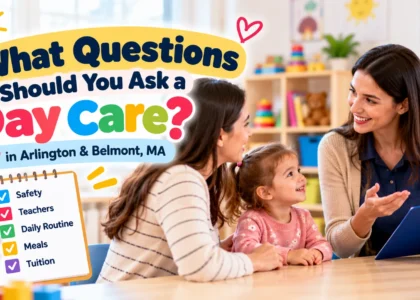
Questions to Ask During a Preschool Tour in Arlington, MA
Take this list with you.
About Teachers
- What qualifications do teachers have?
- How long have teachers worked here?
- What is teacher turnover like?
- How are substitute teachers handled?
About Children
- What age groups are served?
- How many children are in each classroom?
- How are developmental differences supported?
- How are conflicts handled?
About Curriculum
- What does a typical day look like?
- How much time is spent playing?
- What early literacy activities are offered?
- What early math experiences are provided?
- How much outdoor time is offered?
About Families
- How do teachers communicate with parents?
- Are conferences offered?
- How are developmental concerns discussed?
About Health and Safety
- What are the illness policies?
- How are allergies handled?
- What emergency procedures are in place?
- How is pickup authorized?
About Practical Details
- What are the hours?
- What is the tuition?
- Are there registration fees?
- Are meals or snacks provided?
- What supplies must parents provide?
Red Flags Parents Should Investigate
No single observation proves that a program is unsuitable, but parents may want additional information when they notice:
- unclear supervision
- unwillingness to answer safety questions
- lack of communication
- consistently chaotic transitions
- little opportunity for active play
- limited age-appropriate materials
- dismissive responses to parent concerns
- unclear licensing information
- unclear policies
- frequent unexplained staff changes
Always ask questions and verify information before making conclusions.
Positive Signs to Look For
Parents may appreciate programs where:
- teachers speak respectfully to children
- children have opportunities to explore
- classrooms contain age-appropriate materials
- children can make choices
- teachers know individual children
- routines are predictable
- families receive communication
- learning includes play and interaction
- teachers support independence
- children’s interests are incorporated
Massachusetts identifies warm, supportive interactions and safe opportunities for play and exploration as characteristics of high-quality learning environments.
How Parents Can Support Learning After Preschool
Preschool preparation should not stop after the first day.
At home:
Read
Read together every day.
Talk
Ask your child about experiences.
Play
Give your child time for unstructured play.
Explore
Go outside and investigate the environment.
Count
Use ordinary objects for mathematics.
Create
Draw, paint, build, cut, and construct.
Encourage
Praise effort and persistence.
Listen
Allow your child to explain ideas.
Building a Strong Home-to-School Connection
Children benefit when parents and educators communicate.
Share useful information with teachers about:
- interests
- routines
- comfort strategies
- language
- food preferences
- allergies
- sleep
- bathroom development
- sensory preferences
- social behaviors
- family routines
The goal is collaboration.
Massachusetts’ early-learning guidance emphasizes family partnerships as an important part of high-quality early education.
Preschool Preparation for Multilingual Families
Families who speak more than one language should continue using their home language.
A child’s home language is part of their identity and family connection.
Parents can:
- read in the home language
- tell stories
- sing songs
- talk about emotions
- share cultural traditions
- tell teachers about languages spoken at home
When evaluating a preschool, ask how the program supports children’s cultures and languages.
Massachusetts curriculum guidance specifically emphasizes responsiveness to children’s varied interests, skill levels, cultures, and languages.
Preparing Children With Developmental Differences
Every child develops differently.
If you have concerns about:
- speech
- communication
- movement
- behavior
- social interaction
- sensory processing
- learning
- hearing
- vision
- independence
talk with the appropriate professional and the preschool.
Do not wait until the first day to communicate important needs.
For Arlington and Belmont families, public-school preschool systems may also have specific processes for screening and services.
For example, Belmont Public Schools states that it conducts preschool screenings for Belmont children ages 3–5 and provides services based on individual needs.
How Early Should You Start Looking for Preschool in Arlington, MA?
Start earlier than you think.
The exact timeline depends on the program.
Some programs may have:
- application deadlines
- lotteries
- waiting lists
- enrollment periods
- age cutoffs
- required documents
- tours
- interviews
- registration windows
Therefore, parents should research programs well before the intended start date.
Do not assume that every preschool follows the same admissions calendar.
What Documents Might Families Need?
Requirements vary, but parents may be asked for information such as:
- child identification information
- parent/guardian information
- emergency contacts
- health information
- immunization records
- enrollment forms
- authorized pickup information
- residency information
- developmental information
Public programs can have additional eligibility and residency requirements.
Arlington Public Schools states that its student registration process is completed online and provides enrollment guidance through its registration system.
Always confirm the current requirements directly with the program.
How to Make Preschool Feel Exciting Without Creating Pressure
There is a difference between positive anticipation and pressure.
Instead of:
“You need to be a big kid now.”
Try:
“You’re going to have new things to explore.”
Instead of:
“You have to make lots of friends.”
Try:
“You’ll have opportunities to meet other children.”
Instead of:
“You can’t cry.”
Try:
“It’s okay to miss me. Your teachers can help you.”
This language gives children permission to have feelings while reinforcing confidence.
10 Things Your Child Does NOT Need to Master Before Preschool
Your child does not necessarily need to:
- Read independently.
- Write their name perfectly.
- Count to 100.
- Sit still for long periods.
- Never cry.
- Share perfectly every time.
- Dress completely independently.
- Never make mistakes.
- Know every letter.
- Be socially confident in every situation.
Preschool is an environment for learning and development.
The goal is not to arrive “finished.”
10 Things Your Child Can Practice Before Preschool
Instead, focus on:
- Asking for help.
- Communicating basic needs.
- Listening to simple instructions.
- Taking turns.
- Cleaning up.
- Washing hands.
- Eating with increasing independence.
- Separating from caregivers gradually.
- Exploring new activities.
- Recovering after frustration.
These practical skills can make everyday preschool experiences easier.
How to Choose Between Preschool and Daycare
Preschool and daycare can overlap, but they are not always identical.
A daycare program may prioritize longer hours and broader child-care coverage.
A preschool may emphasize a structured early-learning program.
Some programs combine both.
When comparing them, ask:
- What ages are served?
- What hours are offered?
- What is the daily schedule?
- What curriculum is used?
- How much play time is included?
- What happens before and after the preschool day?
- How does the program handle transitions?
- What are the teacher-child ratios?
- What are the enrollment requirements?
Choose based on your family’s actual needs and your child’s developmental needs.
Why Local Convenience Matters
For families searching for Preschool in Arlington, MA, location can have a meaningful practical impact.
Consider:
- commute to work
- commute from home
- traffic
- pickup flexibility
- emergency pickup
- siblings’ schedules
- public transportation
- walking distance
- parking
- weather conditions
A program that works well with your family’s daily routine may reduce stress.
Families near Belmont can also compare nearby Arlington and Belmont programs based on actual travel time rather than city name alone.
Local SEO Section: Preschool in Arlington, MA and Nearby Belmont
If you are researching Preschool in Arlington, MA, you may also search for:
- preschool near me in Arlington MA
- preschool programs Arlington MA
- preschool near Arlington Heights
- early education Arlington MA
- daycare and preschool Arlington MA
- preschool near Belmont MA
- preschool Belmont MA
- early childhood education Belmont MA
- pre-K near Belmont MA
- preschool programs near Arlington and Belmont
- toddler preschool Arlington MA
- early learning center Arlington MA
Search results can change over time, so parents should verify current program information directly.
Massachusetts provides official resources for locating licensed child-care programs geographically, making the state’s EEC resources a useful starting point for families researching programs.
Frequently Asked Questions About Preschool in Arlington, MA
1. What age should a child start preschool in Arlington, MA?
There is no single age that applies to every preschool. Eligibility depends on the program’s age requirements and enrollment policies. Parents should verify the current cutoff date directly with the preschool.
2. How can I prepare my child for preschool?
Focus on emotional, social, communication, and independence skills. Practice routines such as getting dressed, washing hands, cleaning up, listening, taking turns, and asking for help.
3. Does my child need to know the alphabet before preschool?
No. Children can develop early literacy skills through books, conversation, songs, drawing, storytelling, and age-appropriate classroom activities.
4. Does my child need to be potty trained?
Requirements vary by preschool. Ask the program about its current toileting policy before enrollment.
5. How can I reduce preschool separation anxiety?
Practice short separations, establish a predictable goodbye routine, speak positively about preschool, and keep drop-offs calm and consistent.
6. What should I look for in a preschool in Arlington, MA?
Look at safety, teacher-child interactions, curriculum, play opportunities, communication, classroom environment, schedule, licensing, policies, and how well the program fits your child and family.
7. Is preschool the same as daycare?
Not always. Some programs primarily provide early education, while others combine preschool education with longer-day child care. Program structures vary.
8. Should I choose a preschool near Arlington or Belmont?
Consider your child’s needs, commute, schedule, eligibility, curriculum, environment, cost, and family logistics rather than choosing based solely on location.
9. What does Massachusetts recommend for preschool learning?
Massachusetts provides preschool learning guidelines and standards covering developmentally appropriate learning, language, social-emotional development, approaches to play and learning, mathematics, literacy, and other developmental areas.
10. Is play important in preschool?
Yes. Massachusetts guidance emphasizes hands-on, developmentally appropriate, play-based and interactive learning experiences.
11. How do I know if a preschool is licensed?
Use the Massachusetts Department of Early Education and Care’s official child-care search resources and verify the current licensing information with the program.
12. What should I bring on the first day of preschool?
Requirements vary. Common items may include a labeled backpack, spare clothing, appropriate outdoor clothing, and other supplies requested by the preschool.
13. What if my child is shy?
Give your child time to observe and become comfortable. Avoid forcing immediate participation. Communicate with teachers about strategies that help your child feel secure.
14. What if my child cries every morning?
Some separation distress can be normal during a transition. Talk with teachers about how your child settles after drop-off. If distress remains persistent or concerning, discuss it with the teaching team and appropriate professionals.
15. How can I help my child make friends?
Practice turn-taking, cooperative play, greetings, listening, and simple communication. Give your child opportunities to play with peers before preschool.
16. Should I teach writing before preschool?
You can encourage drawing, scribbling, coloring, and fine-motor activities, but avoid making early writing a high-pressure requirement.
17. How can I prepare my child for a preschool routine?
Create consistent wake-up, breakfast, dressing, bathroom, departure, and bedtime routines before school begins.
18. What questions should I ask during a preschool tour?
Ask about curriculum, teachers, safety, daily schedules, meals, toileting, outdoor play, communication, licensing, tuition, enrollment, and how developmental differences are supported.
19. Are there preschool options in Belmont, MA?
Yes. Belmont Public Schools operates an Integrated Preschool Program for eligible children ages 3–5, with specific eligibility and enrollment requirements.
20. Does Arlington have a public preschool program?
Arlington Public Schools identifies an integrated preschool as part of its school system. Families should check the current APS preschool registration information and eligibility requirements.
21. What if my child has developmental concerns?
Speak with your pediatrician, the preschool, and relevant early-childhood professionals. Public-school systems may have screening and special-education processes for eligible children.
22. How important is the teacher-child relationship?
Very important. Massachusetts early-learning guidance places substantial emphasis on relationships and interactions in early childhood programs.
23. Should preschool learning involve worksheets?
Preschool learning does not need to rely primarily on worksheets. High-quality early education can include play, exploration, conversation, movement, hands-on activities, and developmentally appropriate learning experiences.
24. How can parents support preschool learning at home?
Read together, talk, play, explore, count everyday objects, encourage independence, discuss emotions, and allow children to solve age-appropriate problems.
25. When should parents start searching for preschool?
Start early enough to understand each program’s application, tour, enrollment, age, and deadline requirements. Some programs may have limited spaces or specific registration periods.
Final Preschool Readiness Checklist
Before your child’s first day, make sure you have:
Child Preparation
- Practiced separation
- Practiced goodbye routine
- Practiced hand washing
- Practiced simple directions
- Practiced asking for help
- Practiced cleaning up
- Practiced basic dressing
- Practiced eating
- Talked about preschool
- Read books about starting school
Family Preparation
- Completed enrollment paperwork
- Confirmed start date
- Confirmed school hours
- Confirmed pickup procedure
- Confirmed supplies
- Labeled belongings
- Reviewed health policies
- Reviewed emergency contacts
- Saved teacher/program contact information
Conclusion: Helping Your Child Start Preschool With Confidence
Preparing your child for Preschool in Arlington, MA is not about making your child academically advanced before the first day.
It is about building confidence.
The most useful preparation often happens through ordinary family life:
- reading together
- talking
- playing
- exploring
- counting
- drawing
- practicing independence
- taking turns
- naming emotions
- following routines
- trying again after mistakes
Massachusetts’ early-learning guidance supports developmentally appropriate, active, play-based and family-connected learning.
For Arlington families, the process should also include researching local preschool options, understanding eligibility and registration requirements, verifying licensing information where applicable, visiting programs, and choosing an environment that fits the child and family’s needs.
Families in or near Belmont, MA can use the same approach while also checking Belmont-specific eligibility, program models, and enrollment information. Belmont Public Schools, for example, publishes specific information about its integrated preschool program for children ages 3–5.
Most importantly, remember that preschool is not a final exam.
Your child does not need to know everything before entering the classroom.
Preschool is where children continue to learn, play, communicate, explore, build friendships, develop independence, and grow.
The goal of preparation is simply to help your child walk through the classroom door feeling: