

Summary
Finding the best day care in Arlington, MA is about much more than finding a convenient location or reading a few online reviews.
Parents need to consider a combination of factors including safety, licensing, caregiver qualifications, adult-to-child ratios, daily routines, learning opportunities, outdoor play, communication, meals, rest, developmental support, family policies, schedule, location, availability, and cost.
Massachusetts’ Department of Early Education and Care (EEC) provides an official geographic search system for licensed child-care programs. EEC also explains that choosing child care is a personal decision and that families should consider the child’s temperament, interests, health, behavior, family philosophy, schedule, and whether the environment is safe, educational, nurturing, and enjoyable.
For Arlington families, there is another important consideration: the best day care is not necessarily the highest-rated program online.
A program that works extremely well for one family may not be the right fit for another.
For example:
- An infant may need responsive and consistent caregiving.
- A toddler may need movement, exploration, and predictable routines.
- A preschooler may benefit from increasingly intentional early-learning experiences.
- A working family may prioritize longer hours.
- Another family may prioritize a smaller setting.
- Some families may prefer a center-based program.
- Others may prefer licensed family child care.
Massachusetts recognizes several types of early education and care, including licensed family child care and group/center-based care. Family child care is provided in a provider’s home, while group and school-age programs generally operate in non-residential settings.
This guide explains what parents should look for when searching for the best day care in Arlington, MA, how to compare different programs, what questions to ask before enrollment, and how families near Belmont, MA can evaluate child-care options.
Introduction: Finding the Best Day Care in Arlington, MA
Choosing day care is one of the most important decisions many parents make during their child’s early years.
The right child-care environment becomes part of a child’s daily life.
Children may spend many hours each week with their caregivers. During that time, they are not simply being supervised. They are developing relationships, communicating, exploring their surroundings, playing, learning routines, building independence, and interacting with other children.
That is why searching for the best day care in Arlington should involve more than typing a keyword into Google and selecting the first result.
Parents should investigate what happens inside the classroom.
What is the daily routine?
How do teachers respond when children cry?
How are infants comforted?
How much time do children spend outside?
How do educators support language development?
How does the program handle challenging behavior?
How are families kept informed?
What happens when a child has an allergy?
How does the center handle illness?
What are the enrollment requirements?
What happens during emergencies?
These practical questions can tell parents much more about a program than marketing language.
Massachusetts EEC’s quality framework emphasizes areas such as adult-child interactions, curriculum and assessment, physical environment, family and community partnership, leadership/professional learning, and business practices. EEC describes high-quality learning and care environments as places with warm, supportive interactions, safe opportunities for play and exploration, developmentally appropriate curriculum, and meaningful family partnerships.
Therefore, the goal of this guide is not simply to identify a generic “number one” daycare.
Instead, it explains how Arlington parents can identify a high-quality child-care program that is the right fit for their family.
What Does “Best Day Care in Arlington” Actually Mean?
When parents search for best day care in Arlington, they may mean different things.
For one family, “best” could mean:
- Closest to home
- Open early
- Open late
- Infant care available
- Full-day care
- Affordable tuition
- Small groups
- Experienced teachers
- Strong communication
- Outdoor play
- Play-based learning
Another family may prioritize:
- A bilingual environment
- Montessori-inspired learning
- Strong preschool preparation
- Flexible scheduling
- Family child care
- A specific location
- A particular educational philosophy
Therefore, there is no universal definition of the “best” day care.
The better question is:
Which day care in Arlington best matches your child’s developmental needs and your family’s priorities?
That question leads to a much more useful evaluation.
Why Arlington Families Have Different Child-Care Needs
Arlington is home to families with different schedules, household arrangements, work locations, transportation needs, and children’s ages.
A family with a newborn has different requirements from a family with a four-year-old.
Likewise, a parent working from home may have different scheduling requirements from a parent commuting to Boston.
Some families need:
- Five-day care
- Full-day care
- Infant care
- Toddler care
- Preschool care
- Early drop-off
- Later pickup
- Summer care
Others may only need:
- Part-time care
- Morning programs
- Preschool
- Occasional care
- Family child care
This is why the first step is to identify your family’s requirements before comparing providers.
Types of Day Care Available to Arlington Families
Parents searching for daycare in Arlington MA may encounter several different types of programs.
1. Center-Based Child Care
Center-based programs generally operate in dedicated facilities rather than a provider’s home.
They may have:
- Multiple classrooms
- Different age groups
- Larger staffing teams
- Dedicated activity areas
- Outdoor play areas
- Administrative staff
A center may provide care for:
- Infants
- Toddlers
- Preschoolers
- Kindergarten-age children
- School-age children
The exact age range varies by provider.
2. Family Child Care
Family child care is provided in a provider’s residence.
Massachusetts EEC states that licensed family child-care providers may care for up to 10 children with an approved assistant, subject to applicable requirements.
Family child care may appeal to parents who prefer:
- A smaller setting
- A home-like environment
- Mixed-age groups
- More intimate group sizes
- A family-style atmosphere
However, parents should evaluate licensing, safety, routines, policies, caregiver experience, and the provider’s ability to meet their child’s specific needs just as carefully as they would with a larger center.
3. Infant Day Care
Infant care requires specialized attention.
Babies need much more than toys and supervision.
A strong infant program should consider:
- Feeding schedules
- Sleep routines
- Diapering
- Safe sleep
- Individual temperament
- Developmental stages
- Tummy time
- Movement
- Language interaction
- Comforting
- Parent communication
Massachusetts’ Infant and Toddler Early Learning Guidelines emphasize relationships and interactions as central to infant and toddler development.
Parents should therefore pay close attention to how caregivers interact with babies.
Do they respond promptly?
Do they talk to infants?
Do they make eye contact?
Do they recognize individual cues?
Do they provide appropriate opportunities for movement and exploration?
These details matter.
4. Toddler Day Care
Toddlers are in a unique developmental stage.
They want independence but still need substantial adult support.
A strong toddler environment can provide:
- Safe movement
- Exploration
- Language development
- Music
- Stories
- Pretend play
- Sensory activities
- Simple choices
- Social interaction
- Predictable routines
- Positive boundaries
Toddlers often learn by repeating experiences.
A high-quality program should give children opportunities to explore safely while adults provide guidance and support.
5. Preschool Day Care
Preschool-age children are developing increasingly complex:
- Language
- Social skills
- Problem-solving
- Self-regulation
- Independence
- Early literacy
- Early mathematics
- Creativity
Massachusetts preschool guidance emphasizes that young children learn by doing, developmental domains are interconnected, children develop at different rates, and families are primary caregivers and educators.
Therefore, preschool learning does not have to look like elementary school.
Learning may happen through:
- Blocks
- Stories
- Art
- Music
- Outdoor play
- Dramatic play
- Puzzles
- Science exploration
- Conversations
- Group activities
What Makes a High-Quality Day Care in Arlington?
Massachusetts EEC identifies several dimensions that parents can use as a useful framework for evaluating quality.
These include:
- Adult-child interactions
- Curriculum and assessment
- Physical environment
- Family engagement
- Leadership and professional learning
- Business practices
Let’s examine each one.
1. Warm and Responsive Caregivers
One of the most important things parents should observe is how educators interact with children.
Do teachers:
- Smile at children?
- Speak respectfully?
- Listen?
- Get down to the child’s level?
- Respond to emotions?
- Encourage exploration?
- Ask questions?
- Comfort upset children?
Massachusetts’ infant and toddler guidelines specifically emphasize responsive, nurturing, attentive, consistent, predictable, and culturally sensitive care.
For infants and toddlers, relationships are especially important.
2. Consistent Caregivers
Young children often benefit from predictable relationships.
Ask:
- How frequently do caregivers change?
- Are children assigned primary caregivers?
- How are staff absences handled?
- What is the staff turnover like?
- How are transitions managed?
You do not necessarily need a program with zero staff changes, but you should understand how continuity of care is maintained.
3. Appropriate Adult-to-Child Ratios
Ask exactly:
“How many children are in each classroom, and how many educators are present?”
Then ask:
“What happens if a teacher is absent?”
The number of children per adult affects how much individual attention educators can provide.
For infants and toddlers especially, individual attention can be important because daily routines such as feeding, diapering, comforting, and sleeping require close supervision.
4. Safe Physical Environment
Look carefully at the classroom.
Ask yourself:
- Is the space clean?
- Is furniture age appropriate?
- Are toys accessible?
- Are hazardous materials secured?
- Is there enough room to move?
- Is the environment organized?
- Are bathrooms and changing areas appropriate?
- Is outdoor space secure?
Massachusetts EEC identifies the physical environment as an important quality domain and describes strong environments as safe, accessible, thoughtfully arranged, and supportive of exploration and engagement.
5. Developmentally Appropriate Curriculum
A daycare does not need to look like an elementary classroom to provide meaningful learning.
For infants, learning may include:
- Talking
- Singing
- Reading
- Movement
- Sensory exploration
- Social interaction
For toddlers:
- Matching
- Sorting
- Blocks
- Pretend play
- Songs
- Stories
- Art
For preschoolers:
- Early literacy
- Early mathematics
- Science
- Art
- Dramatic play
- Problem-solving
- Group discussions
Massachusetts’ curriculum guidance emphasizes developmentally appropriate learning and recognizes that young children learn through active experiences.
6. Learning Through Play
Parents sometimes assume that “learning” means worksheets.
For young children, that is not necessarily true.
Consider a child building a tower.
The child may be learning:
- Balance
- Size
- Shape
- Cause and effect
- Spatial reasoning
- Persistence
- Problem-solving
If another child joins, the experience can additionally involve:
- Sharing
- Communication
- Cooperation
- Negotiation
That is why play is an important part of high-quality early childhood environments.
Massachusetts EEC describes developmentally appropriate curriculum as being grounded in play and active experiences.
7. Language-Rich Interactions
Listen to the classroom.
Are adults talking with children?
Do teachers:
- Read books?
- Sing songs?
- Ask open-ended questions?
- Describe activities?
- Expand children’s vocabulary?
- Encourage children to tell stories?
- Listen carefully?
Massachusetts preschool guidance identifies language development as particularly important and emphasizes the role of language in children’s learning.
8. Social-Emotional Development
A child-care program should support more than academic development.
Children also need to learn how to:
- Express feelings
- Ask for help
- Cooperate
- Wait
- Take turns
- Solve conflicts
- Build friendships
- Handle frustration
- Follow routines
- Develop independence
Ask providers how they handle difficult behavior.
Avoid focusing only on whether they use a particular label such as “discipline.”
Ask:
“What happens when a child is upset or repeatedly struggling with a classroom expectation?”
The answer can reveal the program’s philosophy.
9. Outdoor Play and Physical Activity
Young children need opportunities to move.
Ask about:
- Outdoor play
- Gross motor activities
- Indoor movement
- Playground access
- Weather policies
- Nature exploration
A good daily routine should not require children to remain seated for long periods.
10. Meals and Snacks
If your child will spend much of the day at the program, food policies are important.
Ask:
- Are meals provided?
- Are snacks included?
- Can parents send food?
- How are allergies handled?
- How is food stored?
- How are infant feeding schedules managed?
- What happens when a child has dietary restrictions?
Get specific answers rather than making assumptions.
11. Nap and Rest
Ask:
- When do children nap?
- Is rest mandatory?
- What happens when a child doesn’t sleep?
- How are infant sleep routines handled?
- What safe-sleep procedures are followed?
- How are sleeping children supervised?
For infants, safe sleep should be discussed directly with the provider.
12. Parent Communication
A high-quality relationship between parents and educators is important.
Massachusetts EEC includes family and community partnership among its program-quality areas and describes quality family engagement as involving regular communication, collaboration, respect, and responsiveness to families’ needs.
Ask how the program communicates.
It might use:
- Daily reports
- Parent apps
- Phone calls
- In-person conversations
- Parent conferences
- Developmental updates
The specific technology matters less than whether communication is clear and consistent.
How to Find a Licensed Day Care in Arlington, MA
One of the most important steps is verifying licensing.
Massachusetts EEC provides a geographic search tool for licensed child-care programs. Families can search by geographic area and program type. EEC also states that families can contact the department for information about a program’s license history, non-compliance findings, and current restrictions.
This is much more useful than relying solely on advertisements.
When researching a provider, verify:
- Program name
- Address
- Type of program
- License status
- Age range
- Current availability
- Applicable restrictions
- Operating schedule
Licensing is a starting point—not the only factor.
How to Research the Best Daycare in Arlington MA
Use a multi-step process.
Step 1: Define Your Needs
Write down:
- Child’s age
- Desired start date
- Required days
- Required hours
- Full-time or part-time
- Infant/toddler/preschool care
- Budget
- Transportation requirements
Step 2: Build a Shortlist
Look for programs that fit your basic requirements.
Search variations such as:
- Best day care in Arlington MA
- Daycare Arlington MA
- Child care Arlington MA
- Infant daycare Arlington MA
- Toddler daycare Arlington MA
- Preschool Arlington MA
- Daycare near Arlington Center
- Child care near Arlington Heights
- Day care near Belmont MA
Step 3: Verify Licensing
Use Massachusetts’ official EEC resources rather than relying exclusively on directory websites.
Step 4: Review the Program Website
Look for:
- Age groups
- Schedule
- Philosophy
- Curriculum
- Staff information
- Parent resources
- Policies
- Contact details
- Location
Step 5: Call the Program
Ask about:
- Availability
- Waitlist
- Tuition
- Hours
- Age eligibility
- Tours
- Enrollment requirements
Step 6: Visit
A tour is one of the most valuable steps.
Observe the environment.
Step 7: Compare
Don’t choose immediately after the first visit.
Create a comparison sheet.
Day Care Tour Checklist
Take this checklist with you.
Environment
- Clean
- Safe
- Organized
- Age appropriate
- Accessible toys
- Books
- Creative materials
- Outdoor area
Staff
- Warm
- Engaged
- Responsive
- Professional
- Communicative
Children
- Engaged
- Exploring
- Playing
- Interacting
- Comfortable
Program
- Clear routine
- Developmentally appropriate curriculum
- Outdoor activities
- Rest periods
- Meals/snacks
- Parent communication
Questions to Ask the Best Day Care in Arlington
Before enrollment, ask at least these questions.
About licensing
- Are you licensed by Massachusetts EEC?
- Can I review your license?
- How can I learn about your licensing history?
About staff
- What qualifications do teachers have?
- What training do staff receive?
- How long have teachers worked here?
- How do you handle staff absences?
About children
- What ages do you accept?
- How are children grouped?
- What are the classroom sizes?
- What are the adult-child ratios?
About learning
- What curriculum do you use?
- Is your program play-based?
- How do you support language development?
- How do you support social-emotional development?
- How do you support early literacy?
- How do you support early math?
About routines
- What does a typical day look like?
- When do children go outside?
- When do children eat?
- When do children rest?
About parents
- How do you communicate with families?
- Do you provide daily reports?
- How do you communicate incidents?
- How often are developmental updates provided?
About health and safety
- What is your illness policy?
- How do you manage allergies?
- What is your emergency procedure?
- How are medications handled?
- What are your pickup policies?
What Parents Should Observe During a Daycare Tour
Do not spend the entire tour listening to the administrator.
Watch the classroom.
Look at how teachers respond to children.
Observe the adults
Are they:
- Talking?
- Listening?
- Smiling?
- Helping?
- Comforting?
- Encouraging?
- Supervising?
Observe the children
Are they:
- Exploring?
- Playing?
- Communicating?
- Moving?
- Creating?
- Participating?
Observe the environment
Is it:
- Safe?
- Organized?
- Stimulating?
- Comfortable?
- Age appropriate?
Red Flags to Investigate Before Choosing Daycare
No single observation automatically proves that a program is poor, but certain situations deserve additional questions.
Examples include:
- Staff appear consistently disengaged
- Teachers cannot explain the daily schedule
- Policies are unclear
- Parents have difficulty obtaining basic information
- The classroom appears unsafe
- Children have limited opportunities for movement
- Staff cannot explain how individual needs are addressed
- Communication procedures are unclear
- Emergency procedures are vague
- The program cannot clearly explain its licensing status
Treat these as reasons to investigate further rather than automatically judging a program from one observation.
Positive Signs of a Strong Day Care
Parents may notice:
- Warm teacher-child interactions
- Children actively exploring
- Accessible learning materials
- Age-appropriate books
- Predictable routines
- Safe play spaces
- Outdoor opportunities
- Teachers who know children individually
- Clear parent communication
- Developmentally appropriate activities
These observations align with several of the quality areas identified by Massachusetts EEC.
Best Day Care in Arlington for Infants
Parents looking for infant daycare in Arlington MA should evaluate infant-specific care carefully.
Ask about:
Feeding
- Bottle procedures
- Breast milk storage
- Feeding schedules
- Introduction of solid foods
- Communication with parents
Sleep
- Safe sleep procedures
- Individual schedules
- Sleep monitoring
- Nap routines
Development
- Tummy time
- Floor play
- Movement
- Books
- Music
- Talking
- Sensory exploration
Relationships
- Primary caregivers
- Consistency
- Comforting
- Individual attention
Massachusetts infant-toddler guidance places substantial emphasis on responsive and consistent relationships.
Best Day Care in Arlington for Toddlers
Toddlers need an environment that balances independence and adult guidance.
Look for:
- Safe movement
- Outdoor play
- Language-rich interaction
- Simple choices
- Pretend play
- Sensory activities
- Books
- Music
- Art
- Social interaction
- Predictable routines
Ask how the program handles:
- Tantrums
- Biting
- Hitting
- Separation anxiety
- Toilet learning
- Sharing
- Transitions
Best Day Care in Arlington for Preschoolers
For preschoolers, evaluate:
- Curriculum
- Early literacy
- Early math
- Science
- Art
- Music
- Social-emotional learning
- Outdoor play
- Problem-solving
- Independence
- Kindergarten transition
Massachusetts’ preschool learning guidelines are designed to help educators plan and evaluate curriculum and emphasize active learning, individual differences, interconnected developmental domains, and family involvement.
Day Care vs. Preschool in Arlington, MA
These terms can overlap.
Day care
Usually emphasizes:
- Care
- Supervision
- Daily routines
- Meals
- Rest
- Play
- Development
Preschool
Generally places greater emphasis on:
- Early education
- Curriculum
- Language
- Early literacy
- Early math
- Social-emotional development
- Kindergarten preparation
However, a high-quality daycare may provide substantial educational experiences, while a preschool may also provide extended care.
Always evaluate the actual program rather than relying solely on its label.
Day Care vs. Family Child Care
Center-based care
Potential characteristics:
- Multiple classrooms
- Larger staffing team
- Dedicated facility
- Separate age groups
- Structured administrative system
Family child care
Potential characteristics:
- Home-based setting
- Smaller groups
- Mixed ages
- Family-style environment
Neither format is automatically the right choice for every child.
The important questions are:
Is the program licensed?
Is the environment safe?
Are caregivers responsive?
Does the program meet your child’s needs?
Does it fit your family schedule?
How Important Is Location?
Very important.
A daycare can be wonderful, but if the commute creates significant daily stress, that matters.
Consider:
- Distance from home
- Distance from work
- Traffic
- Parking
- Public transportation
- Drop-off
- Pickup
- Emergency pickup
- Backup caregivers
For families near the Arlington-Belmont area, it may be practical to compare programs in both communities.
Day Care in Arlington vs. Belmont
Families living close to the Arlington-Belmont area may reasonably search both locations.
Massachusetts’ child-care search system allows families to search by city/town, and both Arlington and Belmont are included in the geographic search interface.
The decision should therefore be based on the specific program and your actual commute.
Consider:
Arlington may be convenient if:
- Your home is in Arlington
- Your workplace is nearby
- Your child’s activities are in Arlington
- Your daily route passes through Arlington
Belmont may be convenient if:
- You live close to Belmont
- You work in Belmont
- Your commute naturally passes through Belmont
- Your family has support nearby
Preschool and Early Childhood Options in Belmont
Belmont has its own early childhood education options.
For example, Belmont Public Schools describes an integrated preschool program for children ages 3–5 that includes children requiring special education services and typically developing neighborhood peers. The program states that its curriculum is aligned with Massachusetts early childhood learning standards and includes language-rich activities supporting communication, social, emotional, cognitive, and motor development.
That is one example of why parents should investigate individual programs rather than assuming every preschool or daycare has the same structure.
Eligibility, hours, tuition, services, and enrollment rules can differ.
How Much Does Day Care Cost in Arlington?
Child-care pricing can vary considerably.
Tuition can depend on:
- Child’s age
- Infant vs. toddler vs. preschool
- Full-time vs. part-time
- Program type
- Hours
- Meals
- Extended care
- Enrollment fees
- Location
- Additional services
Because prices and availability change, parents should request current tuition directly from each provider rather than relying on outdated online articles.
Massachusetts also provides resources for families seeking child-care financial assistance.
How to Compare Daycare Prices
Don’t compare only the monthly number.
Create a true cost comparison.
| Cost Factor | Program A | Program B | Program C |
|---|---|---|---|
| Tuition | |||
| Registration fee | |||
| Meals | |||
| Extended hours | |||
| Summer care | |||
| Supplies | |||
| Late pickup fees | |||
| Other fees |
Then compare the total annual cost.
Day Care Availability and Waitlists
Parents should begin researching early.
Popular child-care programs may have limited enrollment.
Ask:
- Is there currently an opening?
- Is there a waitlist?
- How long is the expected wait?
- Is there a registration fee?
- Is a deposit required?
- Does joining the waitlist guarantee enrollment?
- When should families apply?
Do not assume that an online listing means an immediate opening exists.
Full-Day Day Care in Arlington
Full-day care may be important for working families.
Ask for the exact:
- Opening time
- Closing time
- Drop-off policy
- Pickup policy
- Late pickup fee
- Holiday schedule
- Vacation schedule
- Professional-development closures
- Weather closures
A program’s published hours may not be the same as its permitted drop-off and pickup windows.
Part-Time Day Care
Part-time care may work well for families who:
- Work flexible schedules
- Have a parent at home part of the week
- Need care only certain days
- Want preschool plus additional family time
Ask whether part-time enrollment is available.
Some programs may have minimum enrollment requirements.
How Day Care Supports Child Development
High-quality early education can support multiple developmental areas.
Cognitive development
Children learn through:
- Exploration
- Problem-solving
- Building
- Sorting
- Matching
- Experimenting
Language development
Children develop through:
- Conversation
- Reading
- Songs
- Storytelling
- Questions
Physical development
Children develop through:
- Running
- Climbing
- Dancing
- Manipulating objects
- Drawing
- Building
Social development
Children learn:
- Cooperation
- Turn-taking
- Communication
- Conflict resolution
Emotional development
Children develop:
- Self-awareness
- Emotional expression
- Self-regulation
- Confidence
- Relationships
Early Literacy in Day Care
Parents should look for a language-rich environment.
Activities may include:
- Reading aloud
- Storytelling
- Rhymes
- Songs
- Picture discussions
- Pretend writing
- Name recognition
- Conversation
Massachusetts’ preschool guidance identifies language development as a major part of children’s learning and emphasizes developmentally appropriate experiences.
Early Math in Day Care
Young children can develop mathematical thinking through everyday activities.
Examples:
- Counting blocks
- Sorting toys
- Comparing sizes
- Identifying shapes
- Building patterns
- Measuring water
- Matching objects
- Playing board games
Parents should ask how mathematics is integrated into everyday play.
Science and Exploration
Daycare can also encourage early scientific thinking.
Children may:
- Observe plants
- Explore water
- Investigate shadows
- Examine insects
- Build structures
- Mix materials
- Observe weather
- Ask questions
The goal at a young age is often curiosity and exploration rather than memorizing scientific facts.
Art and Creativity
Creative activities can include:
- Drawing
- Painting
- Clay
- Collage
- Music
- Dance
- Dramatic play
Ask whether children are allowed to make choices or whether every child is expected to produce the same final project.
Cultural and Linguistic Responsiveness
Families may speak different languages and have different cultural traditions.
Parents can ask:
- Are home languages respected?
- Are books representative of different families?
- Are cultural differences respected?
- How does the program communicate with multilingual families?
Massachusetts EEC’s quality guidance specifically includes respect for linguistic and cultural differences as part of strong adult-child interactions and curriculum.
Supporting Children With Different Temperaments
Children are different.
Some children:
- Warm up quickly
- Need time to observe
- Love groups
- Prefer small groups
- Need lots of movement
- Are sensitive to noise
- Are highly verbal
- Are quieter
A good program should have strategies for supporting individual differences.
Massachusetts preschool guidance explicitly recognizes that children show individual differences in development.
Supporting Children With Additional Developmental Needs
Ask:
- How does the program identify concerns?
- How are parents contacted?
- What adaptations are available?
- How does the program work with specialists?
- How does it communicate developmental observations?
Massachusetts provides Early Intervention and other early-childhood resources for families.
Parent Communication: What Good Communication Looks Like
Parents should know what happened during the day.
Depending on age, this might include:
- Meals
- Nap
- Diapering
- Activities
- Mood
- Incidents
- Developmental observations
For older children, communication may focus more on:
- Learning
- Social interactions
- Projects
- Skills
- Areas needing support
How to Prepare Your Child for Day Care
Starting daycare is a major transition.
Before the first day:
Establish routines
Try to maintain consistent:
- Wake time
- Meals
- Nap
- Bedtime
Talk positively about the program
Explain what will happen.
Practice short separations
If appropriate, allow your child to spend brief periods with trusted caregivers.
Label belongings
Label:
- Clothing
- Bottles
- Lunch containers
- Comfort items
Communicate routines to caregivers
Share important information about:
- Sleep
- Food
- Comfort
- Allergies
- Favorite activities
- Communication preferences
Separation Anxiety at Day Care
Some children cry during drop-off.
This can happen even when they eventually enjoy the program.
Ask teachers how they handle separation.
Look for:
- Calm transitions
- Consistent routines
- Comfort
- Parent communication
- Predictability
Avoid making the goodbye unnecessarily long.
What Should Parents Bring?
The exact list depends on the provider.
Potential items include:
- Extra clothes
- Diapers
- Wipes
- Bottles
- Formula or breast milk
- Comfort item
- Outdoor clothing
- Sunscreen where permitted
- Weather-appropriate clothing
Always follow the provider’s written requirements.
Day Care Safety Questions
Ask:
- How are visitors controlled?
- Who can pick up a child?
- How is identification verified?
- What is the emergency plan?
- How are injuries documented?
- How are medications managed?
- What is the illness policy?
- How are allergies handled?
- What are the evacuation procedures?
- How are outdoor areas secured?
What Should Parents Know About Illness Policies?
Children get sick.
Before enrollment, ask:
- When must children stay home?
- What symptoms require pickup?
- When can children return?
- How are contagious illnesses communicated?
- How are medications handled?
This can prevent surprises later.
Best Day Care in Arlington: A Parent Comparison Table
| Factor | Why It Matters |
|---|---|
| Licensing | Establishes regulatory oversight |
| Staff | Caregivers directly affect daily experience |
| Ratios | Influences individual attention |
| Environment | Supports safety and exploration |
| Curriculum | Supports development |
| Play | Provides active learning opportunities |
| Outdoor time | Supports movement and exploration |
| Communication | Keeps families informed |
| Meals | Important for full-day care |
| Rest | Supports children’s daily needs |
| Location | Affects daily practicality |
| Schedule | Must match family needs |
| Cost | Must fit household budget |
| Availability | Determines whether enrollment is possible |
| Philosophy | Should fit family preferences |
| Child’s response | Provides useful information during visits |
30 Questions to Ask Before Choosing Daycare
- Is the program licensed?
- What ages do you accept?
- What are your hours?
- What is the tuition?
- Are there registration fees?
- Do you have a waitlist?
- What are the classroom sizes?
- What are the adult-child ratios?
- What qualifications do teachers have?
- How long have teachers worked here?
- How do you handle staff absences?
- What curriculum do you use?
- How much free play is included?
- How much outdoor time is provided?
- What is the daily schedule?
- How are meals handled?
- How are allergies managed?
- What are your nap policies?
- What is your illness policy?
- What happens during emergencies?
- How do you communicate with parents?
- How do you report incidents?
- How do you handle challenging behavior?
- How do you support shy children?
- How do you support children with additional needs?
- Do you provide developmental updates?
- What is your holiday calendar?
- What happens if parents are late?
- What is the withdrawal policy?
- What does the enrollment process involve?
20-Point Day Care Evaluation Checklist
Parents can create their own evaluation.
Give each category a rating from 1–5 for personal comparison.
Important: This is a decision-making worksheet for families, not an objective ranking of Arlington providers.
| Category | Your Assessment |
|---|---|
| Safety | |
| Licensing information | |
| Staff interaction | |
| Teacher experience | |
| Ratios | |
| Curriculum | |
| Play | |
| Outdoor time | |
| Environment | |
| Cleanliness | |
| Communication | |
| Meals | |
| Rest | |
| Schedule | |
| Location | |
| Cost | |
| Availability | |
| Family philosophy | |
| Child’s reaction | |
| Overall fit |
How to Choose Between Two Good Daycares
Sometimes parents find two programs that both appear suitable.
In that situation, compare the practical details.
Ask:
Which one:
- Has the schedule you actually need?
- Is easier to reach?
- Has the right age group?
- Provides the communication you prefer?
- Fits your budget?
- Matches your educational philosophy?
- Has an environment where your child appears comfortable?
Do not let a single online rating make the entire decision.
Should Online Reviews Matter?
Reviews can be useful.
They can reveal recurring themes about:
- Communication
- Scheduling
- Parent experience
- Staff interactions
- Administrative responsiveness
But reviews should not be treated as a complete quality assessment.
A review is an individual experience.
Parents should combine:
- Official licensing information
- Direct communication
- A tour
- Program policies
- Current availability
- Their own observations
Why You Should Visit Before Enrolling
Photos can look beautiful.
A website can sound impressive.
But a visit allows parents to see:
- Teacher interactions
- Classroom atmosphere
- Children’s engagement
- Noise level
- Cleanliness
- Materials
- Routines
- Outdoor space
Whenever possible, visit before making a final decision.
Arlington Day Care and Working Parents
For working parents, scheduling is often one of the most important factors.
Ask:
- What time does care begin?
- What time does care end?
- Is there a grace period?
- What happens during holidays?
- What happens during teacher training days?
- Is summer care available?
- What happens during weather closures?
A program that technically operates five days per week may still not meet your actual schedule.
Backup Care Planning
Even after selecting a daycare, families should think about backup arrangements.
Consider what happens if:
- Your child is sick
- The center closes
- A caregiver is unavailable
- You are delayed
- There is severe weather
- Your normal pickup person cannot come
Having a backup plan can make childcare transitions easier.
Arlington and Belmont Child-Care Search Strategy
If your family is flexible between Arlington and Belmont, create two shortlists.
Arlington shortlist
Research:
- Day care
- Infant care
- Toddler care
- Preschool
- Family child care
- Full-day programs
Belmont shortlist
Research:
- Day care
- Child care
- Preschool
- Family child care
- Early education programs
Then compare individual programs rather than comparing cities as if one entire community were better than another.
Why Belmont Families May Consider Arlington Day Care
Families near the Arlington-Belmont area may consider providers outside their immediate municipality because of:
- Work commute
- Home location
- School schedules
- Sibling schedules
- Transportation
- Family support
- Program availability
The important question is:
“Does the location fit our actual daily route?”
Why Arlington Families May Consider Belmont
The same logic works in reverse.
If a family lives in Arlington but works in Belmont or regularly travels through Belmont, a Belmont child-care provider may be practical.
Check:
- Eligibility
- Availability
- Schedule
- Tuition
- Travel time
- Enrollment policies
Local SEO Note for Parents
When searching Google, parents may use several variations:
- Best daycare in Arlington
- Best day care in Arlington MA
- Daycare Arlington MA
- Childcare Arlington MA
- Child care Arlington MA
- Day care near me
- Infant daycare Arlington
- Toddler daycare Arlington
- Preschool Arlington
- Daycare near Belmont
- Child care Belmont MA
These searches can have different intentions.
Someone searching “infant daycare Arlington MA” is likely looking for a program that accepts infants.
Someone searching “preschool Arlington MA” may be looking for early education.
Someone searching “best daycare Arlington” may be comparing providers.
A useful website should address these different search intents with separate, genuinely useful pages.
Recommended Arlington Child-Care Content Cluster
If you’re publishing this article for a childcare provider, build a complete topical cluster.
Main pillar
Best Day Care in Arlington, MA: Complete Guide for Parents
Supporting pages
Page 1
Day Care in Arlington, MA: Complete Parent’s Guide
Page 2
Infant Day Care in Arlington, MA: What Parents Need to Know
Page 3
Toddler Day Care in Arlington, MA: A Complete Guide
Page 4
Preschool in Arlington, MA: What Parents Should Look For
Page 5
Play School in Arlington, MA: Benefits of Play-Based Learning
Page 6
What Makes a High-Quality Preschool in Arlington, MA?
Page 7
How to Prepare Your Child for Preschool in Arlington, MA
Page 8
Day Care vs Preschool in Arlington, MA: What’s the Difference?
Page 9
Questions to Ask Before Choosing Day Care in Arlington, MA
Page 10
Infant Play School in Arlington, MA: What Parents Need to Know
This structure creates a stronger topical relationship than publishing dozens of nearly identical “best daycare” pages.
Belmont Content Cluster
For Belmont, create separate genuinely useful content.
Recommended pages include:
- Day Care in Belmont, MA
- Child Care in Belmont, MA
- Preschool in Belmont, MA
- Play School in Belmont, MA
- Infant Day Care in Belmont, MA
- Toddler Day Care in Belmont, MA
- Preschool Readiness in Belmont, MA
- Arlington vs. Belmont Child Care Guide
Do not simply duplicate Arlington content and replace the city name.
Internal Linking Strategy
This article should link naturally to relevant pages.
For example:
Best Day Care in Arlington, MA
→ Infant Day Care in Arlington
→ Toddler Day Care in Arlington
→ Preschool in Arlington
→ Play School in Arlington
→ Preschool Readiness
→ Child Care Questions
Then those pages should link back to this pillar article.
This creates a clear topical structure.
E-E-A-T for a Daycare Website
Local childcare websites should demonstrate genuine trust.
Include:
About page
Explain:
- Who operates the program
- Experience
- Philosophy
- Mission
- Educational approach
Staff page
Where appropriate, include:
- Educator names
- Roles
- Relevant qualifications
- Experience
Contact page
Include accurate:
- Phone
- Address
- Hours
Policies
Where appropriate:
- Enrollment
- Tuition
- Illness
- Pickup
- Safety
- Parent communication
Real photographs
Use authentic photographs of the actual facility and staff where permissions allow.
Avoid using stock photographs as if they depict the real classroom.
Local SEO Checklist for Arlington
For a genuine Arlington child-care provider, optimize:
- Google Business Profile
- Business name consistency
- Address consistency
- Phone consistency
- Website
- Local citations
- Local directories
- Reviews
- Location page
- Arlington-specific content
- Relevant backlinks
- Community relationships
- Local photos
- Contact information
Do not create fake addresses or fake local listings.
Google Business Profile Strategy
If this article belongs to a real local daycare, the Google Business Profile should accurately represent the business.
Keep information updated:
- Business name
- Address
- Phone
- Website
- Hours
- Holiday hours
- Services
- Photos
Encourage genuine families to leave honest reviews.
Do not buy reviews or manufacture testimonials.
Reviews and Reputation
Reviews can help prospective parents understand real customer experiences.
Ask genuine families for honest feedback.
Useful review topics may include:
- Communication
- Teacher relationships
- Child adjustment
- Classroom environment
- Scheduling
- Activities
Never instruct parents to post false experiences.
Image SEO
For the hero image, use an accurate filename such as:
best-day-care-arlington-ma.jpg
Possible alt text:
Best day care in Arlington, MA
Other images can use descriptive alt text such as:
day care classroom in Arlington MAtoddler daycare Arlington MAinfant childcare Arlington MApreschool children learning through playearly education classroom Arlington MA
Avoid using the exact same keyword as alt text on every image.
Recommended Featured Image
A horizontal banner can feature:
Best Day Care in Arlington, MA
with a warm, authentic classroom scene showing:
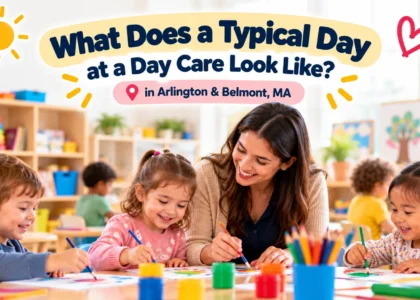
- Young children playing
- A caregiver interacting with children
- Learning materials
- Blocks
- Books
- Bright but calm classroom
- Natural lighting
Keep text on the image minimal.
SEO Title Options
Recommended
Best Day Care in Arlington, MA: Complete Parent’s Guide
Alternative
Best Daycare in Arlington, MA: How to Choose the Right Child Care
Alternative
Best Day Care in Arlington MA: What Parents Should Look For
Meta Description
Looking for the best day care in Arlington, MA? Learn how to compare licensed child care, staff, safety, curriculum, costs, schedules, and more for your child.
Recommended URL
/best-day-care-arlington-ma/
If the existing website structure requires “daycare” rather than “day-care,” select one spelling and keep URLs internally consistent.
Primary Keyword
best day care in Arlington
Secondary Keywords
- best day care in Arlington MA
- best daycare in Arlington MA
- day care Arlington MA
- daycare Arlington MA
- child care Arlington MA
- childcare Arlington MA
- daycare near Arlington MA
- child care near Arlington MA
- infant daycare Arlington MA
- toddler daycare Arlington MA
- preschool Arlington MA
- licensed daycare Arlington MA
- full day daycare Arlington MA
- family daycare Arlington MA
Belmont Keywords
- daycare Belmont MA
- day care Belmont MA
- child care Belmont MA
- childcare Belmont MA
- preschool Belmont MA
- daycare near Belmont MA
- child care near Belmont MA
Frequently Asked Questions About the Best Day Care in Arlington
1. What is the best day care in Arlington, MA?
The right day care depends on your child’s age, temperament, developmental needs, family schedule, location, budget, and educational preferences. Massachusetts EEC recommends evaluating whether a program fits the child and family’s needs rather than using a universal definition of the “best” program.
2. How do I find licensed daycare in Arlington, MA?
Use the Massachusetts Department of Early Education and Care’s geographic child-care search system to identify licensed programs and investigate applicable licensing information.
3. What should I look for in a daycare?
Look at licensing, staff qualifications, adult-child ratios, safety, classroom environment, curriculum, play, outdoor activities, communication, schedule, cost, and whether the program meets your child’s individual needs.
4. Is daycare educational?
It can be. High-quality early education and care can combine supervision with play, relationships, developmentally appropriate curriculum, language experiences, social-emotional learning, and exploration.
5. What is the difference between daycare and preschool?
Daycare often emphasizes regular care while supporting development, whereas preschool generally places more emphasis on early education. Many modern programs combine both.
6. Is play important in daycare?
Yes. Massachusetts EEC describes developmentally appropriate curriculum as grounded in play and active experiences.
7. What should I ask during a daycare tour?
Ask about licensing, ratios, staff qualifications, daily schedule, curriculum, outdoor play, meals, naps, safety, communication, tuition, illness policies, and enrollment.
8. How do I choose infant daycare in Arlington?
Look particularly at caregiver responsiveness, safe sleep, feeding procedures, individual routines, staff consistency, movement opportunities, language interaction, and parent communication.
9. How do I choose toddler daycare?
Look for a safe environment with movement, exploration, language, social interaction, predictable routines, play, and supportive approaches to behavior.
10. What makes a high-quality daycare?
Massachusetts EEC highlights areas including adult-child interactions, curriculum and assessment, physical environment, family engagement, leadership/professional learning, and business practices.
11. Should daycare have a curriculum?
A strong early-learning program should have intentional developmentally appropriate learning experiences. The curriculum does not need to resemble elementary school.
12. How important are daycare reviews?
Reviews can provide useful parent perspectives, but they should be combined with licensing information, direct communication, tours, policies, and your own observations.
13. Should I visit a daycare before enrolling?
Yes. A visit allows you to observe teacher-child interactions, classroom organization, children’s engagement, safety, and the overall environment.
14. What should I bring to daycare?
The provider determines its requirements. Common items can include extra clothes, diapers, wipes, bottles, food, outdoor clothing, and approved comfort items.
15. How can I help my child adjust to daycare?
Use predictable routines, prepare your child for the transition, communicate important routines to teachers, and establish a consistent drop-off process.
16. What if my child cries at drop-off?
Some children experience separation anxiety. Ask the program how educators support children through transitions and how they communicate with parents.
17. What is family child care?
Family child care is licensed child care provided in a provider’s home. Massachusetts EEC regulates family child-care programs.
18. Can I choose daycare in Belmont if I live in Arlington?
Potentially, depending on the provider’s enrollment policies and eligibility requirements. Families should compare commute, schedule, availability, tuition, and program fit.
19. Is Arlington daycare better than Belmont daycare?
There is no universal answer. Compare specific programs rather than entire communities. The right program depends on your child and family’s needs.
20. How much does daycare cost in Arlington?
Prices vary by provider, child age, schedule, program type, and included services. Contact individual providers for current tuition rather than relying on outdated estimates.
21. Does Massachusetts offer child-care financial assistance?
Massachusetts provides child-care financial assistance resources for eligible families.
22. What should I ask about daycare safety?
Ask about emergency procedures, authorized pickup, illness policies, medication, allergies, supervision, visitors, outdoor security, and incident reporting.
23. What should I look for in preschool daycare?
Look for developmentally appropriate curriculum, language-rich interactions, early literacy, early math, social-emotional development, creative activities, movement, and play.
24. Does daycare help with kindergarten readiness?
A strong early-learning environment can support communication, independence, social-emotional development, problem-solving, early literacy, and approaches to learning that are relevant to later schooling.
25. How early should I start looking for daycare?
Start as early as practical, particularly if you need infant care or have a specific start date. Ask providers about availability and waitlists.
26. What is the difference between center-based and family daycare?
Center-based programs generally operate in dedicated non-residential facilities, while family child care operates in a provider’s home. Massachusetts EEC recognizes both types of licensed care.
27. What should I look for in a toddler daycare?
Look for responsive caregivers, safe exploration, movement, language-rich interactions, social opportunities, predictable routines, and developmentally appropriate play.
28. What should I look for in infant care?
Look for responsive caregiving, safe sleep, feeding support, consistent routines, individual attention, safe movement, communication, and strong caregiver-child relationships.
29. How important is teacher-child interaction?
Very important. Massachusetts’ early learning guidance places strong emphasis on responsive relationships and interactions, especially for infants and toddlers.
30. What is the first step when choosing daycare in Arlington?
Start by identifying your child’s age, required schedule, budget, location requirements, and developmental needs. Then create a shortlist of licensed programs and schedule tours.
Conclusion: Choosing the Right Day Care in Arlington, MA
Finding the best day care in Arlington, MA is not about finding a universal number-one provider.
It is about finding a program that creates a strong match between:
Your child + your family + the program.
Start with licensing and basic requirements.
Then investigate:
- Safety
- Staff
- Adult-child ratios
- Relationships
- Curriculum
- Play
- Outdoor activities
- Meals
- Rest
- Communication
- Schedule
- Location
- Cost
- Availability
For infants, pay special attention to responsive caregiving, sleep, feeding, routines, and caregiver consistency.
For toddlers, look for opportunities for movement, language, exploration, social interaction, and independence.
For preschoolers, investigate curriculum, early literacy, early mathematics, social-emotional learning, problem-solving, creativity, and preparation for the next educational stage.
Massachusetts EEC’s quality framework provides a useful foundation by emphasizing adult-child interactions, curriculum and assessment, physical environment, family engagement, leadership/professional learning, and sustainable program practices.
Families near Belmont should also consider programs in both communities when that makes sense for their commute and family routine. Belmont’s public-school preschool system, for example, provides an integrated preschool option for eligible children ages 3–5, illustrating how early-childhood options can differ by program and eligibility.
Most importantly, visit programs whenever possible.
Watch how educators interact with children.
Ask difficult questions.
Review policies.
Check licensing information.
Consider your child’s personality.
And think about whether the program will realistically work for your family every day.
A strong daycare is not simply a place where children spend the day.
It is an environment where children can build relationships, explore, play, communicate, develop independence, and grow.
For parents searching for the best day care in Arlington, that is the standard worth evaluating.