
Summary
Choosing a preschool is one of the most important early-education decisions a family can make.
For parents searching for a Preschool in Arlington, MA, the challenge is not simply finding a program with an available seat. Families need to understand what actually makes an early-childhood program high quality.
A high-quality preschool is more than a colorful classroom, attractive website, convenient location, or long list of activities. It should provide a safe, welcoming, developmentally appropriate environment where children can build relationships, explore through play, communicate, develop independence, practice social-emotional skills, and develop early literacy, mathematics, motor, and problem-solving abilities.
Massachusetts’ official early-learning guidance identifies several important characteristics of quality. Its curriculum guidance emphasizes developmentally appropriate and evidence-based learning experiences, hands-on and open-ended materials, flexible play-based routines, responsiveness to children’s interests and cultures, multiple ways of engaging with learning, clear learning goals, appropriate assessment, and family partnerships.
Massachusetts also emphasizes that young children have individual developmental differences, learn by doing, and develop across interconnected domains. Families are recognized as primary caregivers and educators.
For Arlington families, evaluating preschool quality should therefore involve much more than asking whether children learn letters and numbers.
Parents should examine:
- Teacher-child relationships
- Teacher qualifications and stability
- Curriculum
- Play-based learning
- Social-emotional development
- Language and communication
- Early literacy
- Early mathematics
- Physical development
- Creativity
- Problem-solving
- Classroom environment
- Safety
- Health and hygiene
- Outdoor experiences
- Family communication
- Inclusion
- Individualized support
- Assessment
- Daily routines
- School readiness
- Licensing and regulatory information
- Family fit
Families near Belmont, MA may also compare programs across both communities. Belmont Public Schools currently describes an integrated preschool for children ages 3–5, with developmentally appropriate, language-rich activities supporting communication, social, emotional, cognitive, and motor development.
This guide explains exactly what parents should look for when evaluating a high-quality preschool in Arlington, MA, how to compare Arlington and Belmont options, what questions to ask during a preschool tour, and which warning signs deserve further investigation.
Introduction: What Makes a Preschool High Quality?
Every preschool can look appealing at first.
You might see:
- bright classrooms
- colorful toys
- children’s artwork
- smiling teachers
- playground equipment
- attractive brochures
- educational posters
- impressive websites
But appearances alone do not tell you whether a preschool provides a high-quality early-learning experience.
The more important question is:
What happens every day when children are actually inside the classroom?
Are teachers warm and responsive?
Do children have opportunities to explore?
Are activities appropriate for their developmental levels?
Do teachers listen to children?
Is play treated as an important part of learning?
Do children have opportunities to develop language?
Are children encouraged to solve problems?
Does the program communicate with families?
Does the environment support different cultures, languages, interests, and abilities?
These questions provide much more useful information than simply asking whether a preschool has an attractive facility.
Massachusetts EEC states that high-quality early-education environments are characterized by warm, supportive, stimulating interactions, safe opportunities for children to play and explore, intentional curriculum, responsiveness to individual needs, and strong family partnerships.
Therefore, when searching for Preschool in Arlington, MA, parents should evaluate the quality of children’s experiences, not just the appearance of the building.
What Is a High-Quality Preschool?
A high-quality preschool is an early-learning environment designed around children’s development, relationships, safety, curiosity, learning, and well-being.
It should help children develop across multiple areas rather than focusing exclusively on academics.
These areas include:
Social development
Children learn to interact, cooperate, take turns, communicate, and develop friendships.
Emotional development
Children learn to recognize emotions, develop confidence, manage frustration, and build relationships.
Language development
Children develop vocabulary, listening, speaking, conversation, storytelling, and communication.
Early literacy
Children explore books, sounds, letters, writing, storytelling, and print.
Early mathematics
Children explore counting, quantities, patterns, shapes, measurement, sorting, and spatial relationships.
Physical development
Children develop fine-motor and gross-motor abilities.
Cognitive development
Children explore reasoning, memory, observation, classification, problem-solving, and curiosity.
Creativity
Children experiment with art, music, dramatic play, movement, construction, and imagination.
Independence
Children practice routines, self-help skills, decision-making, and responsibility.
These domains are interconnected. Massachusetts’ preschool guidance specifically emphasizes that developmental domains are highly interrelated and that young children learn by doing.
1. Warm and Responsive Teacher-Child Relationships
One of the most important signs of preschool quality is how teachers interact with children.
Look for educators who:
- speak respectfully
- listen carefully
- respond to questions
- notice children’s emotions
- encourage exploration
- provide reassurance
- help children solve problems
- show genuine interest
- provide appropriate guidance
- treat children as individuals
A teacher’s relationship with a child can influence how comfortable that child feels exploring the classroom.
Massachusetts early-learning guidance places significant emphasis on relationships and interactions in early childhood.
During a preschool tour, observe:
Do teachers get down to the child’s level?
Do they listen when children speak?
Do they respond patiently?
Do they encourage rather than simply correct?
These observations can reveal more than a brochure.
2. Qualified and Supported Teachers
Teachers are central to preschool quality.
Parents should ask about:
- educational qualifications
- early-childhood training
- classroom experience
- ongoing professional development
- staff retention
- teacher turnover
- assistant teachers
- substitute procedures
- professional support
A strong program should also provide teachers with opportunities to plan, reflect, collaborate, and improve their practice.
Massachusetts EEC’s quality framework emphasizes curriculum planning, reflection, professional support, and intentional educational practices as components of program quality.
3. A Developmentally Appropriate Curriculum
A high-quality preschool should not simply give young children elementary-school worksheets.
Instead, learning should match children’s developmental stages.
Massachusetts describes high-quality curriculum as developmentally appropriate and evidence-based, with hands-on experiences and clear learning goals.
Ask:
- What curriculum does the preschool use?
- How are activities selected?
- How are developmental differences considered?
- How are children’s interests incorporated?
- How do teachers plan weekly activities?
- How is learning documented?
A curriculum should provide structure while leaving room for children’s curiosity and exploration.
4. Play-Based Learning
Play is not simply something children do after “real learning.”
For young children, play can be an important way of learning.
Through play, children can practice:
- language
- communication
- cooperation
- planning
- creativity
- mathematics
- problem-solving
- motor skills
- imagination
- emotional expression
For example, a block-building activity can involve:
Mathematics:
How many blocks are needed?
Engineering:
Why did the tower fall?
Language:
How can the child describe the structure?
Social development:
Can children build together?
Problem-solving:
What can they change?
Massachusetts EEC specifically identifies structured, flexible, and play-based routines as a characteristic of high-quality curriculum.
5. Open-Ended Learning Experiences
High-quality preschool classrooms should give children opportunities to use materials in different ways.
For example:
A block can become:
- a tower
- a bridge
- a house
- a road
- a store
- a spaceship
A cardboard box might become:
- a car
- a train
- a castle
- a grocery store
Open-ended materials encourage children to make decisions and develop ideas.
Massachusetts EEC specifically identifies open-ended, hands-on learning experiences and varied, age-appropriate materials as characteristics of high-quality curriculum.
6. Strong Social-Emotional Learning
Preschool is about much more than academics.
Children need opportunities to learn:
- self-awareness
- emotional expression
- self-management
- cooperation
- relationships
- decision-making
- persistence
- confidence
Massachusetts preschool and kindergarten standards explicitly address self and social knowledge, self-management, relationship skills, responsible decision-making, initiative, curiosity, engagement, persistence, creativity, cooperative play, and problem-solving.
A strong preschool should therefore help children learn how to:
“I am frustrated.”
“Can I have a turn?”
“I need help.”
“Let’s try again.”
These are important school-readiness skills.
7. Language-Rich Classrooms
Language development is one of the strongest foundations for later learning.
Massachusetts’ preschool learning guidelines identify children’s language skills as important predictors of academic success.
A language-rich preschool provides opportunities for:
- conversations
- storytelling
- singing
- reading
- questions
- discussions
- dramatic play
- vocabulary development
- describing objects
- explaining ideas
- listening to peers
Look for classrooms where teachers talk with children, not just to them.
8. High-Quality Books and Early Literacy
A strong preschool should provide frequent opportunities to interact with books and language.
Look for:
- accessible books
- picture books
- storytelling
- rhyming
- songs
- letter exploration
- drawing
- early writing
- name recognition
- storytelling
- dramatic play
Children do not need to become fluent readers in preschool.
The objective is to build positive relationships with books, language, stories, symbols, sounds, and communication.
9. Early Mathematics
Preschool mathematics should be hands-on.
Children can explore:
- counting
- quantities
- sorting
- patterns
- shapes
- sizes
- comparisons
- measurement
- spatial relationships
- classification
For example:
“Which tower is taller?”
“How many blocks do we need?”
“Which group has more?”
“Can you find all the circles?”
These experiences make mathematics meaningful.
10. Science and Discovery
Children are naturally curious.
A strong preschool can use that curiosity to introduce early science concepts.
Children might investigate:
- plants
- water
- weather
- shadows
- animals
- rocks
- magnets
- textures
- light
- movement
- seasons
The objective is not memorizing scientific vocabulary.
It is learning to:
observe → ask → predict → experiment → discuss → discover.
11. Creativity and Art
Art should not always mean copying the teacher’s example.
High-quality early education can give children opportunities to:
- paint
- draw
- sculpt
- build
- collage
- experiment with materials
- make music
- dance
- act
- create stories
Ask whether children’s artwork looks identical or whether children are encouraged to create their own ideas.
12. Dramatic and Pretend Play
Pretend play is an important preschool experience.
Children may pretend to be:
- doctors
- teachers
- parents
- chefs
- firefighters
- shopkeepers
- animals
- construction workers
During pretend play, children practice:
- vocabulary
- social roles
- negotiation
- imagination
- emotional expression
- cooperation
- storytelling
A strong classroom may include areas such as:
- pretend kitchen
- store
- doctor’s office
- construction area
- reading corner
- art station
13. Physical Activity and Motor Development
Preschool children need movement.
A quality program should provide opportunities for:
- running
- jumping
- climbing
- balancing
- dancing
- throwing
- catching
- outdoor exploration
Fine-motor activities can include:
- drawing
- painting
- puzzles
- blocks
- play dough
- threading
- cutting
- manipulating small classroom materials safely
Physical development should be considered part of the whole preschool experience.
14. Outdoor Learning
Outdoor play should not be treated only as a break from learning.
Children can explore:
- nature
- weather
- movement
- plants
- insects
- shadows
- textures
- sounds
Outdoor environments can also support social development and physical confidence.
When visiting an Arlington preschool, ask:
- How often do children go outside?
- What happens during bad weather?
- Is outdoor play structured or exploratory?
- Is the outdoor area developmentally appropriate?
- How is supervision managed?
15. Safe and Engaging Physical Environment
The classroom itself should support learning.
Look for:
- safe pathways
- child-sized furniture
- accessible materials
- age-appropriate toys
- books
- art materials
- blocks
- dramatic-play resources
- quiet areas
- sensory opportunities
- organized storage
- safe outdoor spaces
Massachusetts EEC describes high-quality environments as safe places where children can explore freely and engage in active learning.
16. Predictable Daily Routines
Young children often benefit from knowing what happens next.
A preschool schedule may include:
Arrival → Free Play → Group Activity → Learning Centers → Snack → Outdoor Play → Story → Lunch → Rest/Quiet Activity → Afternoon Activities → Pickup
The exact schedule will differ between programs.
What matters is that the day has enough structure to help children understand routines while remaining flexible enough to respond to children’s needs.
17. Balanced Structure and Flexibility
Too little structure can create confusion.
Too much structure can limit exploration.
High-quality early education aims for a balance.
Massachusetts specifically describes quality curriculum as organized around structured, flexible, and play-based routines.
Ask:
“How much of the day is teacher-directed?”
and:
“How much time do children have to choose activities?”
The answer can tell you a lot about the classroom philosophy.
18. Individualized Learning
Children do not develop at exactly the same rate.
One child may love books.
Another may prefer blocks.
One child may speak constantly.
Another may observe quietly.
One child may be highly independent.
Another may need more support.
High-quality preschool should recognize these differences.
Massachusetts guidance emphasizes individual differences in development and curriculum that responds to varied interests and skill levels.
19. Inclusion and Respect for Differences
Families come from different:
- cultures
- languages
- family structures
- backgrounds
- abilities
- traditions
A strong preschool should create an environment where children and families feel respected.
Look for:
- diverse books
- inclusive classroom materials
- culturally responsive activities
- respect for home languages
- accessibility
- supportive communication
- inclusive celebrations
Massachusetts EEC specifically states that quality curriculum should be responsive to learners’ cultures and languages.
20. Support for Multilingual Children
For families speaking multiple languages, ask:
- Does the program support home languages?
- How does the teacher communicate with multilingual families?
- Are bilingual resources available?
- How are children supported when learning English?
- Are children’s cultural experiences included?
A child’s home language can be an important part of family identity and communication.
21. Family Partnerships
Parents should not feel disconnected from the preschool.
High-quality programs communicate with families about:
- daily experiences
- developmental progress
- concerns
- classroom activities
- upcoming events
- routines
- children’s interests
Massachusetts identifies family partnerships as a characteristic of high-quality curriculum and early education.
Ask:
“How do teachers communicate with parents?”
Possible methods include:
- apps
- newsletters
- conferences
- classroom updates
- parent meetings
- informal conversations
22. Developmental Observation and Assessment
Assessment in preschool should not feel like an elementary-school examination.
Instead, educators may observe:
- language
- social behavior
- motor skills
- problem-solving
- play
- communication
- emerging literacy
- mathematical thinking
Teachers can use observations to understand where a child is developing and how classroom experiences can be adjusted.
Massachusetts EEC specifically identifies appropriate assessment as part of high-quality curriculum because it helps document progress and guide teacher decisions.
23. Teachers Should Use Observation to Plan
Suppose a teacher notices that several children are interested in building bridges.
A responsive teacher might introduce:
- new blocks
- books about bridges
- pictures of bridges
- measurement
- drawing
- transportation activities
- engineering challenges
This is an example of turning children’s interests into learning opportunities.
24. Strong School-Readiness Support
A high-quality preschool should help children develop skills needed for the next stage of education.
School readiness can include:
- communication
- listening
- independence
- social interaction
- emotional regulation
- persistence
- problem-solving
- early literacy
- early math
- motor development
It should not mean expecting preschoolers to behave like elementary-school students.
25. Appropriate Teacher-to-Child Attention
Parents should ask how classrooms are staffed and how teachers provide individual attention.
Important questions include:
- How many children are in each classroom?
- How many educators are present?
- How are staff absences covered?
- How are transitions supervised?
- How does the program support children who need additional help?
Do not evaluate a ratio in isolation. Also consider teacher experience, classroom organization, children’s ages, group dynamics, and the actual quality of interactions.
26. Consistency and Staff Stability
Young children form relationships with educators.
Frequent unexplained staff turnover can create disruptions.
Ask:
- How long have lead teachers been here?
- How frequently do teachers change?
- How are transitions handled?
- What happens when the regular teacher is absent?
A stable environment can make routines and relationships easier for children.
27. Health and Hygiene Practices
Parents should ask about:
- hand washing
- cleaning
- illness policies
- food allergies
- medication
- diapering/toileting
- food preparation
- emergency procedures
- communicable illness policies
Health and safety should be part of everyday operations rather than something discussed only after a problem occurs.
28. Nutrition and Mealtimes
If a preschool provides food, ask:
- What meals are provided?
- What snacks are provided?
- How are allergies handled?
- Are children encouraged to eat independently?
- How are dietary restrictions managed?
- How are meals supervised?
Mealtimes can also become opportunities for:
- conversation
- social skills
- independence
- nutrition education
- early mathematics
29. Rest and Quiet Time
Young children can have different energy levels and sleep needs.
Ask:
- Is there a rest period?
- What happens if a child does not sleep?
- Are quiet activities available?
- How are rest areas supervised?
A preschool should have an age-appropriate approach to rest and quiet activities.
30. Toilet Learning and Self-Help Skills
Policies vary.
Before enrollment, ask about:
- toilet-training expectations
- bathroom access
- teacher assistance
- accident procedures
- spare clothing
- hand washing
Do not assume every preschool has identical requirements.
31. Emotional Safety
Physical safety is essential, but emotional safety matters too.
Children should feel comfortable:
- asking questions
- making mistakes
- asking for help
- expressing feelings
- trying new activities
- communicating discomfort
Teachers should guide behavior respectfully and consistently.
32. Positive Behavior Guidance
Ask how the preschool handles:
- biting
- hitting
- tantrums
- refusal
- conflicts
- aggressive behavior
- separation distress
A quality program should have clear, age-appropriate behavior policies.
Ask specifically:
“What happens when two children want the same toy?”
The answer can reveal how the school approaches social learning.
33. Problem-Solving Instead of Immediate Adult Intervention
Children should receive appropriate opportunities to solve manageable problems.
For example:
Two children want the same block.
Instead of immediately deciding who gets it, a teacher might guide them toward:
- taking turns
- finding another block
- building together
- choosing another material
Massachusetts’ social-emotional and approaches-to-play-and-learning standards include problem-solving, persistence, cooperative play, initiative, curiosity, and engagement.
34. Curiosity and Questioning
High-quality preschool classrooms should allow children to ask:
- Why?
- How?
- What if?
- Where?
- What happens next?
Teachers can respond with questions such as:
“What do you think?”
“How could we find out?”
“What might happen if we change it?”
This helps develop thinking rather than simply memorizing answers.
35. Persistence and Productive Struggle
Children should sometimes have opportunities to struggle with an age-appropriate challenge.
For example:
- completing a puzzle
- balancing blocks
- building a structure
- figuring out a pattern
- opening a container
- solving a simple problem
Teachers can provide support without immediately doing everything for the child.
The message becomes:
“You haven’t solved it yet. Let’s think about another way.”
36. Technology Should Have a Purpose
Parents may ask how much technology is used.
Technology should not simply be used to occupy children.
Ask:
- Why is technology used?
- How frequently?
- What alternatives are available?
- Is it interactive?
- Is it developmentally appropriate?
- Does it replace hands-on experiences?
For young children, real-world interaction, conversation, movement, play, books, materials, and relationships remain central to early learning.
37. Strong Outdoor and Community Connections
An Arlington preschool may benefit from the broader community environment through age-appropriate experiences.
Depending on program policies, children may explore:
- neighborhood environments
- parks
- nature
- libraries
- community resources
These experiences can help children connect classroom learning with the world around them.
38. Parent Communication About Development
Parents should know how teachers communicate developmental observations.
Ask:
“How will I know how my child is doing?”
Also ask:
“What happens if the teacher notices a developmental concern?”
A strong program should have a clear process for discussing concerns respectfully and collaboratively.
39. Supporting Children With Different Learning Needs
High-quality programs should recognize that children develop differently.
Ask how the preschool supports:
- speech differences
- developmental delays
- sensory needs
- motor differences
- social-emotional needs
- multilingual learners
- children needing additional support
Massachusetts’ quality guidance emphasizes responsiveness to individual needs.
40. Understanding Preschool Licensing in Massachusetts
When evaluating a preschool in Arlington, parents should understand the difference between marketing claims and official regulatory information.
Massachusetts EEC provides resources concerning early education and care and is also undertaking changes to licensing regulations. The state’s current strategic action plan says EEC is reviewing and updating licensing regulations affecting areas such as health, safety, staffing, and child development.
Parents should therefore verify current information directly through Massachusetts EEC and the specific program rather than relying on an old online listing.
41. Don’t Rely Only on a Preschool’s Rating
Online ratings can be useful as one source of information, but they should not be your only method of evaluating a preschool.
A rating may not tell you:
- how teachers interact with children
- what curriculum is used
- how individual needs are supported
- how much outdoor play occurs
- how teachers handle conflicts
- how families communicate
- what a typical day feels like
Visit the program when possible.
Ask questions.
Observe.
Compare.
42. Visit the Classroom During an Actual School Day
A tour when the classroom is empty can look very different from a normal day.
If permitted, observe children while the program is operating.
Notice:
Children
Do they appear engaged?
Teachers
Are they attentive?
Environment
Is it organized?
Activities
Are children actively participating?
Interactions
Do teachers speak respectfully?
Transitions
Do children understand what happens next?
43. What Parents Should Observe During a Preschool Tour
Use this quick checklist:
Teacher Behavior
- Warm
- Patient
- Responsive
- Respectful
- Engaged
Classroom
- Safe
- Clean
- Organized
- Child-friendly
- Rich in materials
Learning
- Books
- Blocks
- Art
- Dramatic play
- Math
- Science
- Music
- Movement
Social Development
- Turn-taking
- Cooperation
- Communication
- Conflict resolution
Family
- Clear communication
- Parent involvement
- Developmental updates
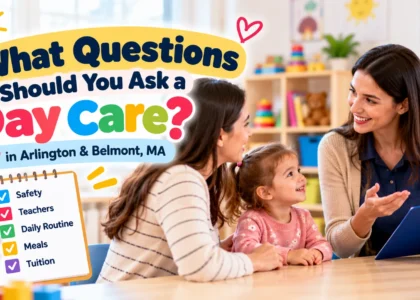
44. Questions to Ask a Preschool in Arlington, MA
Before enrolling, consider asking:
Curriculum Questions
- What curriculum do you use?
- How is the curriculum planned?
- How much of the day involves play?
- How do you support early literacy?
- How do you teach early math?
- How do you incorporate children’s interests?
- How do teachers document progress?
Teacher Questions
- What qualifications do teachers have?
- How long have teachers worked here?
- What professional development do educators receive?
- How do you support teacher consistency?
Child Development Questions
- How do you support shy children?
- How do you support active children?
- How do you handle developmental differences?
- How do you handle challenging behavior?
Safety Questions
- What are your emergency procedures?
- How do you manage allergies?
- What is your illness policy?
- How is pickup managed?
- How is outdoor play supervised?
Family Questions
- How do you communicate with parents?
- How frequently are conferences held?
- How are developmental concerns communicated?
Practical Questions
- What are the hours?
- What are the tuition and fees?
- What supplies are required?
- What is the enrollment process?
- Are there waiting lists?
- What are the age requirements?
- What is the attendance policy?
45. Red Flags Parents Should Investigate
No single observation automatically means a preschool is poor.
However, parents may want to investigate further if they notice:
- unclear safety policies
- unwillingness to answer questions
- limited teacher-child interaction
- little opportunity for play
- few age-appropriate materials
- excessive reliance on worksheets
- unclear enrollment policies
- unclear licensing information
- frequent unexplained staff turnover
- poor communication
- classrooms that appear consistently chaotic
- little opportunity for outdoor movement
- dismissive responses to parent concerns
The appropriate response is to ask questions and verify information.
46. Positive Signs of a High-Quality Preschool
Parents may look for programs where:
- teachers know children individually
- adults communicate respectfully
- children are encouraged to explore
- play is meaningful
- classroom materials are accessible
- children have choices
- learning goals are clear
- routines are predictable
- families receive communication
- children’s interests influence activities
- individual developmental needs are considered
- children can make mistakes safely
- teachers encourage persistence
These characteristics are consistent with Massachusetts EEC’s published description of high-quality learning and care environments.
47. Preschool in Arlington, MA: Public and Private Options
Parents searching for Preschool in Arlington, MA may encounter different program models.
These can include:
- public preschool
- private preschool
- nursery schools
- child-care centers with preschool programs
- family child-care programs
- Montessori-style programs
- bilingual programs
- integrated preschool
- mixed-age early-childhood programs
Each model can have different:
- hours
- tuition
- eligibility
- curriculum
- enrollment
- classroom structure
- staffing
- educational philosophy
Therefore, the term “preschool” alone does not tell you everything about a program.
48. Arlington Public Preschool Resources
Arlington Public Schools publishes preschool-related information through its school system.
Its current online information includes preschool registration resources and identifies an integrated preschool program. Arlington also provides Massachusetts Department of Elementary and Secondary Education family curriculum resources through its website.
Parents should always confirm:
- current eligibility
- registration deadlines
- available placements
- current schedule
- transportation
- program requirements
directly with Arlington Public Schools.
49. What About Preschool in Belmont, MA?
Families living in Belmont or near the Arlington-Belmont area may compare preschool programs across both communities.
Belmont Public Schools currently describes an Integrated Preschool Program for children ages 3–5. Its published information says classrooms include children receiving special education programming and typically developing neighborhood children, and the curriculum is aligned with Massachusetts Early Childhood Program Learning Standards.
Belmont’s public information also states that preschool staff conduct screenings for Belmont children ages 3–5 and that typically developing children can be selected through a lottery for peer-model places.
This is a useful reminder that eligibility and enrollment rules are location- and program-specific.
50. Arlington vs. Belmont: What Should Families Compare?
Families comparing a preschool in Arlington with one in Belmont can consider:
| Factor | Arlington | Belmont |
|---|---|---|
| Preschool availability | Multiple program types | Multiple program types |
| Public preschool resources | Available | Available |
| Integrated preschool | Available through public-school system | Available through Belmont Public Schools |
| Age requirements | Program-specific | Program-specific |
| Tuition | Program-specific | Program-specific |
| Curriculum | Varies | Varies |
| Schedule | Program-specific | Program-specific |
| Admissions | Program-specific | Program-specific |
| Transportation | Family/program dependent | Family/program dependent |
| Licensing/regulatory information | Verify current status | Verify current status |
| Family fit | Individual | Individual |
The right choice depends on the actual program, child, family schedule, eligibility, and educational needs—not simply which town appears in the program’s name.
51. Cost Should Not Be the Only Measure of Quality
Parents naturally consider tuition.
But the cheapest program is not automatically the best value, and the most expensive program is not automatically the highest quality.
Compare:
- teacher qualifications
- schedule
- curriculum
- classroom environment
- meals
- outdoor time
- family communication
- support services
- transportation
- enrollment flexibility
- additional fees
Ask for a complete explanation of costs.
52. Convenience Matters Too
A preschool can be excellent on paper but difficult for a family’s daily routine.
Consider:
- commute
- pickup
- work schedules
- siblings
- transportation
- parking
- emergency pickup
- weather
- extended care
- school calendar
A program that fits your family’s practical needs can make daily life significantly easier.
53. The Best Preschool Is Not the Same for Every Child
There is no universal preschool that is perfect for every family.
One child may thrive in:
- a small classroom
Another may prefer:
- a larger social environment.
One family may need:
- extended-day care.
Another may prioritize:
- a half-day program.
One child may benefit from:
- bilingual education.
Another family may prioritize:
- outdoor learning.
The important question is not:
“Which preschool is universally the best?”
Instead ask:
“Which program’s environment, educational approach, schedule, and support structure fit my child and family?”
54. A Practical Preschool Quality Scorecard for Parents
You can create your own comparison sheet.
Score each program according to your family’s priorities.
| Category | Questions |
|---|---|
| Teachers | Are educators warm, qualified, and responsive? |
| Curriculum | Is learning developmentally appropriate? |
| Play | Is meaningful play part of the day? |
| Language | Are children encouraged to communicate? |
| Math | Are early math concepts explored naturally? |
| Social-emotional | Are relationships and emotional skills supported? |
| Safety | Are safety procedures clear? |
| Environment | Is the classroom engaging and organized? |
| Outdoors | Is there meaningful movement and outdoor time? |
| Inclusion | Are differences respected and supported? |
| Family | Is communication strong? |
| Assessment | Is child development observed appropriately? |
| Schedule | Does it work for the family? |
| Cost | Is the overall cost understood? |
| Location | Is transportation manageable? |
This lets families compare programs based on their own priorities rather than relying on a generic ranking.
55. How to Recognize a Truly Child-Centered Preschool
A child-centered preschool does not mean children can do absolutely anything they want.
It means teachers understand children as active participants in learning.
A child-centered classroom may allow children to:
- choose activities
- ask questions
- investigate
- make mistakes
- try again
- express preferences
- collaborate
- explore interests
- participate in classroom responsibilities
Teachers still establish:
- boundaries
- routines
- expectations
- safety rules
The difference is that children are treated as learners rather than simply recipients of instructions.
56. Why Relationships Matter More Than Fancy Equipment
A preschool does not need the most expensive toys to provide meaningful learning.
A simple set of blocks can support:
- mathematics
- engineering
- language
- social skills
- creativity
- problem-solving
A good teacher can turn an ordinary classroom object into a learning opportunity.
This is why observing interactions is often more useful than simply looking at equipment.
57. What High-Quality Preschool Learning Can Look Like
Imagine children building a bridge from blocks.
A teacher might ask:
“How can we make it stronger?”
Children experiment.
One structure falls.
The children try again.
The teacher introduces the words:
- balance
- tall
- short
- heavy
- strong
- wide
Children count blocks.
They compare structures.
They work together.
They draw the bridge.
They tell a story about where the bridge goes.
One activity has now supported:
language + math + science + engineering + social development + creativity.
That is the power of intentional play-based learning.
58. Preschool Quality Checklist for Arlington Parents
Before choosing a preschool in Arlington, ask yourself:
Relationships
- Does my child feel comfortable with teachers?
- Are teachers warm and responsive?
Curriculum
- Is learning developmentally appropriate?
- Is play meaningful?
- Are activities hands-on?
Development
- Does the program support the whole child?
- Are social-emotional skills included?
Environment
- Is the classroom safe?
- Are materials accessible?
- Is there a quiet space?
Outdoors
- Is there regular movement?
- Is outdoor learning available?
Communication
- Will I receive meaningful updates?
- Can I easily talk to teachers?
Inclusion
- Are children and families respected?
- Are cultures and languages represented?
Practical
- Do the hours work?
- Is the location manageable?
- Do I understand all fees?
Trust
- Can the program clearly explain its policies?
- Can I verify its regulatory information where applicable?
59. Frequently Asked Questions About High-Quality Preschool in Arlington, MA
1. What makes a high-quality preschool in Arlington, MA?
A high-quality preschool generally combines safe and engaging environments, responsive teachers, developmentally appropriate curriculum, meaningful play, social-emotional learning, language-rich interactions, family partnerships, appropriate assessment, and support for individual developmental needs.
2. How do I choose a preschool in Arlington, MA?
Visit multiple programs when possible. Compare teachers, curriculum, classroom environment, safety, schedule, family communication, outdoor activities, enrollment requirements, costs, and how well the program fits your child.
3. Is play-based learning important in preschool?
Yes. Massachusetts EEC identifies play-based routines and hands-on, open-ended learning experiences as characteristics of high-quality curriculum.
4. What should preschool curriculum include?
It can include language and literacy, mathematics, science, social-emotional learning, physical development, creative expression, problem-solving, communication, and approaches to learning.
5. Should preschool focus heavily on reading and writing?
Early literacy is important, but preschool learning should be developmentally appropriate. Reading, storytelling, conversation, drawing, songs, and playful literacy experiences can all support early development.
6. How important are preschool teachers?
Teachers are extremely important because daily interactions shape children’s experiences. Massachusetts emphasizes warm, supportive, stimulating interactions as part of high-quality early education.
7. What should I observe during a preschool tour?
Observe teacher-child interactions, children’s engagement, classroom organization, available materials, safety, play opportunities, transitions, communication, and the overall emotional environment.
8. How important is outdoor play?
Outdoor play can support physical development, exploration, social interaction, confidence, and learning. Ask each preschool how often children have outdoor opportunities.
9. What questions should I ask a preschool teacher?
Ask about curriculum, daily schedule, classroom size, staffing, teacher qualifications, behavior guidance, outdoor play, assessment, family communication, health policies, and how developmental differences are supported.
10. Is a more expensive preschool necessarily better?
No. Tuition alone does not establish quality. Compare the actual educational experience, teachers, curriculum, environment, services, schedule, and family fit.
11. How important is family communication?
It is important because parents and educators can share information about children’s development, interests, routines, and needs. Massachusetts identifies family partnerships as a component of high-quality curriculum.
12. What is play-based preschool?
A play-based preschool uses children’s natural curiosity and play as important contexts for learning while educators intentionally support developmental and learning goals.
13. Should a preschool provide early math?
Yes. Preschool children can explore counting, quantities, patterns, shapes, sorting, comparison, measurement, and spatial relationships through age-appropriate activities.
14. Should preschool children learn science?
Early science can involve observation, questioning, predicting, exploring, experimenting, and discussing everyday phenomena.
15. How should preschool handle challenging behavior?
Ask the program for its behavior-guidance policy. High-quality environments should use age-appropriate guidance and help children develop communication, self-management, relationships, and problem-solving.
16. Does a preschool need to have a large playground?
Not necessarily. Outdoor space is valuable, but quality depends on how the entire environment is used, supervised, and connected to children’s developmental needs.
17. What does individualized preschool learning mean?
It means educators recognize that children have different interests, abilities, developmental rates, cultures, languages, and support needs and adapt learning experiences accordingly.
18. Are there public preschool options in Arlington?
Arlington Public Schools identifies an integrated preschool and publishes preschool registration and school information. Families should verify current eligibility and registration details directly with the district.
19. Are there public preschool options in Belmont?
Belmont Public Schools currently operates an Integrated Preschool Program for children ages 3–5, with specific eligibility and enrollment processes.
20. Can families compare preschool programs between Arlington and Belmont?
Yes. Families can compare programs based on location, eligibility, curriculum, schedule, tuition, classroom environment, teacher interactions, family communication, and child-specific needs.
21. How can I verify preschool information?
Check the preschool directly and use official Massachusetts EEC resources where applicable. Program details such as schedules, fees, staffing, enrollment, and policies can change.
22. Is technology necessary in preschool?
Technology does not need to be the center of preschool learning. Ask whether any technology used has a clear developmental purpose and whether children have abundant opportunities for hands-on, social, physical, and creative experiences.
23. What does a language-rich preschool classroom look like?
Teachers frequently talk with children, read books, ask questions, encourage storytelling, introduce vocabulary, listen to children’s ideas, and create opportunities for conversation throughout the day.
24. How can I tell whether a preschool is truly child-centered?
Look for opportunities for children to make appropriate choices, explore materials, ask questions, collaborate, solve problems, and pursue interests while teachers provide structure, safety, and guidance.
25. What is the most important thing to look for in a preschool?
Look at the total experience: relationships, safety, curriculum, learning environment, play, communication, inclusion, individual support, and whether the program fits your child and family.
Conclusion: What Really Makes a High-Quality Preschool in Arlington, MA?
A high-quality Preschool in Arlington, MA is not defined by one feature.
It is defined by the combination of many small, important experiences children have every day.
It is the teacher who listens carefully.
It is the classroom where children are encouraged to ask questions.
It is the block tower that teaches children about balance.
It is the story that introduces new vocabulary.
It is the art activity that allows children to express an idea.
It is the teacher who helps two children solve a disagreement.
It is the outdoor activity that turns curiosity into discovery.
It is the routine that helps a child become independent.
It is the family communication that helps parents understand their child’s development.
And it is the environment where children feel safe enough to explore, make mistakes, try again, and learn.
Massachusetts EEC’s current guidance provides a strong framework for evaluating these qualities: developmentally appropriate learning, hands-on experiences, play-based routines, responsive curriculum, appropriate assessment, supportive interactions, safe environments, and family partnerships.
For Arlington parents, the best approach is therefore not to search only for a preschool with the most impressive marketing.
Visit. Observe. Ask questions. Compare.
Look at how teachers interact with children.
Look at what children actually do.
Look at whether the curriculum supports the whole child.
Look at how families are treated.
And consider whether the program fits your child’s personality, developmental needs, interests, and your family’s daily life.
For families near Belmont, MA, the same principles apply, while eligibility and program-specific details should be checked with Belmont providers and public-school resources. Belmont Public Schools, for example, currently describes an integrated preschool model for ages 3–5 and provides information about its curriculum and enrollment process.
Ultimately, a strong preschool should help children develop more than academic knowledge.
It should help them become:
curious learners, confident communicators, caring friends, creative thinkers, persistent problem-solvers, and increasingly independent young people.
That is what parents should look for when evaluating a high-quality preschool in Arlington, MA.