
Summary
Finding the right toddler play school in Arlington, MA can be an important decision for parents who want their young child to experience a safe, nurturing, social, and developmentally appropriate environment before entering traditional preschool or kindergarten.
Toddlerhood is a period of rapid development. Children are learning new words, developing stronger motor skills, becoming more independent, discovering how relationships work, exploring emotions, experimenting with cause and effect, and developing an increasing interest in the world around them.
A thoughtfully designed toddler play school can support these developmental changes through play, relationships, exploration, movement, language, music, sensory experiences, creative activities, routines, and social interaction.
For toddlers, “education” does not necessarily mean sitting at a desk or completing worksheets. A child building a block tower may be developing problem-solving skills. A toddler listening to a story may be building vocabulary and early literacy skills. A child playing beside another child may be beginning to understand social interaction. A toddler washing their hands or putting away a toy may be practicing independence and following routines.
Massachusetts’ Early Learning Guidelines for Infants and Toddlers place significant emphasis on relationships between young children and consistent educators, as well as development across social-emotional, physical, cognitive, communication, and learning domains.
For families in Arlington, MA, and nearby families in Belmont, MA, understanding these developmental needs can make it easier to compare toddler play schools, child-care centers, early learning programs, and preschool options.
This comprehensive guide explains:
- What a toddler play school is
- How play-based learning works
- Benefits of early social experiences
- Benefits of early educational experiences
- Toddler language development
- Social-emotional development
- Cognitive development
- Fine and gross motor development
- Early literacy
- Early math
- Creativity
- Sensory learning
- Outdoor learning
- Independence
- Emotional regulation
- Teacher-child relationships
- Classroom environment
- Safety
- Massachusetts licensing
- Arlington and Belmont considerations
- Questions to ask during a tour
- How to compare programs
- What parents should look for
- Frequently asked questions
- SEO and local content strategies
The goal is to help parents make an informed decision while also explaining why a quality toddler play school can be an important part of a child’s early learning journey.
Introduction
The toddler years are full of firsts.
A child may learn to say a new word, climb a playground structure, recognize a familiar song, feed themselves, build a tower, imitate an adult, begin playing alongside another child, or suddenly insist on doing something “by myself.”
These moments may seem ordinary, but they represent significant developmental progress.
During toddlerhood, children are rapidly developing across several interconnected areas:
- Language
- Communication
- Social skills
- Emotional development
- Physical development
- Motor coordination
- Cognitive skills
- Problem-solving
- Independence
- Creativity
- Curiosity
- Self-regulation
Because so much development happens during these years, the environment surrounding a child can make a meaningful difference.
For families searching for a toddler play school in Arlington, MA, the question should not simply be:
“Does this school have educational activities?”
A better question is:
“How does this program support my toddler’s development through everyday experiences?”
A high-quality toddler program may provide opportunities for children to:
- Explore safely
- Build relationships
- Communicate with adults
- Interact with peers
- Listen to stories
- Sing songs
- Create art
- Build with blocks
- Play outdoors
- Explore sensory materials
- Practice self-help skills
- Solve simple problems
- Express emotions
- Follow predictable routines
- Make age-appropriate choices
Massachusetts’ Early Learning Guidelines specifically recognize the importance of relationships and interactions in shaping infant and toddler development.
This means that early learning is not limited to formal “lesson time.”
For toddlers, play itself can be a powerful learning experience.
What Is a Toddler Play School?
The term “toddler play school” can describe an early childhood program that combines age-appropriate care, play, social experiences, and early learning opportunities for young children.
There is not necessarily one standardized definition of “toddler play school” across all providers.
Some programs may call themselves:
- Toddler play school
- Toddler preschool
- Early learning center
- Toddler daycare
- Early childhood program
- Nursery school
- Child-care center
- Play-based preschool
- Infant and toddler program
Parents should therefore look beyond the name.
Instead, ask:
- What age does the program accept?
- What is the classroom age range?
- What is the daily schedule?
- What activities are provided?
- How are children supervised?
- What is the educator-to-child ratio?
- How does the program support development?
- Is the program licensed?
- What are the enrollment requirements?
Massachusetts’ Early Learning Guidelines identify toddlers within the broader 12–33-month developmental framework, while child-care licensing classifications use specific age groupings such as 15–33 months for toddlers. Individual programs may have their own enrollment policies, so parents should confirm age eligibility directly.
Toddler Play School vs. Traditional Preschool
Parents sometimes use “toddler play school” and “preschool” interchangeably.
They are not always the same.
Traditional preschool programs commonly serve children around ages 3–5, although individual programs vary.
Toddler programs generally serve younger children and may place greater emphasis on:
- Caregiving
- Relationships
- Exploration
- Movement
- Communication
- Sensory play
- Emerging independence
- Shorter group activities
- Rest
- Diapering or toilet learning
For example, Belmont Public Schools describes its Integrated Preschool Program as serving children ages 3–5, while Arlington’s Menotomy Preschool serves children from age 3 through kindergarten-entry age.
Therefore, parents with a younger toddler should verify the minimum enrollment age rather than assuming that a preschool listing is automatically a toddler program.
Why Early Experiences Matter During Toddlerhood
The toddler years are a time when children are beginning to make connections between people, objects, language, actions, and emotions.
A toddler learns by:
- Watching
- Listening
- Touching
- Moving
- Repeating
- Experimenting
- Imitating
- Communicating
- Playing
- Exploring
This is why early experiences matter.
A child who repeatedly experiences responsive conversations is developing communication.
A child who plays with other children is beginning to learn social patterns.
A child who has opportunities to make simple choices is practicing independence.
A child who encounters manageable challenges is practicing problem-solving.
A child who receives consistent emotional support is learning that adults can help them manage difficult feelings.
These experiences become the foundation for later learning.
1. Social Development Through Toddler Play School
One of the major benefits of a toddler play school is the opportunity to interact with other children.
Toddlers may not yet participate in complex cooperative play like older children.
Instead, they may experience parallel play.
For example, two toddlers might sit beside each other:
- One building with blocks
- One pushing toy cars
They may watch each other, imitate each other, exchange toys, or gradually begin interacting.
These experiences can be important early social learning opportunities.
Benefits of Early Social Experiences
A toddler play school can provide opportunities to practice:
- Being around peers
- Taking turns
- Waiting briefly
- Sharing space
- Communicating needs
- Watching others
- Imitating behavior
- Participating in group routines
- Responding to simple boundaries
- Beginning to understand emotions
These skills do not develop overnight.
They are built through repeated experiences.
Learning to Share Space
Sharing is often difficult for toddlers.
A child may understand:
“That’s my toy.”
But they may not yet understand:
“You can use it now, and I can use it later.”
A teacher can help by modeling simple language:
“Sam is using the truck. You can use it when Sam is finished.”
This experience teaches:
- Waiting
- Communication
- Boundaries
- Patience
- Social awareness
Learning to Take Turns
Turn-taking can begin with very simple activities.
For example:
- Rolling a ball
- Taking turns adding blocks
- Passing instruments
- Taking turns with a puzzle
- Participating in a song
Teachers can use phrases such as:
“My turn.”
“Your turn.”
“Now it is Maya’s turn.”
This repeated language helps toddlers understand social patterns.
Developing Early Friendship Skills
Toddlers are still learning what friendship means.
They may begin to:
- Recognize familiar children
- Look for certain classmates
- Imitate peers
- Sit near preferred friends
- Offer objects
- Participate in simple shared activities
A play school gives children repeated opportunities to develop familiarity with peers.
2. Emotional Development
Toddler emotions can be intense.
A child can be happy one minute and extremely frustrated the next.
This is partly because emotional regulation develops gradually.
A toddler play school can support emotional development by providing:
- Predictable routines
- Familiar educators
- Calm responses
- Emotional vocabulary
- Consistent boundaries
- Comfort
- Opportunities to express feelings
Massachusetts’ toddler guidelines specifically include social-emotional development and relationships with consistent educators as important areas of development.
Helping Toddlers Name Feelings
A toddler may not have the vocabulary to say:
“I’m disappointed because another child took the toy.”
Instead, they may cry or scream.
A teacher can help by saying:
“You are upset because the truck is being used.”
This connects the child’s experience with language.
Over time, children can begin learning words such as:
- Happy
- Sad
- Angry
- Scared
- Tired
- Excited
- Frustrated
Supporting Self-Regulation
Self-regulation develops gradually.
Toddlers need adults to help them learn how to:
- Wait
- Stop
- Start
- Transition
- Calm down
- Ask for help
- Express frustration
A predictable environment can make these experiences easier.
For example, if the same cleanup song plays every day, children begin to understand that the song signals a transition.
3. Language Development
Language development is one of the most visible areas of toddler growth.
A child may progress from:
- Gestures
- Sounds
- Single words
toward:
- Two-word combinations
- Short phrases
- Questions
- Requests
- Conversations
A toddler play school can create hundreds of opportunities for language throughout the day.
How Teachers Support Toddler Language
Teachers can:
- Talk with children
- Read books
- Sing songs
- Describe activities
- Name objects
- Ask simple questions
- Repeat words
- Expand children’s sentences
- Encourage communication
For example:
Child:
“Ball.”
Teacher:
“Yes, you found the blue ball.”
The teacher has naturally introduced additional vocabulary.
Language-Rich Classrooms
When touring a toddler play school, listen to the adults.
Are teachers talking with children?
Are they asking questions?
Are they describing what children are doing?
Are they responding to gestures?
Are they reading books?
These observations can tell parents a lot about the learning environment.
Massachusetts’ early-learning standards and guidelines recognize language and developmental experiences as important parts of early education.
4. Early Literacy
Toddlers are not expected to read independently.
However, early literacy begins long before conventional reading.
A toddler can develop early literacy through:
- Listening to stories
- Looking at pictures
- Turning pages
- Hearing rhymes
- Singing
- Learning new vocabulary
- Recognizing familiar stories
- Scribbling
- Talking about pictures
Why Storytime Matters
A teacher reading a picture book can help children develop:
- Vocabulary
- Listening
- Memory
- Attention
- Imagination
- Story understanding
Repeated reading can be especially valuable.
Toddlers often request the same story again and again.
That repetition can help children anticipate words and events.
5. Cognitive Development
Cognitive development involves how children:
- Think
- Remember
- Explore
- Compare
- Understand
- Solve problems
- Make connections
Play provides many opportunities for this development.
For example, a toddler trying to fit a shape into a puzzle is experimenting with:
- Shape
- Orientation
- Size
- Trial and error
- Memory
- Persistence
Problem-Solving Through Play
A teacher does not always need to solve a child’s problem immediately.
Suppose a toddler is trying to place a block on top of another block.
The tower keeps falling.
Instead of fixing it, the teacher might ask:
“What could we try?”
Or:
“Which block should go on the bottom?”
The child gets an opportunity to think.
6. Early Math Skills
Toddlers can begin developing mathematical thinking naturally.
Examples include:
- Counting
- Matching
- Sorting
- Comparing
- Recognizing shapes
- Understanding size
- Exploring quantity
- Recognizing patterns
- Understanding position
A toddler does not need a worksheet to learn math.
Math Through Blocks
Blocks can teach concepts such as:
- Tall
- Short
- Big
- Small
- More
- Less
- One
- Two
- Balance
- Position
A teacher might ask:
“Which tower is taller?”
That simple question encourages mathematical thinking.
Sorting Activities
Toddlers can sort objects by:
- Color
- Shape
- Size
- Type
For example:
“Let’s put all the red blocks here.”
This combines:
- Vocabulary
- Observation
- Classification
- Attention
7. Fine Motor Development
Fine motor skills involve small movements, particularly those involving hands and fingers.
Toddler play school activities may include:
- Building blocks
- Turning pages
- Scribbling
- Large crayons
- Play dough
- Simple puzzles
- Scooping
- Pouring
- Picking up objects
- Manipulating safe toys
These activities strengthen coordination.
Why Fine Motor Skills Matter
Fine motor development supports future everyday activities such as:
- Eating
- Dressing
- Drawing
- Writing
- Using scissors
- Buttoning clothing
- Opening containers
Toddlers need repeated opportunities to practice.
8. Gross Motor Development
Gross motor skills involve larger movements.
A toddler play school can provide opportunities to:
- Walk
- Run
- Climb
- Dance
- Jump
- Push
- Pull
- Throw
- Carry
- Balance
Parents should ask about indoor and outdoor movement opportunities when touring a program.
Outdoor Play as Learning
Outdoor play can support:
- Coordination
- Balance
- Strength
- Spatial awareness
- Social interaction
- Sensory exploration
- Curiosity
A playground can become a learning environment.
Children can explore:
- Leaves
- Sticks
- Rocks
- Weather
- Shadows
- Water
- Sand
- Movement
9. Sensory Development
Toddlers naturally learn through their senses.
A toddler play school may offer age-appropriate sensory activities such as:
- Water
- Sand
- Dough
- Textures
- Safe natural materials
- Containers
- Scoops
- Music
- Movement
These experiences can help children explore:
- Texture
- Weight
- Sound
- Movement
- Cause and effect
- Volume
10. Creative Development
Creative experiences can help toddlers express themselves.
Activities may include:
- Drawing
- Painting
- Music
- Dancing
- Pretend play
- Building
- Storytelling
- Singing
Parents should not expect every toddler art activity to produce a recognizable picture.
For young children, the process matters.
11. Pretend Play
Pretend play allows toddlers to imitate everyday experiences.
Children might pretend to:
- Cook
- Feed a baby
- Talk on a phone
- Drive a car
- Shop
- Take care of animals
- Repair something
Pretend play can support:
- Language
- Memory
- Imagination
- Social understanding
- Emotional expression
- Sequencing
12. Music and Movement
Music can be an excellent way to combine learning and social interaction.
Toddler programs may include:
- Songs
- Finger plays
- Dancing
- Clapping
- Instruments
- Action songs
Music can support:
- Listening
- Rhythm
- Memory
- Language
- Coordination
- Group participation
13. Independence
Toddlers frequently say:
“I do it!”
That desire for independence can be valuable.
A toddler play school can provide opportunities to:
- Put toys away
- Wash hands
- Carry a cup
- Choose an activity
- Help set up
- Help clean up
- Attempt self-feeding
- Put belongings away
These small responsibilities can build confidence.
14. Learning Through Daily Routines
Learning does not stop when the “lesson” ends.
Everyday routines can provide learning opportunities.
Arrival
Children practice:
- Greeting
- Separation
- Communication
Handwashing
Children practice:
- Sequencing
- Hygiene
- Independence
Snack
Children practice:
- Self-feeding
- Communication
- Social interaction
Cleanup
Children practice:
- Following directions
- Responsibility
- Sorting
Rest
Children practice:
- Transitions
- Self-regulation
- Body awareness
Departure
Children practice:
- Communication
- Recall
- Transition
15. Teacher-Child Relationships
The relationship between a toddler and educator can be one of the most important aspects of an early childhood environment.
Massachusetts’ Early Learning Guidelines emphasize that toddlers develop relationships with and become attached to consistent educators. The guidelines also provide examples of supportive educator behaviors such as greeting children by name, responding at eye level, and joining children in shared exploration.
Parents should therefore pay attention to teacher behavior during a tour.
Look for adults who:
- Listen
- Respond
- Comfort
- Encourage
- Talk with children
- Notice children’s interests
- Maintain boundaries respectfully
16. Consistency and Familiarity
Toddlers often benefit from predictable relationships.
A child may become comfortable with:
- A familiar teacher
- A familiar classroom
- A familiar routine
- Familiar songs
- Familiar activities
This consistency can help a child feel secure enough to explore.
17. Play-Based Learning
Play-based learning means that children learn through meaningful experiences rather than relying entirely on formal instruction.
Examples:
Blocks
Problem-solving and spatial awareness.
Books
Language and early literacy.
Pretend play
Communication and imagination.
Sensory activities
Exploration and cause-and-effect.
Outdoor play
Motor skills and nature exploration.
Art
Creativity and fine motor development.
18. Child-Led Exploration
Toddlers have different interests.
One child may spend twenty minutes building blocks.
Another may want to look through books.
Another may prefer sensory activities.
A play-based classroom can allow children to explore according to their interests while teachers provide guidance.
19. Teacher-Guided Experiences
Child-led play does not mean teachers simply watch.
Teachers can intentionally extend children’s learning.
For example:
A child builds a tower.
Teacher:
“How many blocks did you use?”
The teacher has transformed the activity into an early mathematics experience.
A child looks at a leaf.
Teacher:
“Is the leaf green or yellow?”
Now the child is exploring language and nature.
20. Learning Through Questions
Teachers can encourage thinking with simple questions.
Examples:
- “What do you think?”
- “Where should this go?”
- “What happens if we add another?”
- “Which one is bigger?”
- “Where did the ball go?”
- “What color is this?”
- “Who is hiding?”
Questions encourage children to observe and think.
21. Building Curiosity
Curiosity is an important foundation for lifelong learning.
A toddler might wonder:
- Why did the tower fall?
- Where did the bird go?
- Why is the water moving?
- What is inside the box?
- What happens when we push this?
A good educator can encourage exploration rather than immediately providing every answer.
22. Developing Persistence
Toddlers can become frustrated when something does not work.
A teacher can help them keep trying.
Instead of:
“Let me do it.”
A teacher might say:
“Let’s try another way.”
This supports persistence and problem-solving.
23. Learning Through Repetition
Toddlers often love repetition.
They may request:
- The same book
- The same song
- The same game
- The same activity
Adults may find this repetitive.
For toddlers, repetition can help strengthen:
- Memory
- Vocabulary
- Confidence
- Prediction
- Understanding
- Motor skills
24. Supporting Shy Toddlers
Not every child immediately joins a group.
A shy toddler may prefer to:
- Observe
- Stay close to a teacher
- Play independently
- Watch other children
Teachers can support gradual participation.
Parents should ask:
“How do you help children who take longer to warm up?”
25. Supporting Active Toddlers
Some toddlers need frequent movement.
Parents should ask:
- How much outdoor play is offered?
- Are there movement activities?
- Can children move around the classroom?
- How are transitions handled?
A toddler should not be expected to sit still for long periods.
26. Supporting Different Developmental Needs
Children develop at different rates.
One toddler may have many words.
Another may communicate mostly through gestures.
One may climb confidently.
Another may still be developing balance.
A good program recognizes individual differences.
Massachusetts’ learning standards emphasize that young children show individual differences in development and that developmentally appropriate practices should account for children’s needs.
27. Early Social Experiences and Communication
Social interaction creates natural communication opportunities.
Children may need to communicate:
- “Mine.”
- “Help.”
- “More.”
- “No.”
- “My turn.”
- “All done.”
Teachers can help turn these simple communications into richer language.
28. Learning to Follow Simple Directions
Toddlers gradually learn to understand directions such as:
- “Come here.”
- “Put it away.”
- “Wash your hands.”
- “Bring the book.”
- “Sit at the table.”
These experiences support:
- Receptive language
- Memory
- Attention
- Routines
- Independence
29. Toddler Play School and School Readiness
A toddler play school is not kindergarten.
The goal should not be to push toddlers into academic expectations intended for older children.
Instead, a quality toddler program can help develop foundational skills such as:
- Listening
- Communication
- Curiosity
- Social interaction
- Independence
- Emotional regulation
- Motor skills
- Problem-solving
These skills can support later preschool experiences.
30. Why Play Matters More Than Worksheets
Toddlers learn differently from older students.
A worksheet may ask a child to identify a shape.
A block activity can allow the child to:
- Touch the shape
- Rotate it
- Stack it
- Compare it
- Build with it
The experience is active.
Massachusetts’ early education guidance emphasizes that young children learn by doing and that developmental domains are interconnected.
31. Early Science Through Play
Toddlers can explore basic scientific ideas.
Examples:
Water
What floats?
What sinks?
What happens when water is poured?
Nature
What does a leaf feel like?
What colors do we see?
Ice
What happens when ice gets warm?
Movement
What happens when we push a ball?
These experiences encourage observation and curiosity.
32. Early Engineering Through Blocks
Building with blocks can encourage children to:
- Plan
- Stack
- Balance
- Test
- Rebuild
A tower falling can become a learning experience.
Instead of viewing failure negatively, teachers can help children experiment.
33. Early Math Through Everyday Activities
Math is everywhere.
Children can count:
- Blocks
- Steps
- Toys
- Cups
- People
They can compare:
- Big and small
- Long and short
- Heavy and light
- More and less
They can identify:
- Circles
- Squares
- Triangles
These experiences build mathematical vocabulary naturally.
34. Early Literacy Through Everyday Experiences
Literacy can happen beyond books.
Children can:
- Recognize their name
- Look at signs
- Listen to songs
- Hear rhymes
- Tell simple stories
- Scribble
- Look at pictures
Teachers can describe what children see.
35. Social-Emotional Learning Through Stories
Books can introduce emotions and social situations.
A story character might:
- Feel sad
- Become scared
- Make a mistake
- Help a friend
- Solve a problem
Teachers can ask:
“How do you think she feels?”
This encourages emotional awareness.
36. Outdoor Learning in Arlington
Arlington families have access to a community environment where outdoor experiences can complement early learning.
A toddler play school can use outdoor time to encourage:
- Movement
- Nature observation
- Seasonal exploration
- Social interaction
- Sensory experiences
Parents should ask individual programs how outdoor activities are incorporated.
37. Toddler Play School Near Belmont, MA
Families in Belmont may also consider Arlington programs when location and commute make them practical.
When searching for toddler play school near Belmont, MA, consider:
- Travel time
- Pickup schedule
- Program hours
- Age eligibility
- Availability
- Tuition
- Licensing
- Classroom environment
- Developmental philosophy
Belmont’s public preschool system currently serves children ages 3–5, so families with younger toddlers should distinguish public preschool options from toddler-focused child-care programs.
38. Arlington vs. Belmont for Toddler Programs
Parents do not necessarily need to choose based solely on municipal boundaries.
Compare programs based on:
| Factor | Arlington | Belmont |
|---|---|---|
| Toddler programs | Provider-specific | Provider-specific |
| Preschool programs | Available | Available |
| Licensing | Massachusetts EEC | Massachusetts EEC |
| Age eligibility | Varies | Varies |
| Tuition | Provider-specific | Provider-specific |
| Schedule | Provider-specific | Provider-specific |
| Commute | Family-specific | Family-specific |
| Outdoor opportunities | Provider-specific | Provider-specific |
| Curriculum | Provider-specific | Provider-specific |
| Availability | Changes frequently | Changes frequently |
The best program for a family depends on the child’s needs and the family’s schedule rather than the city name alone.
39. Massachusetts Licensing
Parents should verify whether a child-care program is licensed or approved by Massachusetts EEC as applicable to its program type.
Massachusetts publishes EEC laws, regulations, and early-learning standards covering child-care programs and early education.
EEC’s public provider information can also include details about age groups served, capacity, investigations, and non-compliance information.
Because provider information can change, parents should verify current details directly through Massachusetts’ official resources before enrolling.
40. Toddler Group Size and Staffing
Staffing is particularly important for toddlers because young children require frequent supervision and assistance.
Parents should ask:
- How many toddlers are in the classroom?
- How many educators are assigned?
- Are staffing levels consistent?
- How are breaks covered?
- What happens if a teacher is absent?
- Are substitute educators used?
Massachusetts licensing regulations establish specific requirements for toddler groups, and parents should verify the current rules and the specific program’s licensed capacity rather than relying on generic online claims.
41. Why Consistent Educators Matter
Toddlers can form meaningful relationships with familiar educators.
A consistent teacher may learn:
- What the child likes
- What the child dislikes
- How the child communicates
- How the child responds to transitions
- What comforts the child
- What activities motivate the child
This familiarity can support a child’s sense of security.
42. Toddler Classroom Environment
A toddler classroom should be designed around young children’s abilities.
Look for:
- Low shelves
- Accessible materials
- Safe furniture
- Books
- Soft spaces
- Open-ended toys
- Blocks
- Pretend-play materials
- Sensory materials
- Art supplies
- Movement space
The classroom should encourage children to explore safely.
43. What Parents Should Observe During a Tour
Do not just look at the building.
Watch the interactions.
Observe teachers
Are they:
- Engaged?
- Calm?
- Responsive?
- Respectful?
- Communicative?
Observe children
Do they appear:
- Comfortable?
- Curious?
- Engaged?
- Supported?
Observe materials
Are they:
- Age appropriate?
- Accessible?
- Varied?
- Safe?
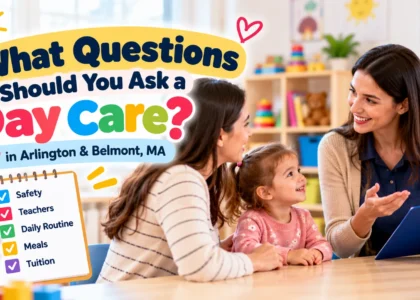
44. Questions to Ask a Toddler Play School in Arlington, MA
Program Questions
- What ages do you accept?
- What is the toddler classroom age range?
- How many children are enrolled?
- What are your hours?
- Do you provide full-day care?
- Do you offer part-time enrollment?
- Are you open year-round?
Learning Questions
- What is your educational philosophy?
- Is your program play-based?
- How do teachers support language development?
- How much outdoor play is provided?
- What sensory activities are offered?
- How often do children hear stories?
- How do you support early math?
- How do you support social-emotional development?
Teacher Questions
- What qualifications do educators have?
- What training do teachers receive?
- How long have teachers worked here?
- What is staff turnover like?
- How are substitute teachers handled?
Care Questions
- How are diapers handled?
- How is toilet learning handled?
- What is the rest policy?
- Are meals provided?
- How are allergies managed?
Safety Questions
- Is the program licensed?
- How are children supervised?
- What is the emergency plan?
- How are authorized pickups managed?
- What is the illness policy?
45. Toddler Play School Safety
Safety should always be a major consideration.
Parents should ask about:
- Supervision
- Secure entrances
- Emergency procedures
- Authorized pickup
- Medication
- Allergies
- Outdoor safety
- Sleeping arrangements
- Cleaning
- Illness policies
Massachusetts EEC regulations establish requirements relating to areas such as supervision, health, safety, educator qualifications, ratios, and group size.
46. Health and Hygiene
Toddlers interact closely with one another.
Ask about:
- Handwashing
- Toy cleaning
- Diapering hygiene
- Food preparation
- Sick-child policies
- Cleaning routines
- Medication
Parents should obtain the written health policy before enrollment.
47. Toddler Meals and Snacks
Meal times can also become learning opportunities.
Children can practice:
- Feeding themselves
- Using cups
- Communicating
- Sitting with peers
- Trying new foods
- Making simple choices
Ask whether the program:
- Provides food
- Requires packed meals
- Accommodates allergies
- Has food restrictions
- Provides snacks
48. Nap and Rest
Toddlers may still need daytime sleep or rest.
Ask:
- When is rest time?
- How long is rest?
- Are children required to sleep?
- What happens if they don’t sleep?
- How are sleeping children supervised?
Policies vary between programs.
49. Diapering and Toilet Learning
Parents should understand the program’s diapering policies.
Ask:
- Who changes diapers?
- How frequently are children checked?
- What supplies are required?
- How are changes communicated?
- When does toilet learning begin?
- Are there classroom requirements related to toileting?
50. Supporting Children Through Separation Anxiety
Starting a toddler play school can be difficult.
Some children may cry at drop-off.
This is not necessarily a sign that the program is inappropriate.
A supportive transition can include:
- Familiar educators
- Predictable routines
- Short goodbyes
- Comfort
- Parent communication
- Familiar objects when permitted
Ask the school how it handles difficult drop-offs.
51. Helping Toddlers Transition
Parents can help by:
- Keeping mornings predictable
- Talking about school
- Visiting before the first day
- Practicing short separations
- Preparing clothes and bags the night before
- Keeping goodbyes calm
Avoid promising that the child will never cry.
Instead:
“It may feel hard to say goodbye, but your teacher will help you and I will come back.”
52. Parent-Teacher Communication
Parents should know how the program communicates.
Possible methods include:
- Daily reports
- Apps
- Emails
- Phone calls
- Parent conferences
- Newsletters
- Photos
Ask:
“How will I know what my child did today?”
Also ask:
“How will you tell me if you have a developmental concern?”
53. Supporting Individual Development
A good toddler play school recognizes that children develop differently.
One child may:
- Talk early
- Walk later
- Prefer books
- Love physical activities
Another child may have an entirely different developmental profile.
The program should provide appropriate opportunities rather than expecting every child to progress identically.
Massachusetts’ early education guidance explicitly recognizes individual differences in development.
54. Toddler Play School and Special Developmental Needs
Parents may have questions about:
- Speech
- Language
- Motor skills
- Social interaction
- Sensory needs
- Behavior
- Feeding
Ask:
“How does your program work with children who need additional support?”
A teacher can document observations and communicate with families.
Formal developmental evaluation should be handled by appropriate professionals.
55. Toddler Play School and Early Intervention
If parents have concerns about a child’s development, they can discuss them with their pediatrician and appropriate early childhood professionals.
The child-care provider can be an important source of observations because teachers see children interacting in a group environment.
However, teachers should not diagnose developmental conditions.
56. Building Independence Through Play
Independence can be built through simple classroom responsibilities.
A toddler can:
- Choose a book
- Select a toy
- Put blocks away
- Carry a cup
- Wash hands
- Help clean up
- Put belongings in a designated location
These experiences communicate:
“You are capable.”
57. Developing Confidence
Confidence can grow when children successfully complete manageable challenges.
A child who learns:
“I can build this.”
“I can put this away.”
“I can ask for help.”
“I can try again.”
is developing a positive relationship with learning.
58. Learning Through Mistakes
Toddlers make mistakes constantly.
They spill.
They drop.
They knock things down.
They put objects in the wrong place.
These moments can become opportunities for learning.
Teachers can respond with:
“Let’s try again.”
“What happened?”
“How could we do it differently?”
This teaches children that mistakes can be part of learning.
59. Building a Growth-Oriented Learning Environment
A toddler does not need to get everything right.
Instead, educators can praise:
- Effort
- Curiosity
- Persistence
- Exploration
- Communication
- Helping
Instead of only saying:
“You’re so smart.”
A teacher might say:
“You kept trying until the piece fit.”
This emphasizes effort and persistence.
60. Toddler Play School and Family Partnership
Parents are the child’s most important source of information.
Teachers can learn from parents about:
- Routines
- Preferences
- Sleep
- Food
- Communication
- Comfort strategies
- Family changes
Parents can learn from teachers about:
- Peer interaction
- New interests
- Emerging skills
- Classroom behavior
- Activities
Strong communication benefits everyone.
61. How Parents Can Extend Learning at Home
Parents do not need complicated educational programs.
Try:
Read together
Choose books your toddler enjoys.
Count
Count steps, toys, fruit, or blocks.
Talk
Describe what you see.
Sing
Use familiar songs.
Explore outdoors
Look at leaves, animals, clouds, and weather.
Pretend
Play store, kitchen, doctor, or family.
Build
Use blocks.
Sort
Sort objects by color or size.
These simple activities reinforce early learning.
62. Arlington Family Life and Early Learning
For families living in Arlington, the best child-care choice may depend on more than the classroom.
Consider:
- Work commute
- Public transportation
- Parking
- Pickup times
- Sibling schedules
- Family support
- School transitions
A program that looks excellent on paper may not be practical if its schedule consistently conflicts with family life.
63. Toddler Play School Near Belmont, MA
Families near Belmont may find Arlington programs practical depending on where they live and work.
When searching for toddler play school near Belmont, MA, use both geographic and service-related search terms.
Examples:
- Toddler play school Belmont MA
- Toddler daycare Belmont MA
- Toddler preschool Belmont MA
- Toddler child care near Belmont
- Toddler play school near Arlington
- Early childhood education Belmont MA
- Toddler daycare near Arlington MA
Then verify each provider’s age eligibility, licensing, schedule, and availability.
64. Why Parents Should Visit Multiple Programs
One program may look perfect online.
Another may feel much better during an in-person visit.
Visiting several programs allows you to compare:
- Teacher interactions
- Classroom environment
- Daily routines
- Safety
- Outdoor space
- Communication
- Tuition
- Schedule
Try to visit during a normal operating period rather than relying entirely on promotional materials.
65. Red Flags to Investigate
Potential concerns include:
- Unclear supervision
- Staff unable to explain the daily schedule
- Unclear licensing information
- Frequent unexplained staff turnover
- Poor teacher-child interactions
- Unsafe classroom conditions
- Limited age-appropriate materials
- Lack of outdoor or movement opportunities
- Unclear behavior policies
- Pressure to enroll immediately
- Poor communication
One observation does not necessarily determine the quality of an entire program.
Use concerns as reasons to ask additional questions.
66. Positive Signs to Look For
Parents may notice:
- Teachers greeting children warmly
- Children appearing comfortable
- Adults getting down to children’s level
- Teachers talking with children
- Accessible books
- Open-ended materials
- Opportunities for movement
- Predictable routines
- Calm transitions
- Individual attention
- Respectful behavior guidance
- Clear communication with parents
67. How to Compare Toddler Play Schools
Create a simple comparison chart.
| Factor | Program A | Program B | Program C |
|---|---|---|---|
| Age eligibility | |||
| Location | |||
| Commute | |||
| Hours | |||
| Licensing | |||
| Staffing | |||
| Teacher consistency | |||
| Classroom size | |||
| Outdoor play | |||
| Play-based learning | |||
| Language activities | |||
| Sensory activities | |||
| Meals | |||
| Nap/rest | |||
| Diapering | |||
| Parent communication | |||
| Tuition | |||
| Availability |
This can make a complicated decision easier.
68. Cost of Toddler Play School in Arlington, MA
Tuition varies significantly between providers.
Factors can include:
- Number of days
- Full-time vs. part-time
- Hours
- Meals
- Extended care
- Registration
- Materials
- Program type
- Age group
- Schedule
Parents should ask for a complete fee schedule.
69. Questions About Tuition
Ask:
- Is tuition weekly or monthly?
- Is there a registration fee?
- Is there a deposit?
- Are meals included?
- Is extended care included?
- Are holidays charged?
- What happens during vacation?
- What is the withdrawal policy?
- Are there late-pickup fees?
- How often can tuition change?
70. Full-Time vs. Part-Time Toddler Play School
Full-time care may be useful for:
- Working parents
- Long commutes
- Families needing consistent weekday care
Part-time care may be useful for:
- Flexible schedules
- Parents working from home
- Families combining care arrangements
Ask whether the provider requires a minimum number of days.
71. Toddler Play School and Outdoor Learning
Outdoor experiences can complement classroom learning.
Teachers may use outdoor play to explore:
- Weather
- Plants
- Animals
- Movement
- Colors
- Textures
- Shapes
Parents should ask how often toddlers go outside.
72. Toddler Play School and Nature
Nature provides endless learning opportunities.
A child can observe:
- Leaves
- Trees
- Birds
- Clouds
- Rain
- Snow
- Insects
Teachers can ask:
“What do you see?”
“What color is it?”
“Where did the bird go?”
These questions build observation and language.
73. Toddler Play School and Community Learning
A local early childhood program can help children begin developing a sense of community.
Simple experiences can involve:
- Familiar teachers
- Familiar classmates
- Classroom responsibilities
- Group routines
- Neighborhood observations
This helps children understand that they are part of a larger social environment.
74. Preparing for the Next Educational Stage
Toddler play school should not be viewed as a race toward academic achievement.
The goal is to establish foundations.
By the time children move toward preschool, useful foundational skills may include:
- Communicating needs
- Following routines
- Listening
- Participating in group activities
- Exploring independently
- Interacting with peers
- Managing simple transitions
75. Why Social Experiences Matter Before Preschool
Some parents focus heavily on letters and numbers.
But social skills are also important.
A child needs to gradually learn:
- How to be around other children
- How to ask for help
- How to follow routines
- How to wait
- How to communicate
- How to manage emotions
These skills can help children participate in later classroom experiences.
76. Why Educational Experiences Should Be Age Appropriate
Toddlers are not miniature elementary students.
A developmentally appropriate toddler program should recognize:
- Short attention spans
- Need for movement
- Need for repetition
- Need for sensory experiences
- Need for emotional support
- Emerging language
- Individual differences
Massachusetts’ early learning framework is designed around children’s developmental stages and emphasizes developmentally appropriate experiences.
77. How Parents Can Recognize Quality
Ask yourself:
Are children engaged?
Are teachers responsive?
Do children have opportunities to choose?
Is there enough movement?
Are books accessible?
Are teachers communicating with children?
Does the program support emotional development?
Are routines predictable?
Does the environment feel safe?
Does the program communicate honestly with parents?
These observations can be more informative than marketing language.
78. A Complete Toddler Play School Tour Checklist
Before leaving the tour, confirm:
Child
- Age eligibility
- Developmental support
- Transition process
Classroom
- Group size
- Materials
- Books
- Play areas
- Movement space
Teachers
- Qualifications
- Experience
- Training
- Turnover
Schedule
- Arrival
- Meals
- Outdoor time
- Activities
- Rest
- Pickup
Safety
- Licensing
- Supervision
- Emergency procedures
- Allergy policies
- Illness policies
Financial
- Tuition
- Registration
- Additional fees
- Withdrawal policy
Communication
- Daily reports
- Parent meetings
- Developmental updates
79. Frequently Asked Questions About Toddler Play School in Arlington, MA
1. What is a toddler play school?
A toddler play school is an early childhood setting where young children receive age-appropriate care and have opportunities to learn through play, relationships, exploration, movement, communication, and everyday routines.
2. What age is appropriate for a toddler play school?
Age requirements vary by provider. Massachusetts’ early-learning guidance discusses toddler development from approximately 12–33 months, while licensing classifications identify toddlers in fixed-age groups as 15–33 months. Always confirm the individual program’s enrollment age.
3. What are the benefits of toddler play school?
Benefits can include social interaction, language development, emotional development, motor development, independence, early literacy, early math, creativity, problem-solving, curiosity, and self-regulation.
4. Is play school good for toddlers?
A high-quality, developmentally appropriate program can provide meaningful opportunities for toddlers to build relationships, explore, communicate, move, play, and develop emerging independence.
5. How does toddler play school support social development?
Toddlers can interact with peers, practice turn-taking, communicate needs, share space, observe others, and participate in group routines.
6. How does toddler play school support language?
Teachers can support language through conversation, books, songs, storytelling, questions, descriptive language, and responsive interactions.
7. Do toddlers learn math at play school?
Yes. Toddlers can explore counting, sorting, matching, shapes, size, quantity, patterns, and spatial concepts through play.
8. Do toddlers learn literacy at play school?
Toddler literacy is generally foundational rather than formal reading instruction. Children can develop early literacy through books, songs, rhymes, conversations, storytelling, and scribbling.
9. Why is play important for toddler learning?
Play gives children opportunities to experiment, explore, communicate, solve problems, move, imagine, and interact socially.
10. How does outdoor play support toddlers?
Outdoor play can support gross motor development, balance, coordination, sensory exploration, social interaction, curiosity, and nature awareness.
11. How does toddler play school support emotional development?
Teachers can help children identify feelings, communicate needs, manage transitions, receive comfort, and gradually develop self-regulation.
12. How important are teacher-child relationships?
They are very important. Massachusetts’ toddler guidelines emphasize children’s relationships with consistent educators and responsive adult interactions.
13. How do I choose a toddler play school in Arlington, MA?
Visit several programs and compare licensing, staffing, teacher-child interactions, classroom environment, activities, safety, schedule, tuition, communication, and your child’s individual needs.
14. How do I find a toddler play school near Belmont, MA?
Search both Belmont and nearby Arlington programs, then verify age eligibility, licensing, availability, tuition, hours, and commute.
15. Is Arlington preschool the same as toddler play school?
Not necessarily. Arlington’s Menotomy Preschool is described as serving children from age 3 through kindergarten entry, while toddler programs generally serve younger children.
16. Is Belmont preschool the same as toddler play school?
No. Belmont Public Schools describes its Integrated Preschool Program as serving children ages 3–5. Families seeking care for younger toddlers should investigate toddler-specific programs.
17. What should I look for during a toddler play school tour?
Look for responsive teachers, safe classrooms, age-appropriate materials, books, opportunities for movement, predictable routines, outdoor play, positive behavior guidance, and clear communication.
18. What questions should I ask teachers?
Ask about daily routines, staffing, age groups, developmental activities, outdoor time, meals, rest, diapering, behavior guidance, communication, and safety.
19. Does toddler play school prepare children for preschool?
It can support foundational skills such as communication, independence, social interaction, listening, emotional regulation, problem-solving, and following routines.
20. Does toddler play school provide structured activities?
Many programs combine teacher-guided activities with child-led exploration. The exact balance varies by program.
21. Should toddlers have outdoor play?
Outdoor play can provide valuable opportunities for movement, exploration, sensory learning, and social interaction. Ask each program about its specific outdoor schedule.
22. What is play-based learning?
Play-based learning uses meaningful play and hands-on experiences as opportunities for children to explore concepts, communicate, solve problems, and develop skills.
23. How can parents support toddler learning at home?
Read books, talk with your child, sing songs, count everyday objects, explore outdoors, encourage pretend play, build with blocks, and give children opportunities for age-appropriate independence.
24. How much does toddler play school cost in Arlington?
Tuition varies by provider, schedule, age, hours, and services. Request a current fee schedule directly from the program.
25. How can I verify a Massachusetts child-care program?
Use Massachusetts EEC resources to verify the provider’s licensing information and review available public information. EEC publishes laws, regulations, standards, and child-care program data.
26. How important is staff consistency?
Consistency can help toddlers develop familiar relationships and feel secure in the classroom. Ask about teacher turnover and classroom assignments.
27. What if my toddler is shy?
A quality program can provide time for observation and gradual participation rather than forcing immediate social interaction.
28. What if my toddler is very active?
Ask about movement opportunities, outdoor play, classroom layout, and how teachers support active children.
29. What if my child has developmental concerns?
Discuss concerns with your pediatrician and appropriate early childhood professionals. Ask the program how it communicates observations and collaborates with families.
30. What is the most important benefit of toddler play school?
A quality program can combine secure relationships, play, social interaction, exploration, communication, movement, and emerging independence in a developmentally appropriate environment.
Conclusion
A toddler play school in Arlington, MA can provide much more than supervision.
When thoughtfully designed, it can become an environment where young children develop relationships, discover new interests, communicate, move, explore, experiment, express emotions, solve problems, and practice independence.
The most important learning experiences may happen during ordinary moments.
A toddler stacking blocks is exploring balance and problem-solving.
A child turning the pages of a book is building early literacy.
A toddler talking with a teacher is developing language.
A child waiting for a turn is beginning to understand social interaction.
A toddler washing hands is practicing a routine and independence.
A child running outdoors is developing physical skills.
A child asking “Why?” is demonstrating curiosity.
These experiences matter because toddler development is interconnected.
Language supports social interaction.
Movement supports exploration.
Relationships support emotional security.
Play supports cognitive development.
Independence supports confidence.
Curiosity supports learning.
For families searching for toddler play school in Arlington, MA, the most useful approach is therefore to look beyond labels and marketing claims.
Visit the classroom.
Observe the educators.
Ask questions.
Review the program’s policies.
Verify licensing.
Understand the schedule.
Compare tuition.
Think about your commute.
And consider whether the environment matches your child’s personality, developmental stage, and needs.
Families in or near Belmont, MA can use the same process and may also consider Arlington programs when location and transportation make them practical.
Massachusetts’ early-learning guidance emphasizes that young children learn through relationships, interactions, exploration, and developmentally appropriate experiences.
That is the central idea behind effective toddler play-based learning:
Children learn by doing, exploring, communicating, playing, and building relationships.
A thoughtfully chosen toddler play school can give children a safe place to do exactly that.