

Summary
Finding the right toddler day care in Arlington, MA is one of the most important decisions parents make during the early years of a child’s life. Toddlers are entering a period of rapid development when they are becoming more independent, developing language, learning to interact with other children, exploring their surroundings, and beginning to understand routines, emotions, and boundaries.
For parents in Arlington, choosing child care is about much more than finding a convenient place to leave a child during working hours. A quality toddler day care should provide a safe, nurturing, age-appropriate environment where children can build secure relationships with caregivers, explore through play, practice communication, develop physical skills, and gradually become more independent.
This comprehensive guide explains what parents should know before choosing toddler daycare in Arlington, MA, including what toddler care means, what a typical day looks like, how to evaluate a program, what questions to ask during a tour, how Massachusetts licensing works, what to look for in teachers and classrooms, how daycare differs from preschool, and how families in nearby Belmont, MA can evaluate Arlington-area child care options.
Massachusetts’ Department of Early Education and Care, commonly called EEC, provides licensing and regulatory oversight for family, group, and school-age child care programs. EEC also provides a geographic search tool that allows families to look for licensed programs and review information such as licensing history and compliance findings.
The goal of this guide is simple: help Arlington and Belmont parents make a well-informed toddler child-care decision based on safety, relationships, development, schedule, communication, location, and family needs.
Introduction
The toddler years are full of change.
A child who was recently dependent on adults for almost everything may suddenly want to feed themselves, choose their own toys, walk everywhere, say “no,” imitate adults, interact with other children, and explore every corner of their environment.
This period can be exciting, but it can also be challenging for parents.
Many families in Arlington and nearby communities eventually face questions such as:
- Where can I find a good toddler day care in Arlington, MA?
- What age does toddler daycare accept?
- What should a toddler daycare classroom look like?
- How many children should be in a toddler classroom?
- What qualifications should caregivers have?
- How does toddler daycare differ from preschool?
- Should I choose a center-based daycare or family child care?
- Does the program provide meals and snacks?
- What happens during nap or rest time?
- How does the daycare handle diapering and potty training?
- How much outdoor play does my toddler get?
- How does the daycare communicate with parents?
- What happens if my toddler has separation anxiety?
- What should I ask during a daycare tour?
- How can I compare Arlington daycare with options in Belmont?
- How do I verify whether a child-care program is licensed?
These questions matter because toddlers do not simply need supervision.
They need responsive adults, predictable routines, opportunities to explore, appropriate boundaries, language-rich interactions, movement, sensory experiences, social experiences, rest, and a secure environment.
Massachusetts’ Early Learning Guidelines for Infants and Toddlers emphasize relationships between young children and significant adults in their world. The guidelines specifically recognize the importance of consistent educators, positive relationships, responsive interactions, exploration, and developmentally appropriate learning experiences.
That makes the selection of toddler day care in Arlington, MA an important developmental decision as well as a practical family decision.
What Is Toddler Day Care?
Toddler day care is an early childhood care program designed for children who have moved beyond infancy but are not yet developmentally ready for a traditional preschool environment.
In Massachusetts child-care terminology, toddlers are commonly grouped within the 15-to-33-month age range for fixed-age group licensing requirements.
However, individual programs may define their toddler classroom differently.
Some programs may accept children around 12 months.
Others may begin toddler enrollment at 15 months.
Some programs transition children into toddler classrooms based on age, developmental readiness, classroom availability, or a combination of factors.
Parents should therefore always ask:
“What age range does your toddler classroom serve?”
A toddler day care typically combines several components:
- Supervision
- Caregiving
- Meals and snacks
- Diapering or toileting support
- Rest
- Indoor play
- Outdoor play
- Social interaction
- Language development
- Sensory activities
- Music and movement
- Art and creative exploration
- Early problem-solving
- Developmentally appropriate learning experiences
The emphasis should generally be on relationships, exploration, routines, and development, rather than formal academic instruction.
Why the Toddler Years Are So Important
Toddlers are developing rapidly across multiple areas simultaneously.
A toddler may be learning to:
- Walk confidently
- Run
- Climb
- Carry objects
- Use utensils
- Stack blocks
- Turn pages
- Scribble
- Point
- Name objects
- Combine words
- Follow simple directions
- Express preferences
- Recognize familiar adults
- Play alongside other children
- Begin sharing
- Manage frustration
- Follow simple routines
- Develop independence
A high-quality toddler day care recognizes that these skills develop through everyday experiences.
For example, putting toys away is not merely “clean-up.”
It can involve:
- Following directions
- Categorizing objects
- Gross motor movement
- Language
- Cooperation
- Memory
- Independence
- Understanding routines
Likewise, snack time can involve:
- Fine motor skills
- Communication
- Social interaction
- Self-help skills
- New food experiences
- Following routines
A well-designed toddler classroom turns ordinary moments into meaningful learning opportunities.
What Should You Expect From Toddler Day Care in Arlington, MA?
Parents searching for toddler day care in Arlington, MA should expect a program to address the whole child rather than focusing solely on academic preparation.
A strong toddler program should generally provide opportunities for:
1. Secure relationships
Toddlers benefit from consistent, responsive caregivers who learn their individual personalities, preferences, communication styles, and comfort signals.
2. Predictable routines
Toddlers often feel more comfortable when they know what happens next.
A daily sequence may include:
- Arrival
- Free or choice play
- Morning activities
- Snack
- Outdoor play
- Lunch
- Rest
- Afternoon activities
- Outdoor play
- Departure
The exact schedule varies by program.
3. Active exploration
Toddlers learn through touching, moving, manipulating, carrying, stacking, pouring, pushing, pulling, climbing, and experimenting.
4. Language-rich interactions
Teachers can support language development through:
- Conversations
- Songs
- Stories
- Naming objects
- Describing actions
- Asking simple questions
- Expanding children’s words
- Encouraging gestures
- Repeating familiar phrases
5. Social experiences
Toddlers are beginning to understand that other children have their own needs, preferences, emotions, and boundaries.
6. Physical movement
Toddler programs should provide appropriate opportunities for gross and fine motor development.
7. Rest
Toddlers typically need substantial sleep and downtime, although individual sleep needs vary.
8. Family communication
Parents should know how their child is doing throughout the day and have a clear way to communicate important information to caregivers.
Toddler Day Care vs. Preschool: What’s the Difference?
One of the most common sources of confusion for parents is the difference between toddler daycare and preschool.
Although there can be overlap, they generally serve different developmental stages.
| Feature | Toddler Day Care | Preschool |
|---|---|---|
| Typical age | Approximately 1–3 years | Approximately 3–5 years |
| Primary focus | Care, relationships, exploration | Early learning and school readiness |
| Routine | Flexible and highly predictable | More structured |
| Rest | Often an important part of the day | Depends on program |
| Toileting | Diapers and toilet learning commonly supported | More independent toileting expected |
| Language | Rapid language development | More advanced communication |
| Group activities | Short and flexible | Longer group experiences |
| Learning | Primarily play and exploration | Play plus more intentional curriculum |
| Motor development | Major focus | Continues with greater complexity |
| Independence | Emerging | Increasing |
| Separation support | Often substantial | Still important |
Parents should not assume that a preschool program is automatically appropriate for a toddler simply because the program has a good reputation.
Age and developmental fit matter.
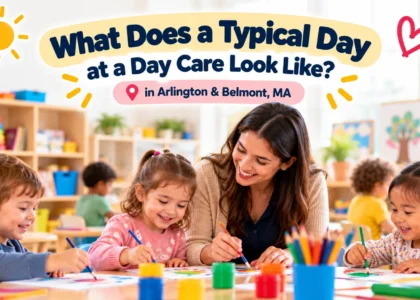
What Does a Typical Toddler Day Care Day Look Like?
Every program is different, but a toddler day may include several predictable components.
Arrival
A child may arrive with a parent or caregiver.
Teachers welcome the child and help them transition into the classroom.
For a toddler experiencing separation anxiety, this can be an important moment.
A quality program should have a consistent approach to helping children transition from parent to classroom.
Choice Time
Children may choose among several developmentally appropriate activities.
Examples include:
- Blocks
- Books
- Puzzles
- Dolls
- Pretend food
- Cars
- Art materials
- Sensory materials
- Soft climbing equipment
Choice time supports independence and allows educators to observe children’s interests.
Morning Snack
Snack time provides an opportunity for children to practice:
- Sitting with others
- Drinking from a cup
- Feeding themselves
- Communicating preferences
- Waiting briefly
- Following routines
Parents should ask whether meals and snacks are provided or packed from home.
Group Activities
Toddler group activities should usually be short enough to match children’s developmental abilities.
Examples include:
- Songs
- Finger plays
- Movement games
- Simple stories
- Music
- Greeting routines
- Animal sounds
- Interactive books
A toddler classroom does not need long academic lessons to support learning.
Outdoor Play for Toddlers
Outdoor play is an important part of early childhood.
Toddlers need opportunities to move their bodies, experience different textures, observe nature, and practice physical skills.
Outdoor experiences may include:
- Walking
- Running
- Climbing
- Pushing toys
- Balls
- Sand
- Water
- Nature exploration
- Playground equipment
- Music and movement
When touring a daycare, parents should ask:
“How often do toddlers go outside?”
Also ask:
“What happens during bad weather?”
The answer can reveal how seriously the program approaches physical activity.
Indoor Learning and Play
A toddler classroom should offer a variety of developmentally appropriate materials.
Look for:
- Low shelves
- Clearly accessible toys
- Books
- Soft spaces
- Building materials
- Pretend-play materials
- Art supplies
- Sensory materials
- Age-appropriate furniture
- Safe movement areas
A classroom does not have to be filled with expensive toys.
In fact, simple open-ended materials can create excellent learning opportunities.
For example:
Blocks
Can support:
- Balance
- Spatial awareness
- Problem-solving
- Fine motor development
- Early math concepts
Books
Can support:
- Vocabulary
- Attention
- Listening
- Communication
- Early literacy
Pretend play
Can support:
- Language
- Social development
- Imagination
- Emotional expression
Sensory activities
Can support:
- Exploration
- Fine motor development
- Cause-and-effect understanding
Toddler Language Development in Day Care
Language development is one of the most important areas to observe.
Toddlers may communicate through:
- Words
- Gestures
- Sounds
- Facial expressions
- Pointing
- Body language
- Emerging sentences
Teachers can support language development by narrating what children are doing.
For example:
Instead of simply saying:
“Good job.”
A teacher might say:
“You put the red block on top of the blue block.”
That gives the child additional language connected to their experience.
Parents should listen for educators who:
- Talk with children
- Listen to children
- Respond to gestures
- Expand vocabulary
- Read books
- Sing songs
- Encourage communication
- Respect children’s attempts to communicate
Social-Emotional Development in Toddler Day Care
Toddlerhood is a major period for emotional development.
Children may experience strong emotions but have limited ability to regulate them.
A toddler may:
- Become frustrated quickly
- Cry when routines change
- Struggle with sharing
- Become upset when another child takes a toy
- Resist transitions
- Have difficulty waiting
- Want to do everything independently
This is normal toddler behavior.
The goal of a quality program is not to eliminate these behaviors.
Instead, educators should help children gradually learn how to manage emotions and interact with others.
How Should a Day Care Handle Toddler Tantrums?
Parents should ask this question during a daycare tour.
A strong answer should generally focus on:
- Safety
- Calm adult responses
- Understanding the reason behind behavior
- Redirection
- Consistent boundaries
- Helping children identify feelings
- Teaching alternative behaviors
- Age-appropriate expectations
Parents should be cautious about programs that describe normal toddler emotions primarily in terms of punishment or shame.
Toddlers need guidance because they are still developing self-regulation.
Toddler Separation Anxiety
Separation anxiety is common during early childhood.
A toddler who happily entered daycare one month may suddenly cry at drop-off the next month.
This does not automatically mean the program is bad.
Development changes.
Children may experience separation anxiety because of:
- Developmental changes
- Changes at home
- New classroom routines
- Illness
- Travel
- A new sibling
- Changes in sleep
- Developmental transitions
Ask the daycare:
- How do you handle difficult drop-offs?
- Can parents call after leaving?
- Do teachers send updates?
- Is there a consistent caregiver?
- What strategies help children transition?
Toddler Day Care and Independence
One of the most valuable benefits of quality toddler care is increasing independence.
Teachers can encourage children to:
- Put toys away
- Wash hands
- Carry small items
- Choose activities
- Help with simple routines
- Try feeding themselves
- Put belongings in designated places
- Attempt simple self-care tasks
The goal is not to make toddlers completely independent.
The goal is to give them opportunities to practice.
Diapering and Potty Training
Parents should ask exactly how diapering works.
Important questions include:
- Who changes diapers?
- How frequently are diapers checked?
- Are diaper supplies provided by parents?
- How are diaper changes documented?
- How are diapering areas cleaned?
- How does the program support toilet learning?
- Does the program require children to be toilet trained before moving classrooms?
Do not assume that every daycare has the same policy.
Meals and Snacks
Nutrition policies can vary considerably.
Ask:
- Does the program provide food?
- Do parents send meals?
- Are snacks included?
- How are allergies handled?
- How are food allergies communicated to staff?
- Are children encouraged to self-feed?
- How are choking risks addressed?
- Are special dietary needs accommodated?
- Are children allowed enough time to eat?
Parents should also ask how the center handles food brought from home.
Nap and Rest Time
Toddlers may need a substantial rest period during the day.
However, children have different sleep patterns.
Ask:
- What time is rest?
- How long is rest?
- Are children required to sleep?
- What happens if a child does not sleep?
- Are children allowed quiet activities?
- Where do children sleep?
- How are sleeping children supervised?
- What bedding should parents provide?
A good program should have a clear, developmentally appropriate rest policy.
Toddler Classroom Ratios
Staffing ratios are one of the most important things parents should investigate.
Massachusetts regulations include specific requirements for toddler groups. For fixed-age groups, the state identifies toddlers as 15 to 33 months, with a maximum group size of 9 and an adult-child ratio of 1:4, with an additional adult required for groups of 5 to 9 toddlers.
Parents should still ask how a particular program staffs the classroom throughout the entire day.
Questions to ask include:
- How many children are enrolled?
- How many educators are normally present?
- What happens during staff breaks?
- How are absences covered?
- Is there a floating teacher?
- How often do substitute teachers enter the classroom?
- Are children ever combined with another age group?
The number of adults matters, but consistency also matters.
Why Consistent Caregivers Matter
A toddler may develop a strong relationship with a familiar caregiver.
Consistency helps children know:
- Who will greet them
- Who understands their routines
- Who knows their comfort signals
- Who helps them during transitions
- Who can communicate with their parents
Ask:
“How often do teachers change classrooms?”
Also ask:
“What is your staff turnover like?”
A program with a stable teaching team may offer children greater continuity.
How Massachusetts Regulates Child Care
Massachusetts Department of Early Education and Care oversees licensing for different types of child-care programs.
EEC requirements address areas such as:
- Health
- Safety
- Supervision
- Staff qualifications
- Training
- Background checks
- Educator-child ratios
- Program operations
Parents can use Massachusetts’ child-care search resources to look for licensed programs.
EEC also states that families can contact the agency for information about a program’s license history, including non-compliance findings and current restrictions.
This is an important step before enrolling a toddler.
How to Verify a Toddler Day Care in Arlington, MA
Before choosing a program, parents should independently verify its licensing information.
Start by searching the Massachusetts EEC child-care database.
Then look for:
- Program name
- Address
- Age groups served
- License status
- Capacity
- Schedule
- Inspection information
- Monitoring reports
- Compliance information
- Any restrictions listed
Do not rely only on Google reviews.
Reviews can provide useful context, but licensing and direct observation are especially important when evaluating child care.
Arlington, MA Toddler Day Care Options
Arlington has a range of early childhood and child-care providers serving different age groups and schedules.
Depending on availability and program structure, parents may encounter:
- Center-based child care
- Family child care
- Preschool programs
- Nursery schools
- Infant-toddler programs
- Mixed-age programs
- Private early education centers
- School-affiliated programs
Availability changes frequently, so parents should confirm current enrollment, age eligibility, hours, tuition, and licensing directly with each provider.
When searching online, useful terms include:
- Toddler day care Arlington MA
- Toddler daycare Arlington Massachusetts
- Child care Arlington MA
- Daycare for toddlers Arlington MA
- Infant toddler daycare Arlington MA
- Early childhood education Arlington MA
- Toddler preschool Arlington MA
- Full-day toddler daycare Arlington MA
- Affordable toddler daycare Arlington MA
- Licensed daycare Arlington MA
Toddler Day Care Near Belmont, MA
Families living in Belmont may also consider Arlington because the communities are geographically close and families may travel between them for work, school, or daily activities.
When searching for child care near Belmont, parents should avoid focusing only on the city name.
Instead, evaluate:
- Actual driving time
- Morning traffic
- Pickup flexibility
- Parking
- Program hours
- Emergency pickup requirements
- School-year vs year-round schedule
- Holiday closures
- Vacation closures
- Toddler age eligibility
A daycare that is technically nearby may not be convenient if its closing time conflicts with a parent’s work schedule.
Arlington vs. Belmont for Toddler Day Care
Parents searching both communities can create a simple comparison.
| Factor | Arlington | Belmont |
|---|---|---|
| Toddler daycare availability | Multiple provider types | Multiple provider types |
| Center-based care | Available | Available |
| Family child care | Available | Available |
| Preschool programs | Available | Available |
| Public early childhood programs | Available for eligible age groups | Available for eligible age groups |
| Licensing verification | Massachusetts EEC | Massachusetts EEC |
| Commute considerations | Important | Important |
| Tuition | Varies by provider | Varies by provider |
| Schedule | Provider-specific | Provider-specific |
| Age eligibility | Provider-specific | Provider-specific |
There is no universal “best” location.
The right choice depends on your child’s needs and your family’s practical requirements.
Public Preschool vs. Toddler Day Care
Parents sometimes compare toddler daycare with public preschool.
The age distinction is important.
For example, Arlington’s Menotomy Preschool is designed for children from age 3 through kindergarten-entry age, rather than the younger toddler stage. Its program is integrated and includes children with and without special needs.
Belmont’s public integrated preschool similarly serves children ages 3–5.
Therefore, families seeking care for a child who is still in the toddler age range will generally need to investigate child-care programs specifically designed for younger children rather than assuming a public preschool program will meet their needs.
What Does a High-Quality Toddler Curriculum Look Like?
A toddler curriculum does not necessarily mean worksheets.
Massachusetts EEC describes high-quality early education curriculum as developmentally appropriate, hands-on, responsive to children’s interests and abilities, and capable of providing multiple ways for children to engage through movement, words, songs, and sensory experiences.
For toddlers, curriculum may emerge through:
- Blocks
- Water play
- Sand
- Music
- Movement
- Books
- Art
- Nature
- Dramatic play
- Puzzles
- Sorting
- Matching
- Sensory activities
- Simple cooking experiences
- Outdoor exploration
The most important question is not:
“How many worksheets does my child complete?”
It is:
“What is my child learning through everyday experiences?”
Early Math for Toddlers
Toddlers can begin developing mathematical thinking without formal math lessons.
Examples include:
- Counting objects
- Comparing sizes
- Matching
- Sorting
- Stacking
- Filling and emptying
- Identifying shapes
- Recognizing patterns
- Understanding more and less
- Exploring spatial relationships
A teacher might say:
“You have two blocks.”
Or:
“That tower is taller.”
These simple interactions build mathematical vocabulary and concepts.
Early Literacy for Toddlers
Early literacy begins long before children read independently.
A strong toddler classroom should provide:
- Frequent book reading
- Picture books
- Songs
- Rhymes
- Conversation
- Storytelling
- Drawing
- Scribbling
- Vocabulary-building activities
Parents should look for books that are accessible to children throughout the day.
Art for Toddlers
Toddler art should focus on exploration rather than producing perfect crafts.
Children might explore:
- Finger paint
- Crayons
- Large brushes
- Paper
- Stickers
- Clay
- Safe collage materials
The process is often more important than the finished product.
Sensory Play
Sensory activities allow toddlers to explore through touch, sight, sound, movement, and sometimes smell.
Examples include:
- Water
- Sand
- Dough
- Rice alternatives designed for safe use
- Textured materials
- Soft objects
- Large containers
- Scoops
- Cups
Programs should ensure sensory materials are appropriate for the age group and supervised appropriately.
Music and Movement
Music can support:
- Language
- Memory
- Coordination
- Rhythm
- Social interaction
- Emotional expression
Toddler programs may incorporate:
- Singing
- Clapping
- Dancing
- Instruments
- Finger plays
- Movement games
Toddler Outdoor Safety
During a tour, parents should observe outdoor areas carefully.
Look for:
- Secure boundaries
- Appropriate equipment
- Safe surfaces
- Shade where appropriate
- Adequate supervision
- Age-appropriate equipment
- Safe entry and exit
- Clean areas
Ask how teachers position themselves during outdoor play.
Supervision is not simply about being outside with children.
Adults need to actively monitor the children.
Indoor Safety Checklist
Look for:
- Secure doors
- Child-safe furniture
- Covered electrical outlets where required
- Safe storage
- Accessible emergency exits
- Clean floors
- Age-appropriate toys
- Secure shelving
- Safe sleeping arrangements
- Appropriate diapering areas
- Handwashing facilities
Also notice what is happening around you.
Do teachers know where the children are?
Are they engaged?
Are children being supervised continuously?
Health and Hygiene
Toddlers frequently encounter illnesses because they are still developing immune defenses and often interact closely with other children.
Ask about:
- Handwashing
- Cleaning schedules
- Toy sanitation
- Illness policies
- Fever policies
- Medication administration
- Diapering hygiene
- Food safety
- Allergy procedures
- Cleaning of sleeping areas
Ask for the written illness policy before enrollment.
How Does Toddler Day Care Handle Sick Children?
Every daycare should have a written illness policy.
Ask:
- What temperature requires pickup?
- How long must a child remain home?
- What happens after vomiting?
- How is diarrhea handled?
- What happens if a child develops symptoms during the day?
- How quickly are parents contacted?
- Can another authorized adult pick up the child?
Understanding these rules before enrollment prevents surprises later.
Toddler Allergies
Food allergies require special attention.
Ask:
- Does the classroom have allergy restrictions?
- Are allergy lists visible to staff?
- Are substitute teachers informed?
- What happens during meals?
- Is outside food allowed?
- Are emergency medications handled?
- What training do staff receive?
Parents should provide complete and updated medical information.
Communication With Parents
Strong parent communication can make a major difference.
Depending on the program, communication may include:
- Daily reports
- Apps
- Phone calls
- Photos
- Written notes
- Parent meetings
- Developmental conferences
Ask:
“How will I know how my child spent the day?”
Also ask:
“How do teachers communicate concerns?”
You want a clear process rather than finding out weeks later that your child has been struggling.
Questions to Ask During a Toddler Day Care Tour
Before choosing a daycare, prepare questions.
Program Questions
- What ages do you accept?
- What is the minimum enrollment age?
- What is the maximum age for the toddler classroom?
- How many children are enrolled?
- How many educators are assigned?
- What are your hours?
- Are you open year-round?
- What holidays are you closed?
- Are you open during school vacations?
- Do you offer extended hours?
Teacher Questions
- What qualifications do teachers have?
- What training do teachers receive?
- Are staff CPR and First Aid certified?
- How long have teachers worked here?
- What is staff turnover like?
- How are substitutes handled?
Toddler Development Questions
- How do you support language development?
- How do you handle tantrums?
- How do you support shy children?
- How do you support active children?
- How do you handle biting?
- How do you handle toy conflicts?
- How do you support toilet learning?
- How do you handle separation anxiety?
Daily Routine Questions
- What does a typical day look like?
- How much outdoor time do toddlers receive?
- When do children nap?
- What happens if a child does not sleep?
- How are meals handled?
- What activities are available?
Safety Questions
- How is the classroom supervised?
- How are children released to adults?
- How are visitors managed?
- What is your emergency procedure?
- How are allergies handled?
- What is your illness policy?
What to Observe During the Tour
Do not simply listen to the director.
Observe.
Look at the Children
Do they appear:
- Comfortable?
- Curious?
- Engaged?
- Relaxed?
- Active?
- Supported?
No classroom will look perfectly calm all the time.
Toddlers are energetic.
The question is whether the environment appears appropriately managed.
Watch the Teachers
Look for educators who:
- Get down to children’s eye level
- Respond to children’s communication
- Comfort children
- Speak respectfully
- Notice children’s interests
- Redirect calmly
- Know children’s routines
Look at the Environment
Ask yourself:
- Is the room clean?
- Is it organized?
- Are materials accessible?
- Are toys age appropriate?
- Is there enough room to move?
- Is there a quiet area?
- Is there a reading area?
- Is the environment stimulating without being overwhelming?
Red Flags Parents Should Investigate
No single issue automatically means a program is unsuitable, but certain warning signs deserve careful attention.
Potential concerns include:
- Staff unable to explain daily routines
- Unclear supervision practices
- High staff turnover
- Unwillingness to answer licensing questions
- Poor communication
- Dirty or unsafe environments
- Teachers frequently using phones while supervising
- Children spending most of the day in restrictive settings
- Lack of outdoor opportunities
- No clear illness policy
- Unclear emergency procedures
- Pressure to enroll immediately
- Inconsistent answers from different staff members
Parents should investigate concerns rather than relying solely on first impressions.
Green Flags in a Toddler Day Care
Positive indicators can include:
- Warm teacher-child interactions
- Stable staffing
- Clear routines
- Clean classrooms
- Accessible materials
- Active supervision
- Respectful communication
- Developmentally appropriate expectations
- Outdoor play
- Family involvement
- Clear policies
- Transparent tuition
- Clear enrollment procedures
- Strong licensing documentation
How Much Does Toddler Day Care Cost in Arlington, MA?
Toddler daycare tuition can vary significantly.
Pricing depends on factors such as:
- Child’s age
- Number of days
- Full-time vs. part-time enrollment
- Program hours
- Extended care
- Meals
- Location
- Program type
- Staffing
- Facilities
- Curriculum
- Year-round operation
Parents should never assume that one advertised price represents the actual annual cost.
Ask for a complete fee schedule.
Questions About Daycare Tuition
Ask whether tuition includes:
- Registration
- Enrollment fees
- Materials
- Meals
- Snacks
- Extended care
- Summer care
- Field trips
- Special activities
- Late pickup
- Vacation weeks
Also ask about:
- Deposits
- Refunds
- Sibling discounts
- Payment schedules
- Withdrawal policies
- Tuition increases
Full-Time vs. Part-Time Toddler Day Care
Some families need full-time care.
Others need only a few days each week.
Before choosing a program, determine your actual schedule.
Full-time care may be useful for:
- Full-time working parents
- Families with long commutes
- Families needing consistent weekday coverage
Part-time care may be useful for:
- Flexible work schedules
- Parents working from home
- Families combining daycare with family care
- Gradual transitions
Ask whether part-time enrollment is offered.
Some centers may prioritize full-time enrollment.
What If Your Toddler Has Special Developmental Needs?
Every child develops differently.
Some toddlers may need additional support related to:
- Speech
- Language
- Motor development
- Social interaction
- Sensory needs
- Communication
- Behavior
- Feeding
- Developmental differences
Parents should ask:
“How does your program support children who need additional developmental assistance?”
Also ask whether the program works with:
- Speech-language professionals
- Occupational therapists
- Physical therapists
- Early intervention providers
- Pediatric specialists
Massachusetts’ early learning guidance emphasizes responsive relationships and developmentally appropriate experiences, while local public early childhood programs such as Menotomy Preschool and Belmont Integrated Preschool demonstrate that Arlington and Belmont have established early-childhood systems serving children with varied developmental needs.
Toddler Day Care and Early Intervention
If you have concerns about your child’s development, talk with your pediatrician and relevant early childhood professionals.
A daycare should not diagnose developmental conditions.
Instead, teachers can:
- Observe
- Document
- Communicate with parents
- Share developmental observations
- Collaborate with families and authorized professionals
Parents should ask how developmental concerns are communicated.
How to Make the Transition Easier
Starting daycare can be emotional.
Parents can prepare toddlers by:
Establishing routines
Try to maintain consistent:
- Wake-up times
- Breakfast
- Getting dressed
- Leaving home
- Pickup routines
Talking about daycare
Use simple language.
For example:
“We’re going to your classroom. You will play with your teachers and friends. I will come back after lunch.”
Practicing short separations
Allow your child to spend time with trusted adults before starting.
Bringing a comfort item
If the program permits it, a small comfort object can help.
Keeping goodbyes predictable
Long emotional goodbyes can sometimes make transitions harder.
Ask teachers about their preferred drop-off process.
What Should Parents Pack for Toddler Day Care?
Depending on the program, you may need:
- Diapers
- Wipes
- Extra clothing
- Weather-appropriate clothing
- Shoes
- Bottles or cups
- Food
- Comfort item
- Sunscreen if permitted
- Medication if required
- Nap items
Label everything.
Toddlers often have remarkably similar-looking clothing and belongings.
Seasonal Clothing for Arlington Toddlers
New England weather can change considerably throughout the year.
Parents should ask whether children go outside daily and prepare accordingly.
Depending on the season, this might mean:
- Warm layers
- Hats
- Gloves
- Rain gear
- Snow clothing
- Waterproof footwear
- Light jackets
- Sun protection
Keep a backup outfit at daycare.
How to Compare Multiple Toddler Daycares
Do not compare programs based on tuition alone.
Create a comparison sheet.
| Factor | Daycare A | Daycare B | Daycare C |
|---|---|---|---|
| Location | |||
| Commute | |||
| Hours | |||
| Toddler age range | |||
| Staffing | |||
| Classroom size | |||
| Outdoor play | |||
| Meals | |||
| Nap policy | |||
| Tuition | |||
| Registration fee | |||
| Extended care | |||
| Staff turnover | |||
| Parent communication | |||
| Licensing information | |||
| Tour experience | |||
| Child’s reaction |
Your child’s reaction during a visit can be useful information, but it should not be the only factor.
How Far Should Toddler Day Care Be From Home?
There is no universal distance.
Instead, consider your actual daily routine.
A daycare five minutes farther away may be easier if:
- It is on your commute
- Parking is easier
- Pickup is flexible
- Hours match your work schedule
A closer daycare may be less practical if:
- It closes too early
- It is difficult to park
- Your commute goes in the opposite direction
- It does not provide the days you need
Think in terms of door-to-door daily logistics, not simply miles.
Arlington Neighborhood Considerations
Arlington families may evaluate daycare based on proximity to:
- Home
- Work
- Major roads
- Public transportation
- Schools
- Family members
- Regular activity locations
If you live close to the Arlington-Belmont border, compare providers in both communities.
This can expand your options.
How to Search Google for Toddler Day Care in Arlington, MA
Parents often begin with Google.
Useful searches include:
Primary keyword
Toddler day care in Arlington, MA
Supporting keywords
- Toddler daycare Arlington MA
- Toddler childcare Arlington MA
- Daycare for toddlers Arlington MA
- Toddler child care near Arlington MA
- Infant toddler daycare Arlington MA
- Best toddler daycare Arlington MA
- Licensed toddler daycare Arlington MA
- Full-time toddler daycare Arlington MA
- Part-time toddler daycare Arlington MA
- Affordable toddler daycare Arlington MA
- Early childhood care Arlington MA
- Toddler preschool Arlington MA
- Child care center Arlington MA
- Daycare near Arlington MA
- Toddler care near Belmont MA
- Toddler daycare Belmont MA
- Child care Belmont MA
Local SEO Strategy for Arlington and Belmont
If this article is being published on a local child-care website, the page should not simply repeat “Toddler Day Care in Arlington, MA” dozens of times.
Instead, use semantic relevance.
Include natural references to:
- Arlington
- Arlington, Massachusetts
- Belmont
- Belmont, Massachusetts
- Greater Boston
- Middlesex County
- Local families
- Toddler care
- Early childhood education
- Child care
- Preschool
- Infant care
- Toddler development
- Family child care
- Licensed child care
- Early learning
- Daycare enrollment
This creates a stronger topical relationship than keyword stuffing.
Suggested Internal Links
This article should connect to other relevant pages on the website.
Suggested internal links:
- Day Care in Arlington, MA
- Toddler Day Care Services
- Infant Day Care
- Preschool in Arlington, MA
- Child Care in Belmont, MA
- Early Childhood Education
- Daycare Tuition and Enrollment
- About Our Teachers
- Our Safety Policies
- Parent Handbook
- Contact Us
- Schedule a Tour
Internal links should use descriptive anchor text rather than generic phrases such as “click here.”
Suggested Supporting Blog Topics
To build topical authority around this page, create supporting content such as:
1. Toddler Day Care vs. Preschool in Arlington, MA
2. How Much Does Toddler Day Care Cost in Arlington, MA?
3. How to Choose a Daycare for a 2-Year-Old in Arlington, MA
4. Questions to Ask Before Choosing Toddler Daycare
5. How to Prepare Your Toddler for Daycare
6. Toddler Separation Anxiety: A Parent’s Guide
7. Toddler Daycare Near Belmont, MA
8. Full-Time vs. Part-Time Daycare in Arlington
9. What Does a Toddler Do at Daycare All Day?
10. How Daycare Supports Toddler Development
11. Daycare Safety Checklist for Parents
12. Toddler Meal and Snack Policies: What Parents Should Ask
13. Toddler Nap and Rest Time at Daycare
14. How to Find Licensed Child Care in Massachusetts
15. Arlington, MA Preschool vs. Toddler Daycare
This cluster can strengthen topical authority around the primary keyword.
Common Mistakes Parents Make
Mistake 1: Choosing Based Only on Reviews
Reviews are useful, but they do not tell the entire story.
Visit the program.
Mistake 2: Focusing Only on Tuition
A lower monthly price does not necessarily mean lower total cost.
Consider:
- Hours
- Holidays
- Extended care
- Registration fees
- Meals
- Commute
- Vacation schedules
Mistake 3: Ignoring Staff Stability
Ask about turnover.
Toddlers benefit from consistent relationships.
Mistake 4: Not Checking Licensing
Always investigate licensing information.
Massachusetts provides resources for parents to search licensed child-care programs and learn about license history and compliance information.
Mistake 5: Waiting Too Long
Popular programs can have waiting lists.
Start researching before you urgently need care.
Mistake 6: Not Asking About Sick Policies
Your child will eventually get sick.
Know the rules before enrollment.
Mistake 7: Forgetting About Pickup Logistics
A daycare that closes at 5:00 PM may not work if your commute makes a 5:00 PM pickup difficult.
How Early Should You Start Looking?
There is no universal timeline because availability varies.
However, families should begin researching well before their desired start date.
A practical approach is:
Several months before enrollment
Research programs.
After creating a shortlist
Schedule tours.
After tours
Compare policies and costs.
Before enrollment
Review the contract and parent handbook carefully.
Before the first day
Complete required paperwork and prepare your child.
The Importance of a Daycare Tour
A website can tell you what a daycare claims to provide.
A tour lets you see what happens in real life.
During the tour, notice:
- Teacher interactions
- Classroom cleanliness
- Children’s engagement
- Noise levels
- Outdoor space
- Materials
- Organization
- Staff communication
- Safety procedures
Trust observations more than marketing language.
What Parents Should Look for in Teachers
A strong toddler educator should be able to:
- Build relationships
- Communicate with children
- Recognize individual needs
- Set appropriate boundaries
- Support emotional regulation
- Encourage exploration
- Maintain safety
- Communicate with parents
- Work as part of a team
The most important question is not simply:
“What degree does the teacher have?”
Also ask:
“How does the teacher interact with my child?”
Toddler Day Care and Play-Based Learning
Play is one of the primary ways young children explore the world.
A toddler stacking blocks is learning.
A toddler pretending to feed a doll is learning.
A toddler pouring water from one cup to another is learning.
A toddler running outside is learning about movement and space.
A toddler looking through a picture book with a teacher is learning language.
This is why high-quality early childhood programs often integrate learning into play and everyday routines rather than relying heavily on formal instruction.
Why Relationships Matter More Than Worksheets
For toddlers, a caring relationship with a responsive adult can support learning in ways that a worksheet cannot.
A teacher who notices a child struggling with a puzzle can:
- Encourage persistence
- Offer a hint
- Ask a question
- Model a strategy
- Celebrate effort
The child learns problem-solving while also developing trust and confidence.
Preparing Your Child for Kindergarten
Toddler daycare is not kindergarten.
Parents should not expect a toddler classroom to function like elementary school.
However, high-quality toddler care can help establish foundational skills such as:
- Communication
- Independence
- Following routines
- Listening
- Social interaction
- Emotional regulation
- Curiosity
- Problem-solving
- Motor skills
- Self-help skills
These foundational skills become useful later in preschool and kindergarten.
A Parent’s Final Toddler Daycare Checklist
Before enrolling, make sure you can answer:
Safety
- Is the program licensed?
- Are staff background checks completed?
- Are safety procedures clear?
- Is supervision adequate?
Teachers
- Are educators qualified?
- Are they responsive?
- Is staff turnover reasonable?
Classroom
- Is the classroom clean?
- Is it age appropriate?
- Are materials accessible?
Development
- Is there language-rich interaction?
- Is there physical activity?
- Is there sensory exploration?
- Is there social interaction?
Daily Care
- How are diapers handled?
- How is food handled?
- What is the nap policy?
- What happens when a child is sick?
Schedule
- Are the hours compatible with work?
- Are holidays manageable?
- Is vacation care available?
Cost
- What is the complete tuition?
- Are there additional fees?
- What is the withdrawal policy?
Communication
- How do teachers communicate with parents?
- Are developmental concerns discussed?
- Are daily updates provided?
30 Frequently Asked Questions About Toddler Day Care in Arlington, MA
1. What age is considered a toddler for daycare in Massachusetts?
Programs may define age groups differently, but Massachusetts’ fixed-age licensing requirements identify toddlers as children from approximately 15 through 33 months.
Always confirm the specific age range directly with the daycare.
2. What should I look for in toddler daycare in Arlington, MA?
Look for a licensed program, responsive educators, appropriate staffing, safe facilities, predictable routines, developmentally appropriate activities, outdoor opportunities, good communication, and policies that fit your family’s needs.
3. How do I find licensed toddler daycare in Arlington?
Use the Massachusetts EEC child-care search resources and verify the program’s licensing information, age groups, schedule, and compliance history.
4. Is daycare good for toddlers?
A high-quality daycare can provide opportunities for secure relationships, social interaction, communication, physical activity, exploration, independence, and developmentally appropriate learning.
The quality of the specific program matters.
5. What is the difference between toddler daycare and preschool?
Toddler daycare generally serves younger children and places greater emphasis on caregiving, relationships, routines, exploration, and emerging independence. Preschool generally serves older children and may include more structured early-learning experiences.
6. How much does toddler daycare cost in Arlington, MA?
Tuition varies considerably by provider, schedule, age, hours, and services. Parents should request a current tuition and fee schedule directly from each program.
7. Is toddler daycare available near Belmont, MA?
Yes, families in Belmont can investigate local child-care and early education programs as well as nearby Arlington options. Availability and age eligibility vary by provider.
8. Should I choose daycare close to home or work?
Consider your entire daily commute. The best location is one that makes drop-off and pickup realistic and reliable.
9. How many children should be in a toddler classroom?
Massachusetts licensing requirements include specific toddler group-size and adult-child ratio requirements. Parents should verify the current staffing arrangement with the specific provider.
10. What is the Massachusetts toddler daycare ratio?
For fixed-age toddler groups of 15–33 months, Massachusetts requirements specify a maximum group size of nine and an adult-child ratio of 1:4, with additional staffing requirements as group size increases.
11. Do toddlers nap at daycare?
Many toddler programs provide rest or nap opportunities, but policies differ. Ask when rest occurs and what happens if your child does not sleep.
12. Do toddler daycares help with potty training?
Some do, while others have specific requirements. Ask for the program’s toilet-learning policy before enrollment.
13. What should my toddler bring to daycare?
Depending on the provider, children may need diapers, wipes, extra clothing, food, bottles or cups, comfort items, and weather-appropriate clothing.
14. How do daycare teachers handle tantrums?
Teachers should generally use calm, age-appropriate guidance, redirection, emotional support, safety procedures, and consistent boundaries.
15. What if my toddler cries every morning?
Separation anxiety is common. Ask the program how teachers support difficult drop-offs and how parents receive updates after leaving.
16. How can I prepare my toddler for daycare?
Establish predictable routines, talk positively about daycare, practice short separations, and follow the center’s recommended transition plan.
17. Does toddler daycare provide meals?
Some programs provide meals and snacks; others require parents to pack food. Always ask about nutrition and allergy policies.
18. How much outdoor play should toddlers get?
Ask each program about its daily outdoor routine and what happens during rain, snow, or extreme weather.
19. What questions should I ask during a daycare tour?
Ask about staffing, ratios, daily schedules, safety, meals, nap, diapering, outdoor play, tuition, licensing, communication, illness policies, and teacher turnover.
20. How do I know if a daycare is safe?
Review licensing information, visit the facility, observe supervision, ask about emergency procedures, and review health and safety policies.
21. Is family child care different from center-based daycare?
Yes. Family child care typically operates in a residential setting and may have a smaller group. Center-based programs operate in non-residential settings and may have multiple classrooms.
22. Can toddlers attend preschool?
Some programs accept younger children, but many preschool programs begin around age 3. Confirm the exact age eligibility of each program.
23. Can Arlington families use daycare in Belmont?
Eligibility depends on the provider. Private child-care programs may have their own enrollment policies, while public programs can have residency and eligibility requirements.
24. Can Belmont families use daycare in Arlington?
Potentially, depending on the provider’s enrollment rules. Parents should confirm whether the program accepts families who live outside Arlington.
25. Should I visit more than one daycare?
Yes. Visiting multiple programs makes it easier to compare environments, teachers, routines, communication, and costs.
26. How long does it take for a toddler to adjust to daycare?
Adjustment varies from child to child. Some children transition quickly while others need more time and consistent routines.
27. What happens if my toddler bites another child?
Ask the program for its behavior policy. A developmentally appropriate approach should prioritize safety, communication with families, understanding triggers, and teaching alternative behaviors.
28. How important is teacher turnover?
Teacher stability can matter because toddlers benefit from consistent relationships with familiar adults. Ask about staffing stability and how the center handles employee absences.
29. How can daycare support toddler development?
Daycare can support development through responsive relationships, language-rich interactions, play, movement, social experiences, sensory activities, routines, and opportunities for independence.
30. What is the best toddler daycare in Arlington, MA?
There is no universally best program for every family. Parents should compare licensing, safety, teacher-child interactions, age fit, schedule, cost, location, communication, and their child’s individual needs.
Arlington and Belmont Parent Research Checklist
If you are comparing toddler day care in Arlington, MA and toddler daycare near Belmont, MA, use this process:
Step 1: Define your child’s age
Determine exactly how old your child will be when care begins.
Step 2: Define your schedule
Write down:
- Required start time
- Required pickup time
- Number of days
- Full-time or part-time
- Vacation needs
Step 3: Search licensed programs
Use Massachusetts EEC resources.
Step 4: Create a shortlist
Choose several programs.
Step 5: Read policies
Review:
- Tuition
- Illness
- Food
- Diapers
- Nap
- Pickup
- Holidays
Step 6: Tour
Visit the classroom.
Step 7: Observe
Watch teacher-child interactions.
Step 8: Ask questions
Use your prepared checklist.
Step 9: Compare total cost
Don’t compare only monthly tuition.
Step 10: Consider your child’s personality
Think about:
- Shyness
- Energy
- Sensory preferences
- Communication
- Sleep
- Comfort with groups
Step 11: Check availability
Ask about current openings and waiting lists.
Step 12: Review the contract
Understand the financial and enrollment commitments before signing.
Final Thoughts: Choosing Toddler Day Care in Arlington, MA
Choosing a toddler day care in Arlington, MA is about finding the right combination of safety, relationships, development, schedule, location, communication, and family fit.
Toddlers are not simply smaller preschoolers.
They have unique developmental needs.
They need adults who understand their communication, support their emerging independence, provide predictable routines, respond to emotions, encourage exploration, and maintain a safe environment.
For Arlington families, there are multiple types of early childhood programs to investigate. Families near Belmont can also expand their search across nearby communities when practical.
The most important step is not simply finding a daycare with an attractive website.
Visit.
Ask questions.
Observe.
Check licensing information.
Talk with teachers.
Understand the policies.
Compare the total cost.
Consider your commute.
And most importantly, consider whether the environment appears to understand and respect toddlers as developing individuals.
A quality toddler program can become an important part of a child’s early years—not only providing reliable care while parents work, but also creating opportunities for relationships, exploration, language, movement, social development, confidence, and independence.
For parents searching for toddler day care in Arlington, MA, the right decision begins with informed research and a careful look at what happens inside the classroom every day.