
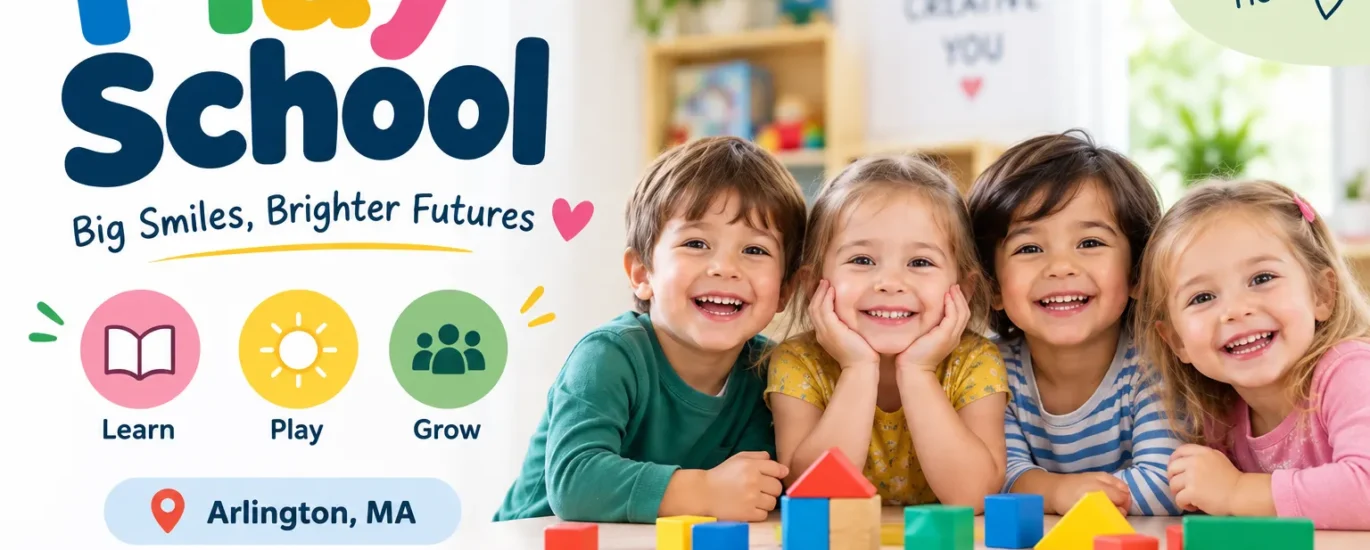
Choosing an early learning environment is one of the first major educational decisions a family makes. For parents searching for a play school in Arlington, MA, the goal is often bigger than simply finding a convenient place where a young child can spend part of the day. Parents want an environment where their child can feel safe, make friends, develop confidence, learn through exploration, strengthen communication skills, and build a positive relationship with learning.
That is exactly where a high-quality play-based early childhood program can make a difference.
A play school provides young children with opportunities to discover the world in ways that feel natural to them. Rather than expecting preschool-aged children to learn primarily through worksheets, memorization, or long periods of sitting still, play-based programs use activities such as building, storytelling, art, music, movement, imaginative play, outdoor exploration, puzzles, sensory activities, games, and conversations to promote development.
For families in Arlington, Massachusetts, and nearby Belmont, MA, choosing the right early learning environment requires looking carefully at much more than a school’s name.
Parents should consider the quality of teacher-child interactions, curriculum, daily routine, safety practices, opportunities for free play, social-emotional support, outdoor time, communication with families, location, schedule, classroom environment, and preparation for the transition to kindergarten.
This detailed guide explains what play school means, why play-based learning matters, the developmental benefits it can provide, how to choose a play school in Arlington, MA, what Belmont families should consider, what questions to ask during a tour, and how to decide whether a play-based preschool is the right fit for your young child.
Quick Summary: Why Choose a Play School in Arlington, MA?
A high-quality play school in Arlington, MA can help young children develop through purposeful play, teacher guidance, social interaction, creativity, movement, and exploration.
Potential benefits include:
- Building communication and language skills
- Encouraging creativity and imagination
- Developing friendships
- Improving social skills
- Strengthening emotional regulation
- Developing fine motor skills
- Improving gross motor development
- Introducing early literacy
- Building early mathematical thinking
- Supporting problem-solving
- Increasing independence
- Developing confidence
- Encouraging curiosity
- Creating positive attitudes toward learning
- Helping children become familiar with classroom routines
- Supporting preparation for kindergarten
Parents in Arlington and Belmont, MA should look beyond labels such as “play school,” “preschool,” or “childcare” and evaluate what children actually experience during the day.
The strongest early learning environments usually combine:
Play + Relationships + Exploration + Structure + Communication + Safety + Developmentally Appropriate Learning
What Is a Play School?
A play school is an early childhood program where young children learn primarily through developmentally appropriate activities, exploration, social interaction, and guided play.
Depending on the provider, similar programs may also be described as:
- Preschool
- Play-based preschool
- Early learning center
- Nursery school
- Early childhood program
- Child development center
- Pre-K program
- Early education program
In the United States, including Massachusetts, “preschool” and “early education” are generally more common terms than “play school.”
However, when parents search for a “play school,” they are usually looking for an environment that places significant value on learning through play.
A play-based classroom may include areas for:
- Blocks and construction
- Dramatic or pretend play
- Books and storytelling
- Drawing and painting
- Music
- Puzzles
- Science exploration
- Sensory activities
- Manipulative toys
- Outdoor play
- Movement
- Cooperative games
- Early writing
- Early mathematics
Teachers do not simply leave children to entertain themselves.
In a well-designed play-based program, educators carefully create opportunities that encourage children to experiment, communicate, cooperate, imagine, solve problems, and develop new skills.
Why Is Play So Important for Young Children?
Adults often separate “play” and “learning.”
Young children usually do not.
For a preschool-aged child, play is one of the primary ways of understanding the world.
When children build a tower, they are not merely stacking blocks.
They may be exploring:
- Balance
- Size
- Shape
- Cause and effect
- Spatial relationships
- Counting
- Planning
- Persistence
When children pretend to operate a restaurant, they may be practicing:
- Vocabulary
- Communication
- Turn-taking
- Imagination
- Social roles
- Early mathematics
- Cooperation
- Problem-solving
When children draw or paint, they may be developing:
- Fine motor strength
- Hand-eye coordination
- Creativity
- Symbolic thinking
- Self-expression
When children play outdoors, they can strengthen:
- Balance
- Coordination
- Gross motor skills
- Confidence
- Spatial awareness
- Social cooperation
That is why an effective play school in Arlington, MA should not treat play as a break from learning.
Play can actually be an important vehicle for learning.
Why Arlington, MA Families Are Looking for Play-Based Early Education
Families searching for early education in Arlington have multiple types of programs available to consider.
Arlington Public Schools currently identifies one integrated preschool within the district, alongside its elementary, middle, and high school system. New student registration is handled online.
Families can also explore private early childhood centers, nursery schools, Montessori programs, childcare centers, family childcare providers, and other early-learning settings.
Massachusetts also has a statewide child-care licensing system.
The Massachusetts Department of Early Education and Care, commonly known as EEC, licenses or approves several types of childcare programs, including group, school-age, and family childcare programs.
This gives parents an important starting point when evaluating childcare.
However, licensing should be considered a baseline rather than the only factor in determining whether a particular program is the right choice for your child.
15 Major Benefits of Choosing a Play School in Arlington, MA
1. Play School Helps Children Develop Social Skills
One of the biggest benefits of early childhood education is the opportunity to interact regularly with other children.
At home, a child may be comfortable interacting with parents, grandparents, siblings, or familiar adults.
A group early-learning setting introduces a different social environment.
Children gradually learn how to:
- Introduce themselves
- Join activities
- Share toys
- Wait for turns
- Listen to others
- Express ideas
- Negotiate
- Cooperate
- Solve disagreements
- Understand personal space
- Participate in group routines
- Make friends
These interactions provide valuable opportunities to develop social awareness.
For example, two children may both want the same toy.
Instead of immediately solving the problem for them, an experienced educator might help the children communicate, wait, take turns, or find another solution.
That experience helps children build skills they can use later in school and everyday life.
2. Play-Based Learning Supports Language Development
Young children develop language partly through repeated interaction with adults and peers.
A language-rich play school environment can introduce children to new words and encourage them to communicate.
Teachers may support language development through:
- Storytime
- Songs
- Rhymes
- Conversation
- Pretend play
- Questions
- Picture books
- Vocabulary activities
- Group discussions
- Storytelling
- Show-and-tell
- Puppet activities
Imagine children pretending to run a grocery store.
They may naturally use words such as:
- Customer
- Basket
- Cashier
- Total
- Fruit
- Vegetables
- Shopping
- Money
- Receipt
Instead of memorizing those words from a worksheet, children encounter vocabulary in context.
That can make learning meaningful.
3. Play School Can Build Confidence
Young children are constantly encountering experiences they have never tried before.
In a supportive classroom, a child may:
- Speak in front of a small group
- Complete a puzzle
- Build a structure
- Paint a picture
- Ask a teacher for help
- Make a new friend
- Put away belongings
- Help another child
- Participate in music
- Try a new activity
Each successful experience can contribute to confidence.
A good play school does not expect children to perform perfectly.
Instead, educators encourage them to explore, make mistakes, try again, and gradually develop independence.
4. Children Develop Independence
Young children naturally rely on adults.
Preschool gives them opportunities to practice age-appropriate independence.
Children may gradually learn to:
- Put away toys
- Wash their hands
- Carry their belongings
- Choose an activity
- Clean up
- Put on a jacket
- Open containers
- Ask for help
- Follow classroom routines
- Participate without a parent nearby
These may seem like small skills.
However, they are important parts of becoming ready for school.
5. Play School Encourages Creativity
Creativity is not limited to art.
Children demonstrate creativity when they:
- Invent stories
- Build structures
- Pretend
- Solve problems
- Combine materials
- Experiment
- Ask imaginative questions
- Develop games
A play-based classroom gives children room to think beyond one “correct” answer.
Instead of asking:
“Can you copy this exact picture?”
teachers may ask:
“What would you like to create?”
That simple difference encourages imagination and original thinking.
6. Children Learn Problem-Solving Skills
Play regularly presents small challenges.
A block tower falls.
A puzzle piece does not fit.
Two children want the same toy.
A pretend train cannot fit through a tunnel.
An art project needs something to hold it together.
These situations encourage children to think:
What should I try next?
Educators can guide children without immediately solving every problem for them.
This builds persistence and flexible thinking.
7. Play School Supports Emotional Development
Young children experience strong emotions but are still learning how to understand and manage them.
A skilled early childhood educator can help children identify and communicate emotions.
Children can learn words such as:
- Happy
- Sad
- Angry
- Excited
- Worried
- Frustrated
- Proud
- Calm
- Disappointed
Teachers can also model ways to respond.
For example:
Instead of hitting when frustrated, a child might learn to say:
“I was using that.”
Instead of immediately giving up when something is difficult, a child may learn:
“Can you help me?”
These emotional skills matter both inside and outside school.
8. Play School Supports Early Literacy
Early literacy does not mean preschoolers need to read long books independently.
Literacy foundations can begin through playful experiences.
A good program may introduce:
- Books
- Stories
- Songs
- Rhymes
- Letter awareness
- Letter sounds
- Name recognition
- Drawing
- Scribbling
- Early writing
- Vocabulary
- Listening
- Story sequencing
Teachers might place menus in a pretend restaurant, signs in a block area, labels around the room, or notebooks in dramatic-play areas.
This lets children see that written language has a purpose.
9. Play School Builds Early Mathematics Skills
Mathematics is everywhere in play.
Children may develop early mathematical thinking when they:
- Count blocks
- Sort objects
- Compare sizes
- Create patterns
- Match shapes
- Measure sand
- Share pretend food
- Build symmetrical structures
- Compare quantities
- Recognize numbers
For example, a teacher might ask:
“Which tower is taller?”
or:
“How many plates do we need for four people?”
These conversations introduce mathematical concepts naturally.
10. Play School Supports Physical Development
Children need opportunities to move.
A balanced early childhood program supports both fine and gross motor development.
Fine motor skills can develop through:
- Drawing
- Painting
- Cutting
- Puzzles
- Clay
- Beading
- Building
- Manipulative toys
Gross motor skills can develop through:
- Running
- Jumping
- Climbing
- Dancing
- Throwing
- Catching
- Balancing
- Outdoor games
These abilities help children develop coordination and confidence.
11. Children Learn to Follow Routines
School involves routines.
A typical play school schedule might include:
- Arrival
- Free-choice play
- Morning meeting
- Learning centers
- Snack
- Outdoor play
- Storytime
- Lunch
- Rest or quiet time
- Art or music
- Afternoon exploration
- Cleanup
- Departure
Following predictable routines helps children understand what happens next.
This can provide a sense of security while also preparing children for future classroom environments.
12. Play School Can Encourage Curiosity
Young children ask endless questions.
Why?
How?
What happens if?
Where does that come from?
A high-quality play school treats curiosity as an advantage.
Teachers can build learning experiences around children’s questions.
If children become interested in insects, for example, the class might:
- Read insect books
- Look for insects outdoors
- Draw insects
- Count legs
- Compare species
- Build insect models
- Talk about habitats
One question can become an interdisciplinary learning experience.
13. Play School Can Make the Transition to Kindergarten Easier
Kindergarten can be a major transition.
Children suddenly need to navigate:
- A classroom
- Teachers
- Peers
- Group instructions
- Transitions
- Personal belongings
- Classroom expectations
Play school can help children become familiar with these experiences before kindergarten.
A preschooler may already understand how to:
- Join circle time
- Listen to a teacher
- Wait for a turn
- Participate in a group
- Put away materials
- Transition between activities
- Ask an adult for help
- Spend time away from caregivers
This familiarity can make the transition feel less overwhelming.
14. Play School Creates Opportunities for Friendship
Friendships matter even in early childhood.
Children learn important social lessons by building relationships with peers.
They discover:
- Other children may think differently.
- Friends sometimes disagree.
- Cooperation can make activities more enjoyable.
- Kindness affects others.
- Communication can solve problems.
These social experiences are difficult to reproduce through worksheets or isolated academic activities.
15. Play School Can Help Parents Understand Their Child’s Development
Teachers observe children in ways parents may not see at home.
For example, educators can notice how a child:
- Interacts with peers
- Responds to instructions
- Handles frustration
- Communicates in groups
- Uses fine motor skills
- Participates in physical activities
- Approaches problems
- Engages with books
- Manages transitions
Regular communication between parents and teachers can provide a broader view of a child’s development.
Play School vs. Traditional Preschool: Is There a Difference?
The terms can overlap significantly.
A preschool may be strongly play based.
A program calling itself a play school may also offer structured preschool learning.
Therefore, parents should not make assumptions based on the name.
Instead, ask:
- How much child-directed play occurs?
- How much teacher-guided learning occurs?
- Is the program academically intensive?
- Are worksheets frequently used?
- Are children expected to sit for long periods?
- How much outdoor play is available?
- How are literacy and mathematics taught?
- How does the program balance structure with choice?
The daily experience matters more than the label.
Play School vs. Daycare
Parents sometimes compare a play school in Arlington, MA with daycare.
The distinction depends heavily on the provider.
Play school generally emphasizes:
- Play-based learning
- Early childhood development
- Social interaction
- Creativity
- School readiness
Daycare generally emphasizes:
- Childcare
- Longer operating hours
- Supervision
- Daily routines
- Convenience for working families
However, modern daycare centers may also offer strong educational programs.
Likewise, play schools may provide full-day care.
The best way to compare them is by evaluating the actual curriculum, teachers, environment, hours, and philosophy.
Play School vs. Montessori
Montessori education and play-based preschool can share some features but are not identical.
A Montessori program generally follows principles associated with the Montessori educational approach and typically uses specific learning materials and classroom structures.
A general play-based preschool may offer more open-ended dramatic play, collaborative imaginative activities, and a wider range of teacher-guided play experiences.
Neither approach is automatically better.
Parents should consider their child’s personality and learning style.
What Age Is Best for Play School?
There is no universal perfect age.
Programs establish their own enrollment requirements.
Many early childhood programs serve children during the preschool years, while childcare centers may begin with infants and toddlers.
Rather than focusing solely on age, consider whether your child is developmentally ready.
Signs Your Child May Be Ready for Play School
A child does not need to read, write, count to 100, or know the alphabet before preschool.
Possible readiness signs include:
- Interest in other children
- Curiosity
- Ability to communicate basic needs
- Growing independence
- Interest in new environments
- Ability to follow simple directions
- Ability to participate in short routines
- Interest in pretend play
- Ability to spend some time away from caregivers
Children develop at different rates.
Readiness should never be treated as a competition.
What Does a Good Play School Classroom Look Like?
When visiting a play school in Arlington, MA, look beyond decoration.
A beautiful classroom does not automatically mean a strong program.
Look for spaces that invite children to interact.
A well-designed room may include:
Reading Area
Look for:
- Age-appropriate books
- Comfortable seating
- Accessible shelves
- Diverse topics
Block Area
Look for:
- Blocks
- Vehicles
- Figures
- Construction materials
Dramatic Play
This may include:
- Kitchen materials
- Dress-up clothes
- Dolls
- Pretend stores
- Community-role materials
Art Area
Look for:
- Paper
- Crayons
- Paint
- Child-safe scissors
- Clay
- Collage materials
Science and Discovery
Possible materials include:
- Magnifiers
- Natural objects
- Magnets
- Plants
- Simple science materials
Math and Manipulatives
Possible materials include:
- Puzzles
- Counters
- Shape materials
- Sorting games
- Pattern activities
Movement and Outdoor Areas
Children need opportunities to move as well as think.
Play School Curriculum: What Should Children Learn?
Parents sometimes ask:
“If children are playing, are they actually learning?”
The answer can be yes—if the program is designed thoughtfully.
A comprehensive curriculum should address multiple areas of development.
Language and Literacy Development
Children can develop:
- Vocabulary
- Listening
- Story comprehension
- Storytelling
- Rhyming awareness
- Letter familiarity
- Writing readiness
- Communication
Mathematical Development
Children can explore:
- Counting
- Shapes
- Patterns
- Sorting
- Measurement
- Size
- Quantity
- Spatial concepts
- Number recognition
Cognitive Development
Play can support:
- Memory
- Reasoning
- Planning
- Problem-solving
- Observation
- Prediction
- Classification
Social Development
Children learn:
- Cooperation
- Friendship
- Turn-taking
- Sharing
- Communication
- Conflict resolution
- Group participation
Emotional Development
Children practice:
- Identifying emotions
- Managing frustration
- Building confidence
- Developing patience
- Asking for help
- Expressing needs
Physical Development
Activities can strengthen:
- Balance
- Coordination
- Hand strength
- Fine motor control
- Gross motor control
- Body awareness
Creative Development
Children can explore:
- Music
- Dance
- Painting
- Drawing
- Sculpture
- Storytelling
- Dramatic play
Why Outdoor Play Matters
Outdoor time should not simply be considered a break from education.
Outdoor play creates different opportunities than indoor activities.
Children can:
- Run
- Climb
- Balance
- Observe nature
- Dig
- Build
- Explore weather
- Collect leaves
- Investigate insects
- Play group games
Outdoor experiences can support both physical and cognitive development.
When touring a program, ask:
“How much outdoor time do children typically receive?”
Also ask what happens during different weather conditions.
Why Social-Emotional Learning Matters
Parents naturally care about reading and mathematics.
However, young children also need skills that help them function in a group.
For example:
Can the child wait briefly?
Can they ask for help?
Can they recover when frustrated?
Can they join another child’s game?
Can they express an emotion without hitting?
Can they listen during a short group activity?
These are foundational classroom skills.
A quality play-based program intentionally supports them.
What Should Parents in Arlington, MA Look for?
When comparing early-learning programs, evaluate several categories.
1. Program Philosophy
Ask the director:
“How do young children learn best in your program?”
The answer should help you understand whether the school’s philosophy matches your family’s preferences.
2. Teacher Qualifications
Teachers have an enormous impact on children’s experiences.
Ask:
- What qualifications do teachers have?
- What early childhood training have they completed?
- How long have they worked at the program?
- What ongoing professional development is provided?
- Are teachers trained in CPR and first aid?
Massachusetts states that EEC-licensed group and school-age childcare programs must meet health, safety, supervision, and training standards. Its current guidance also says administrators and educators must have First Aid and CPR certification and training in child development and curriculum implementation.
3. Licensing
Parents considering private childcare should understand the Massachusetts licensing system.
The Massachusetts Department of Early Education and Care licenses group and school-age childcare programs and family childcare providers, among other program types.
Massachusetts also offers resources for families searching for licensed childcare providers.
Ask a provider about its licensing status rather than assuming.
4. Classroom Size
Ask:
- How many children are enrolled?
- How many teachers are present?
- How are age groups organized?
- What happens if a teacher is absent?
Small-group interaction can be valuable, but the entire classroom experience should be considered.
5. Teacher-Child Interaction
This is one of the most important things to observe.
During a tour, notice whether teachers:
- Speak respectfully
- Listen to children
- Ask questions
- Encourage exploration
- Comfort upset children
- Guide behavior calmly
- Participate in activities
- Respond to individual needs
A beautiful building cannot replace caring adult-child relationships.
6. Safety
Ask about:
- Entry security
- Authorized pickup
- Emergency procedures
- Staff background checks
- Fire procedures
- Illness policies
- Medication procedures
- Allergy management
- Outdoor supervision
- First aid
Never hesitate to ask safety questions.
7. Cleanliness
Look at:
- Floors
- Toys
- Bathrooms
- Eating areas
- Rest areas
- Outdoor equipment
- Handwashing areas
Young children frequently touch shared objects, so hygiene systems matter.
8. Daily Schedule
Ask for an example daily routine.
A balanced preschool day should generally provide a mixture of:
- Child-directed activity
- Teacher-guided activity
- Physical movement
- Outdoor play
- Creative activity
- Group time
- Individual exploration
- Meals/snacks
- Rest where appropriate
9. Parent Communication
Parents should know what happens during their child’s day.
Communication methods may include:
- Apps
- Daily reports
- Photographs
- Newsletters
- Parent conferences
- Pickup conversations
- Progress reports
Ask how frequently teachers provide meaningful developmental feedback.
10. Location
Convenience matters more than many parents initially realize.
A preschool might be wonderful, but if it creates an exhausting morning and afternoon commute, it may not work for your family.
Consider:
- Distance from home
- Distance from work
- Traffic
- Parking
- Public transportation
- Sibling schedules
- Emergency pickup arrangements
For families near the Arlington-Belmont border, programs in either community may be practical depending on where you live and commute.
Play School for Arlington and Belmont Families
Families searching for early childhood education do not necessarily need to restrict themselves to one town.
Arlington and Belmont are neighboring communities, so some families may reasonably compare programs across both areas depending on their daily routines.
Belmont Public Schools currently operates an integrated preschool program for children ages 3–5. The district states that its curriculum aligns with Massachusetts Early Childhood Program Learning Standards and supports communication as well as social, emotional, cognitive, and motor development.
Belmont’s public program has specific eligibility and admission structures, so parents should check current district information rather than assume it functions like a private neighborhood play school.
Families can also investigate private early childhood and childcare options in and around Belmont.
Why Arlington Families May Consider Belmont Programs
A Belmont program might make sense if:
- You live close to Belmont.
- You work in or near Belmont.
- It falls directly along your commute.
- Its hours are more suitable.
- Its educational philosophy fits your child.
- It has availability when your preferred Arlington program does not.
Why Belmont Families May Consider Arlington Programs
An Arlington program may make sense if:
- You commute through Arlington.
- You live near the town boundary.
- Its schedule aligns better with your workday.
- You prefer a particular curriculum.
- You want a certain classroom structure.
- You find a program that is an especially good fit for your child.
The best early-learning decision should be based on quality and practical family fit, not simply a municipal boundary.
Full-Day vs. Half-Day Play School
Families should think carefully about schedule.
Half-Day Play School
A half-day schedule may work well for families who:
- Have flexible work schedules
- Have another caregiver available
- Prefer shorter separation
- Want early socialization without full-day childcare
Potential benefits
- Shorter day for young children
- Plenty of family time
- Focused classroom experience
Potential challenges
- Midday pickup
- Additional childcare may be necessary
- Difficult for full-time working parents
Full-Day Play School
Full-day care may work better for:
- Dual-income households
- Parents with traditional work schedules
- Families needing consistent childcare
- Children comfortable with longer days
A good full-day program should not simply extend formal instruction.
Children need:
- Rest
- Free play
- Outdoor activity
- Meals
- Quiet periods
- Movement
A long day should still be developmentally appropriate.
Play School for a 2-Year-Old
Two-year-olds are still in a rapid developmental stage.
A program for this age should prioritize:
- Responsive caregiving
- Safe exploration
- Language
- Sensory activity
- Movement
- Predictable routines
- Emotional security
- Rest
Long academic lessons are not appropriate for most toddlers.
Young toddlers typically learn more effectively through activity and interaction.
Play School for a 3-Year-Old
Three-year-olds often become increasingly interested in:
- Peers
- Pretend play
- Questions
- Stories
- Art
- Music
- Building
- Movement
A program may begin offering more structured group experiences while still giving children plenty of time to play.
Play School for a 4-Year-Old
Four-year-olds can often handle more complex collaborative activities.
A strong program can support:
- Longer conversations
- Storytelling
- Early literacy
- Early mathematics
- Cooperative play
- Problem-solving
- Self-regulation
- Independence
Kindergarten readiness may become a greater focus, but play should still remain important.
Play School for a 5-Year-Old
Children approaching kindergarten can benefit from increased opportunities to practice:
- Following directions
- Participating in groups
- Managing belongings
- Communicating needs
- Taking turns
- Early literacy
- Number awareness
- Fine motor tasks
- Classroom routines
However, school preparation should not mean turning preschool into a first-grade classroom.
How Play School Prepares Children for Kindergarten
Kindergarten readiness includes much more than the alphabet.
A well-rounded child needs multiple kinds of readiness.
Social readiness
Children practice:
- Sharing
- Cooperation
- Friendship
- Group participation
Emotional readiness
Children learn:
- How to communicate emotions
- How to manage frustration
- How to ask for help
Language readiness
Children develop:
- Vocabulary
- Listening
- Conversation
- Story comprehension
Physical readiness
Children develop:
- Fine motor strength
- Gross motor coordination
- Independence with everyday tasks
Cognitive readiness
Children practice:
- Memory
- Problem-solving
- Counting
- Classification
- Patterns
- Observation
All of these areas matter.
Play-Based Learning vs. Worksheets
Worksheets can sometimes support particular skills for older preschool children.
However, worksheets should not dominate an early childhood curriculum.
Consider the difference.
A worksheet might ask a child to circle three apples.
A play activity might allow the child to:
- Count three pretend apples
- Sort them by color
- Sell them in a pretend store
- Divide them between friends
- Draw them
- Talk about where apples grow
The play experience engages multiple skills simultaneously.
That is one of the biggest strengths of active learning.
Why Pretend Play Is Valuable
Pretend play may look simple to adults.
It is actually complex.
Imagine children pretending to run a doctor’s office.
They must decide:
- Who is the doctor?
- Who is the patient?
- What happens first?
- What tools are needed?
- What should the doctor say?
- How will they take turns?
That one activity can involve:
- Language
- Social negotiation
- Memory
- Imagination
- Sequencing
- Emotional understanding
This is sophisticated learning disguised as fun.
The Role of Teachers in Play-Based Education
A misconception about play-based learning is that teachers simply watch children.
High-quality play-based teaching is intentional.
Teachers may:
- Arrange the environment
- Introduce new materials
- Observe children
- Ask open-ended questions
- Extend children’s thinking
- Introduce vocabulary
- Help children resolve conflicts
- Document development
- Change activities based on interests
- Connect play to learning goals
For example, if children build a bridge, a teacher might ask:
“How could we make it stronger?”
That encourages problem-solving without taking control away from the children.
Teacher-Led vs. Child-Led Activities
The best programs usually offer balance.
Child-led learning
Children choose activities and direct exploration.
This encourages:
- Independence
- Creativity
- Motivation
- Decision-making
Teacher-guided learning
Teachers create structured experiences.
This helps introduce:
- New concepts
- Skills
- Group routines
- Vocabulary
Neither approach has to eliminate the other.
Why Routine Matters in Play School
Children tend to feel more comfortable when they know what will happen next.
A predictable routine helps children understand:
- When parents return
- When they eat
- When they play outdoors
- When activities change
- When the school day ends
At the same time, routines should not become overly rigid.
Young children still need flexibility.
How Play School Supports Separation From Parents
Starting preschool may be the first time a child spends regular time away from a parent.
Separation can be difficult at first.
Good programs help families manage this transition.
Teachers may:
- Welcome children warmly
- Create consistent arrival routines
- Redirect children toward engaging activities
- Comfort children appropriately
- Communicate with parents
Parents can help by keeping goodbye routines calm and predictable.
Does a Child Need to Be Potty Trained?
Policies vary significantly.
Never assume.
Ask each provider:
- Are diapers allowed?
- Are pull-ups allowed?
- Is toilet training supported?
- Are there specific requirements for older classrooms?
- How are accidents handled?
The answer may influence which program is appropriate for your child’s developmental stage.
Meals and Snacks
Food policies also vary.
Ask:
- Are meals provided?
- Are snacks provided?
- Can parents send food?
- How are allergies handled?
- Are there nut restrictions?
- Where do children eat?
- Are mealtimes used as social-learning opportunities?
Meals can support independence as children learn to sit together, communicate, clean up, and manage age-appropriate eating tasks.
Nap and Rest Policies
Younger children may still need a nap.
Older preschoolers may need quiet time even when they do not sleep.
Ask:
- Does the program have nap time?
- How long does it last?
- What happens if a child does not sleep?
- Are quiet activities available?
- What bedding must parents provide?
A child’s sleep needs should be considered when evaluating a full-day program.
Screen Time in Play School
Ask how screens are used.
Young children benefit greatly from:
- Hands-on play
- Books
- Conversation
- Outdoor activity
- Art
- Physical movement
- Social interaction
If technology is used, parents should understand its purpose and frequency.
How to Evaluate Safety at an Arlington Play School
Parents should never hesitate to ask detailed safety questions.
Consider:
Building security
- Who can enter?
- Is the entrance monitored?
- How are visitors handled?
Pickup
- Who may collect the child?
- Is identification required?
- How are authorized pickup changes handled?
Emergency plans
Ask about procedures for:
- Fire
- Severe weather
- Medical emergencies
- Building evacuation
Health
Ask about:
- Illness policies
- Medication
- Allergies
- Handwashing
- Cleaning
Staff preparation
Ask about:
- First aid
- CPR
- Emergency training
The EEC requires licensed programs under its jurisdiction to meet safety, supervision, training, and other regulatory requirements.
Massachusetts Childcare Licensing: What Parents Should Know
If you are choosing a private early-learning or childcare program in Massachusetts, licensing is an important area to investigate.
The Massachusetts Department of Early Education and Care regulates several categories of early education and care.
According to the state, group and school-age childcare programs provide early education and care in non-residential settings and can include center-based programs serving infants, toddlers, preschoolers, and kindergarten-aged children.
Massachusetts also provides a resource to help families locate licensed family, group, or school-age childcare programs.
Parents should independently verify a provider’s current licensing status.
Questions to Ask When Touring a Play School in Arlington, MA
Use this checklist when visiting a program.
General Questions
- What ages do you serve?
- What are your operating hours?
- Do you offer full-day enrollment?
- Is part-time enrollment available?
- Are you open year-round?
- Do you offer summer programs?
- What is your holiday schedule?
Curriculum Questions
- What educational philosophy do you follow?
- How would you describe your play-based curriculum?
- How much free-choice play do children receive?
- What teacher-guided activities are offered?
- How do you support early literacy?
- How do you introduce mathematics?
- How do you support social-emotional learning?
- How much outdoor time is provided?
- Do you use worksheets?
- Do children use screens?
Teacher Questions
- What qualifications do teachers have?
- What training do staff members receive?
- Are staff trained in CPR and first aid?
- How long do teachers typically stay with the program?
- How do you support professional development?
Classroom Questions
- How many children are in each classroom?
- How many teachers are present?
- How are children grouped?
- What happens when a staff member is absent?
- How do children transition between classrooms?
Behavior Questions
- How do you respond to biting?
- How do you handle hitting?
- How do teachers respond to tantrums?
- How do you manage conflicts between children?
- What discipline approach do you use?
Parent Communication Questions
- Do parents receive daily updates?
- Do you use an app?
- Are parent-teacher meetings offered?
- How is developmental progress communicated?
- Who should parents contact with concerns?
Health and Safety Questions
- How is entry secured?
- What is the pickup authorization process?
- How are emergencies handled?
- How do you manage food allergies?
- What is the illness policy?
- How are medications handled?
Enrollment Questions
- Is there currently a waiting list?
- What are the enrollment requirements?
- Is there a registration fee?
- Is a deposit required?
- What is the cancellation policy?
- What is the tuition schedule?
- Are there additional charges?
What to Observe During Your Tour
Do not spend the entire tour looking at the director.
Look at the children.
Ask yourself:
- Do children seem engaged?
- Do they appear comfortable?
- Do teachers speak warmly?
- Are teachers interacting with children?
- Is there evidence of children’s own artwork?
- Can children reach toys independently?
- Are books accessible?
- Is the room excessively noisy or chaotic?
- Do children have space to move?
- Do activities appear age appropriate?
Trust what you see as well as what you hear.
Positive Signs of a Quality Play School
Strong programs often demonstrate:
- Warm teacher-child interactions
- Clear daily routines
- Developmentally appropriate expectations
- Active learning
- Plenty of conversation
- Safe environments
- Parent communication
- Outdoor experiences
- Creative activities
- Accessible books
- Opportunities for independent choice
- Respectful behavior guidance
Potential Warning Signs
Parents may want to investigate further when:
- Staff appear repeatedly disengaged.
- Teachers frequently shout.
- Children spend long periods waiting.
- Screens dominate the day.
- Safety questions receive vague answers.
- Staff turnover is extremely high.
- Classroom materials seem inaccessible.
- Children have little opportunity to play.
- Behavior guidance appears punitive or inappropriate.
- The provider pressures you to enroll immediately without answering questions.
One isolated observation may not tell the whole story, but reasonable concerns deserve reasonable answers.
Cost of Play School in Arlington, MA
Tuition varies widely based on factors such as:
- Child’s age
- Program type
- Number of days
- Full-day vs. half-day schedule
- Extended hours
- Meals
- Activities
- Summer care
- Organization type
Because rates can change, families should request current tuition directly from individual providers.
Do not compare only the advertised tuition.
Ask:
What exactly is included?
Potential additional costs may include:
- Registration
- Deposits
- Materials
- Extended care
- Lunch
- Snacks
- Summer programs
- Late pickup charges
- Special activities
Calculate the total annual cost, not simply the weekly or monthly base price.
Is the Most Expensive Play School the Best?
No.
Price does not automatically determine quality.
A higher tuition may reflect:
- Location
- Building expenses
- Longer hours
- Additional enrichment
- Meals
- Lower group sizes
- Facilities
But families should still evaluate teacher interactions, safety, curriculum, and child fit.
Likewise, a less expensive program should not automatically be assumed to be lower quality.
Should You Choose the Closest Play School?
Location matters, but it should not be your only criterion.
A program five minutes away might be convenient but not a good developmental fit.
A program fifteen minutes away might offer a much better environment.
Try to find a reasonable balance between:
Quality + Convenience + Schedule + Cost + Child Fit
How Early Should Parents Start Their Search?
Parents often underestimate how early childcare planning can begin.
Some popular programs may have limited spaces.
Start researching well before the date you actually need enrollment.
Your process might include:
- Identifying your needs.
- Creating a program list.
- Checking age eligibility.
- Checking schedules.
- Touring programs.
- Comparing costs.
- Reviewing policies.
- Confirming availability.
- Completing applications.
Do not assume availability based on a website.
Contact the provider directly.
A Simple Play School Comparison Chart
| Factor | School A | School B | School C |
|---|---|---|---|
| Location | |||
| Travel time | |||
| Ages | |||
| Hours | |||
| Full-day option | |||
| Part-time option | |||
| Play-based curriculum | |||
| Outdoor time | |||
| Classroom size | |||
| Teacher qualifications | |||
| Meals | |||
| Nap/rest | |||
| Parent communication | |||
| Tuition | |||
| Extra fees | |||
| Licensing | |||
| Overall impression |
This helps families make a more objective comparison.
Common Mistakes Parents Make When Choosing a Play School
Mistake 1: Choosing Based Only on Location
Convenience matters, but quality matters too.
Mistake 2: Choosing Based Only on Cost
The cheapest and most expensive options are not automatically the worst or best.
Mistake 3: Focusing Only on Academics
Preschool should support the whole child.
Language, emotional development, relationships, creativity, movement, and independence matter.
Mistake 4: Ignoring the Teachers
The teacher-child relationship is one of the most important parts of preschool.
Mistake 5: Not Visiting the School
Websites can tell you only so much.
Visit if possible.
Mistake 6: Not Asking About Staff Turnover
Consistency can be important for young children.
Ask how long teachers typically stay.
Mistake 7: Waiting Too Long
Some programs have limited availability.
Mistake 8: Ignoring Your Child’s Personality
A program that works beautifully for one child may not fit another.
Consider whether your child:
- Loves large groups
- Needs more time to warm up
- Enjoys physical activity
- Loves imaginative play
- Prefers quieter spaces
- Needs predictable routines
How Parents Can Support Play-Based Learning at Home
Learning does not stop after pickup.
Families can extend play through simple everyday activities.
Read Together
Ask open-ended questions such as:
- What do you think happens next?
- Why did the character do that?
- What would you do?
Build
Use:
- Blocks
- Boxes
- Household materials
Ask:
“What can we make?”
Cook Together
Cooking can introduce:
- Measurement
- Counting
- Sequencing
- Vocabulary
Explore Outdoors
Walks can become opportunities to notice:
- Leaves
- Weather
- Birds
- Shapes
- Colors
- Sounds
Encourage Pretend Play
Provide simple materials such as:
- Cardboard boxes
- Toy dishes
- Fabric
- Paper
- Dolls
- Toy animals
Children can create the story.
Play School and Screen-Free Learning
Many parents are increasingly interested in hands-on early learning.
A strong play-based environment can give children experiences that screens cannot easily reproduce:
- Physical interaction
- Eye contact
- Negotiation
- Building
- Touch
- Movement
- Outdoor exploration
- Real-world cause and effect
Ask providers how technology fits into their philosophy.
Why Local Community Connections Matter
Young children benefit from becoming familiar with the world around them.
Programs can help children understand their community through topics such as:
- Neighborhoods
- Libraries
- Parks
- Community helpers
- Transportation
- Nature
- Seasons
For families in Arlington and Belmont, community-oriented learning can help children connect classroom experiences with everyday life.
Is a Play School Right for Every Child?
Not every child needs exactly the same educational approach.
Some children thrive in open-ended environments.
Others prefer strong routines.
Most high-quality programs combine structure and flexibility.
Consider your child’s:
- Temperament
- Interests
- Communication
- Energy level
- Social comfort
- Need for predictability
- Independence
The “best” school is the one that supports the individual child.
Why “Best Play School in Arlington, MA” Is Different for Every Family
Parents naturally search for the best play school in Arlington, MA.
But “best” depends on what your family needs.
For one family, best may mean:
- Full-day hours
For another:
- Small classrooms
Another may prioritize:
- Outdoor learning
Another might want:
- A strong arts program
Another needs:
- Easy commuting access
Another may prioritize:
- Play-based kindergarten preparation
Instead of asking:
“Which school is ranked number one?”
ask:
“Which environment is the strongest fit for my child?”
Arlington vs. Belmont: Where Should You Enroll?
Families deciding between a program in Arlington, MA and one in Belmont, MA should compare:
- Travel time
- Program quality
- Schedule
- Curriculum
- Tuition
- Teacher experience
- Availability
- Educational philosophy
For public school-based programs, residency and eligibility requirements may apply.
Belmont’s integrated preschool, for example, currently has specific eligibility and admission arrangements for children in its special-education program and typically developing neighborhood peer models.
Always verify current requirements directly with the relevant district or provider.
Play School Search Checklist for Arlington and Belmont Parents
Before enrolling, confirm:
Program
- Appropriate age range
- Schedule
- Calendar
- Curriculum
- Teaching philosophy
Classroom
- Group size
- Teacher-child interaction
- Materials
- Learning centers
- Outdoor areas
Staff
- Qualifications
- Experience
- Training
- Stability
Child Development
- Social-emotional support
- Literacy
- Mathematics
- Creativity
- Physical activity
- Independence
Safety
- Entry security
- Pickup procedures
- Emergency plan
- First aid
- Health procedures
Family Experience
- Communication
- Parent meetings
- Daily updates
Logistics
- Tuition
- Fees
- Location
- Parking
- Hours
- Summer availability
- Waiting list
Frequently Asked Questions About Play School in Arlington, MA
1. What is a play school?
A play school is an early childhood program that uses play, exploration, social interaction, creative activities, movement, and teacher-guided experiences to support learning and development.
2. Is play school the same as preschool?
The terms can overlap. In the United States, “preschool” is generally more commonly used, while “play school” often refers to an early-learning program with a strong play-based philosophy.
3. What age is best for play school?
There is no universal ideal age. Enrollment ages vary by provider, and families should consider both age requirements and their child’s developmental readiness.
4. What do children learn in play school?
Children can develop early literacy, early mathematics, language, creativity, social skills, emotional regulation, motor skills, independence, and problem-solving through play-based activities.
5. Is play-based learning effective for preschoolers?
Play can provide meaningful opportunities for young children to develop language, reasoning, physical skills, relationships, imagination, self-regulation, and early academic concepts.
6. How do I choose a play school in Arlington, MA?
Compare teacher quality, curriculum, licensing where applicable, classroom environment, schedule, safety, outdoor opportunities, parent communication, tuition, location, and overall fit for your child.
7. Should I visit a play school before enrolling?
Yes. A tour gives you an opportunity to observe teachers, classrooms, children, learning materials, safety practices, and the general atmosphere.
8. What questions should I ask during a preschool tour?
Ask about hours, curriculum, teachers, classroom sizes, safety, meals, naps, outdoor play, behavior guidance, parent communication, tuition, enrollment, licensing, and waiting lists.
9. Is play school good for shy children?
A supportive early-learning environment can provide gradual opportunities for shy children to build relationships and confidence. Parents should ask how teachers support children who take longer to feel comfortable.
10. Does play school help with kindergarten readiness?
Yes, a strong early childhood program can help children become familiar with classroom routines while developing language, social-emotional, cognitive, physical, and independence skills that can support the transition to kindergarten.
11. Does Arlington, MA have public preschool?
Arlington Public Schools currently identifies an integrated preschool as part of its district programming. Families should confirm current eligibility, enrollment, and placement requirements directly with the district.
12. Does Belmont, MA have a preschool program?
Yes. Belmont Public Schools currently operates an integrated preschool for children ages 3–5, with specific enrollment arrangements depending on student needs and peer-model placement.
13. Can Belmont families choose a play school in Arlington?
Families may consider private programs across municipal boundaries depending on program admission policies, availability, schedule, and commute. Public programs may have residency or other eligibility requirements.
14. Can Arlington families consider play schools near Belmont?
Yes. Families near the Arlington-Belmont area can consider private programs in surrounding communities when permitted by the provider. Location, commute, program quality, hours, and availability should all be considered.
15. Is play school better than daycare?
Neither is automatically better. A play school may emphasize early learning and play-based development, while daycare may prioritize longer childcare coverage. Many modern childcare centers combine both education and care.
16. Is play school better than Montessori?
Neither philosophy is universally better. Families should understand each program’s approach and choose according to their child’s learning style, personality, developmental needs, and family preferences.
17. How much does play school cost in Arlington, MA?
Costs vary by provider, schedule, child’s age, number of days, program length, and additional services. Parents should request current tuition and a complete list of fees directly from providers.
18. Do play schools offer full-day programs?
Some do, while others operate only during mornings or part of the day. Check individual program schedules.
19. Do children need to be toilet trained before play school?
Requirements vary. Some programs accept children who are still learning, while others require toilet independence for certain classrooms.
20. How much outdoor play should a preschool provide?
There is no single schedule that applies to every program. Parents should ask how outdoor movement and exploration are incorporated into the daily routine.
21. What should a play-based classroom include?
A strong classroom may contain books, blocks, dramatic-play materials, art supplies, puzzles, sensory materials, science resources, manipulatives, music, and opportunities for movement.
22. How important are preschool teachers?
Teachers are extremely important because they shape children’s daily interactions, emotional experiences, communication, learning opportunities, and behavior guidance.
23. How do I verify childcare licensing in Massachusetts?
The Massachusetts Department of Early Education and Care provides information and resources for locating licensed family, group, and school-age childcare programs.
24. Should preschool focus heavily on academics?
Young children benefit from a balanced approach that includes language, early literacy and mathematics, play, movement, creativity, social interaction, emotional development, and outdoor activity rather than an exclusive focus on worksheets or formal academics.
25. What is the best play school in Arlington, MA?
There is no single objectively best program for every family. The best option is one that offers a safe and nurturing environment, qualified teachers, developmentally appropriate learning, strong communication, practical hours, and a good fit for your child’s needs.
Conclusion: Why Choose a Play School in Arlington, MA?
Choosing a play school in Arlington, MA can give young children an opportunity to learn in the way early childhood naturally encourages: through curiosity, exploration, movement, relationships, imagination, conversation, and meaningful play.
A strong play school does much more than keep children entertained.
Purposeful play can help children build:
- Language
- Early literacy
- Early mathematics
- Social skills
- Emotional awareness
- Independence
- Creativity
- Motor abilities
- Problem-solving
- Confidence
At the same time, children become more comfortable interacting with teachers and peers, participating in routines, communicating needs, making choices, handling small challenges, and spending time away from their primary caregivers.
For families researching play schools in Arlington, Massachusetts, the most important step is to look beyond marketing language.
Visit programs.
Watch how teachers interact with children.
Ask about curriculum.
Understand the daily routine.
Check safety practices.
Verify licensing where applicable.
Compare schedules.
Calculate the complete cost.
Consider the commute.
Ask how teachers support children’s emotions and individual development.
Families in nearby Belmont, MA can follow the same process and, where enrollment policies permit, consider both Belmont and Arlington-area options based on quality, location, availability, and family needs.
Ultimately, the best early-learning environment is not necessarily the school with the fanciest building, the longest list of activities, or the most aggressive academic program.
It is the place where your child can feel:
Safe.
Supported.
Curious.
Confident.
Connected.
Ready to learn.
When play, caring relationships, thoughtful teaching, and age-appropriate learning come together, early childhood education can create a foundation that supports children long beyond their preschool years.