
Summary
Choosing an early childhood program is one of the most important decisions parents make during the early years. A quality play school in Belmont, MA can give young children a nurturing environment where they can learn through play, explore new ideas, build friendships, develop independence, and become more comfortable in a group setting.
For young children, learning does not always need to look like traditional classroom instruction. Building with blocks, pretending in a dramatic-play area, listening to stories, painting, singing, sorting objects, completing puzzles, playing outdoors, and talking with teachers and classmates can all support important developmental skills.
Massachusetts’ early education framework recognizes play, creativity, social-emotional development, communication, and approaches to learning as important parts of preschool experiences. State preschool learning guidance, for example, includes opportunities for imaginative play, storytelling, creative expression, and exploration of open-ended materials.
For families in Belmont, MA, and nearby Arlington, MA, a good play school can therefore be much more than a place where children spend a few hours during the day. It can become an important first step toward school readiness, confidence, communication, and lifelong learning.
Introduction: Why Play School Matters in the Early Years
The first few years of a child’s life are filled with rapid growth.
Children are learning how to communicate their needs, interact with other people, understand emotions, solve simple problems, use their bodies, follow routines, and make sense of the world around them. The environment in which they spend these years can influence how they approach learning and relationships later on.
This is one reason many parents in Belmont, MA, Arlington, and surrounding communities consider preschool and play-based early education programs.
A play school offers children an opportunity to learn in an environment designed around their developmental stage. Rather than expecting young children to sit still for long periods and absorb information through formal instruction, a strong play-based program uses activities that naturally encourage curiosity and participation.
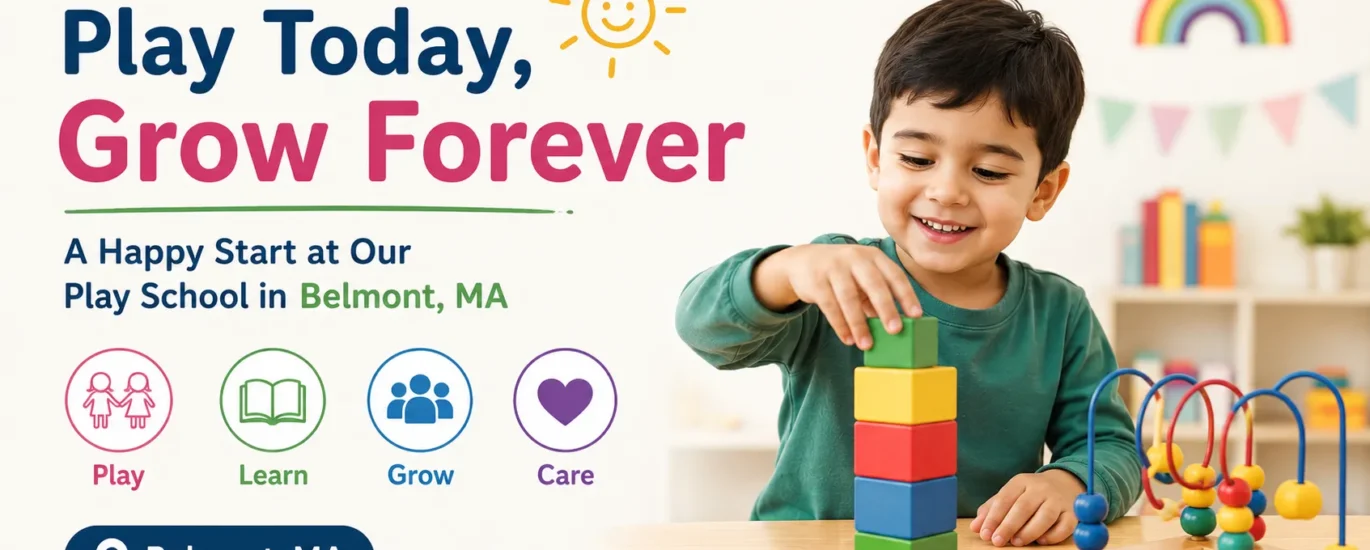
For example, a child building a tower with blocks may be developing:
- Spatial awareness
- Fine motor skills
- Problem-solving abilities
- Early mathematical concepts
- Creativity
- Patience
- Communication
- Cooperation
Similarly, pretending to operate a grocery store can introduce children to:
- Vocabulary
- Counting
- Social interaction
- Imagination
- Decision-making
- Turn-taking
- Everyday concepts
That is why choosing the right play school in Belmont, MA should not simply be about finding the closest available program.
Parents should look at the overall learning environment, teachers, safety practices, curriculum philosophy, opportunities for play, communication with families, daily routines, and how well the program matches their child’s needs.
What Is a Play School?
A play school is an early childhood education setting where young children learn through age-appropriate activities, exploration, interaction, and structured and unstructured play.
The exact meaning of “play school” can vary between programs. Some may function similarly to a preschool or nursery school, while others may combine early education with child care.
In Massachusetts, child care programs may operate under different structures and licensing categories. The state’s Department of Early Education and Care (EEC) licenses or approves group, school-age, and family child care programs.
This makes it important for parents to understand exactly what a particular program offers.
A high-quality play school may include activities such as:
- Free play
- Guided play
- Storytelling
- Music and movement
- Art
- Sensory activities
- Building and construction
- Dramatic play
- Outdoor play
- Nature exploration
- Puzzles
- Early literacy activities
- Early math activities
- Group discussions
- Circle time
- Social-emotional learning
- Practical self-help activities
The goal is not simply to keep children occupied.
The goal is to create meaningful experiences through which children develop.
12 Major Benefits of Enrolling Your Child in a Play School in Belmont, MA
1. Play School Supports Social Development
One of the biggest benefits of attending a play school is the opportunity to interact with other children.
A child who spends most of the day at home may have limited opportunities to regularly interact with a larger group of same-age children.
At a play school, children may learn how to:
- Share toys
- Take turns
- Ask for help
- Join a game
- Listen to others
- Express their opinions
- Cooperate
- Resolve minor disagreements
- Respect personal space
- Participate in group activities
These skills are extremely important because children eventually need to function in classrooms, playgrounds, sports teams, extracurricular activities, and other social environments.
A well-designed play school in Belmont, MA can provide children with regular opportunities to practice these behaviors in a supportive setting.
Why socialization matters
A child does not automatically know how to cooperate simply because they are surrounded by other children.
Social skills develop through repeated experiences.
A teacher might help children understand how to say:
“Can I play with you?”
or:
“Can I have a turn when you’re finished?”
These small interactions can gradually build confidence and social awareness.
2. Play School Encourages Independence
Young children naturally want to do things themselves.
A quality play school can provide age-appropriate opportunities for children to practice independence.
For example, children may be encouraged to:
- Put toys away
- Choose an activity
- Put on or remove simple clothing items
- Wash their hands
- Carry their own belongings
- Help prepare for snack time
- Choose between activities
- Clean up after an activity
- Ask teachers for assistance when necessary
These seemingly simple tasks can help children develop a sense of responsibility.
Instead of an adult doing everything for the child, the teacher can provide guidance while allowing the child to attempt the task.
This can help build confidence.
3. Play-Based Learning Builds Creativity
Creativity is one of the most important advantages of play-based education.
Children naturally experiment.
Give a child a box, some blocks, paper, crayons, and a few other safe materials, and they may create something completely different from what an adult expected.
That process is valuable.
A good play school allows children to:
- Imagine
- Experiment
- Create
- Change ideas
- Make mistakes
- Try again
- Tell stories
- Express themselves
Massachusetts preschool learning guidance specifically includes creativity and imaginative activities such as storytelling, dramatic play, visual arts, music, movement, and working with open-ended materials.
This makes play-based learning particularly appropriate for young children.
4. Play School Can Strengthen Communication Skills
Communication develops through interaction.
At a play school, children may spend significant portions of the day talking with teachers and classmates.
They may learn new vocabulary through:
- Storybooks
- Songs
- Conversations
- Pretend play
- Classroom discussions
- Art activities
- Nature exploration
- Group projects
A teacher may ask questions such as:
- “What are you building?”
- “Why did you choose that color?”
- “What do you think will happen next?”
- “How can we solve this problem?”
- “Can you tell me about your picture?”
These conversations encourage children to express ideas rather than simply answer yes-or-no questions.
Over time, children may become more comfortable communicating their thoughts, needs, emotions, and experiences.
5. It Introduces Children to Early Academic Concepts
A common misconception is that play-based learning means children are not learning academic concepts.
In reality, play can introduce many foundational skills.
Early mathematics
Children can encounter mathematics through:
- Counting blocks
- Sorting objects
- Comparing sizes
- Recognizing patterns
- Identifying shapes
- Measuring ingredients during pretend or supervised activities
- Matching objects
- Understanding quantities
Early literacy
Children can develop early literacy through:
- Listening to stories
- Recognizing letters
- Singing songs
- Rhyming
- Looking at books
- Retelling stories
- Talking about pictures
- Recognizing their names
- Practicing drawing and early writing movements
Science
Science can begin with simple questions:
- What happens when ice melts?
- Which objects float?
- How do plants grow?
- What happens when we mix colors?
- Where do insects live?
The important point is that young children can learn concepts through exploration rather than relying exclusively on worksheets.
6. Play School Helps Develop Fine Motor Skills
Fine motor skills involve the smaller muscles of the hands and fingers.
Children use these skills for future activities such as writing, cutting, buttoning clothing, tying shoes, and manipulating classroom materials.
A play school can support fine motor development through:
- Drawing
- Coloring
- Painting
- Play dough
- Building blocks
- Puzzles
- Bead activities
- Cutting with child-safe scissors
- Manipulating small learning materials
- Turning book pages
- Simple crafts
These activities can make skill development enjoyable.
Children often do not think of these activities as “practice.”
They simply think they are playing.
That is one of the strengths of developmentally appropriate play.
7. It Supports Gross Motor Development
Young children also need opportunities to move.
Running, climbing, jumping, balancing, dancing, and other physical activities help children develop gross motor abilities.
Depending on the program and facilities, a play school may provide:
- Outdoor playground time
- Running games
- Dance
- Music and movement
- Ball activities
- Balance activities
- Climbing
- Obstacle courses
- Nature walks
Physical activity can also give children opportunities to practice cooperation, spatial awareness, body control, and following simple instructions.
When evaluating a play school in Belmont, MA, parents should ask how much active play children receive during a typical day.
8. Play School Can Help Children Become Comfortable With Routines
Young children often benefit from predictable routines.
A typical play school schedule may include elements such as:
- Arrival
- Free play
- Group activity
- Learning centers
- Snack
- Outdoor play
- Story time
- Art or sensory activity
- Cleanup
- Departure
The exact schedule will differ between programs.
The important thing is consistency.
A predictable routine can help children understand what happens next.
This may make transitions easier and help children gradually develop time awareness.
9. It Can Help Prepare Children for Kindergarten
One of the most frequently discussed benefits of preschool and play school is kindergarten readiness.
However, kindergarten readiness is not simply about knowing the alphabet or counting to a certain number.
Children also need to develop:
- Communication
- Self-regulation
- Listening
- Following directions
- Cooperation
- Independence
- Classroom participation
- Problem-solving
- Emotional awareness
- Confidence
- Curiosity
A quality play school can provide opportunities to practice many of these skills.
For example, a child may learn that after playing with blocks, it is time to clean up before moving to another activity.
That simple routine introduces concepts that will eventually become important in a formal school environment.
10. Children Learn How to Handle Small Challenges
Play provides children with opportunities to experience manageable challenges.
A block tower falls.
A puzzle piece does not fit.
Another child wants the same toy.
A drawing does not look the way the child expected.
These situations can become learning opportunities.
With appropriate teacher support, children can learn:
- “Let’s try again.”
- “What else could we do?”
- “Can you ask your friend?”
- “Let’s find another piece.”
- “How can we make the tower stronger?”
These experiences help children begin developing resilience and problem-solving skills.
11. Play School Can Build Confidence
Children gain confidence when they successfully accomplish something independently.
A child might:
- Complete a puzzle
- Finish an art project
- Make a new friend
- Tell a story
- Build a structure
- Help clean the classroom
- Participate in a song
- Successfully follow a routine
Teachers can recognize these efforts without creating unhealthy pressure to perform.
Over time, children can develop the belief:
“I can try.”
That mindset is valuable throughout education.
12. It Gives Parents a Supportive Early Education Environment
The benefits of play school are not limited to children.
Parents may also benefit from having access to trained educators who observe and interact with their children regularly.
Teachers can sometimes notice developmental patterns that parents may not see at home.
Regular communication can help parents understand:
- What their child enjoys
- How their child interacts with others
- What activities interest them
- Where they may need additional support
- How they handle transitions
- What skills they are developing
The strongest parent-teacher relationships are collaborative.
The goal is not for the teacher to replace the parent.
Instead, teachers and parents can share information and work together to support the child.
What Does a Quality Play School in Belmont, MA Look Like?
Not every program described as a “play school” will offer the same experience.
Parents should look beyond the name.
A quality program should demonstrate thoughtful attention to:
Safety
Parents should ask about:
- Licensing
- Emergency procedures
- Staff background checks
- Supervision
- Child pickup procedures
- Facility safety
- Outdoor safety
- Medication policies
- Illness policies
Massachusetts EEC licensing covers areas including health, safety, supervision, training, educator requirements, background checks, and child-to-educator ratios.
Qualified educators
Ask:
- What qualifications do teachers have?
- How much experience do they have with preschool children?
- Is there ongoing professional development?
- Are educators trained in child development?
- Are required first-aid and CPR certifications current?
Massachusetts EEC certification pathways include specific qualifications for preschool teachers and lead teachers.
Developmentally appropriate curriculum
Look for activities appropriate to the children’s ages.
A good program should not simply push academic worksheets onto very young children.
Instead, activities should encourage:
- Exploration
- Conversation
- Movement
- Creativity
- Social interaction
- Problem-solving
- Early literacy
- Early math
Play School vs. Traditional Preschool: Is There a Difference?
The terms can overlap.
Some programs use “play school,” “preschool,” “nursery school,” “early learning center,” or “child care center” to describe their services.
The name alone does not tell you whether a program is high quality.
Instead, ask about the program’s philosophy.
Play-based environment
Usually emphasizes:
- Exploration
- Imaginative play
- Hands-on activities
- Social development
- Child interests
- Teacher-guided discovery
More academically structured environment
May emphasize:
- Worksheets
- Letter recognition
- Number practice
- Formal lessons
- Structured academic activities
Neither label automatically tells you whether a program is good or bad.
What matters is whether the curriculum is developmentally appropriate, whether children are engaged, and whether the environment supports the whole child.
Why Play-Based Learning Is Important for Young Children
Children learn differently from adults.
Young children often learn best when they can:
See → Touch → Move → Experiment → Talk → Repeat
For example, instead of only telling a child that a triangle has three sides, a teacher might let children:
- Find triangles in the classroom
- Build triangles
- Draw triangles
- Sort shapes
- Compare triangles with circles and squares
The child is not merely memorizing information.
They are experiencing the concept.
This approach can make learning more meaningful.
How a Play School Can Support Social-Emotional Development
Social-emotional development is a major part of early childhood.
Children are learning to understand:
- Happiness
- Frustration
- Anger
- Sadness
- Excitement
- Fear
- Empathy
A teacher can help children name emotions and develop appropriate ways to respond.
For example:
Child: “I’m angry because he took my truck.”
Teacher: “You really wanted the truck. Let’s think about what we can say.”
The child is gradually learning that emotions are acceptable while certain behaviors may not be.
This distinction can help children develop emotional regulation.
Benefits for Children Who Are Shy or Slow to Warm Up
Not every child immediately joins a group.
Some children are naturally cautious.
A quality play school should not force every child to participate in exactly the same way.
Instead, teachers can offer gradual opportunities.
A shy child might first:
- Observe other children.
- Play near the group.
- Join a smaller activity.
- Interact with one child.
- Eventually participate in a larger group.
A supportive environment can help children build confidence without making them feel pressured.
Benefits for Children Who Are Highly Active
Some children learn through movement.
A play-based environment can give them appropriate opportunities to:
- Move
- Build
- Dance
- Run outdoors
- Manipulate materials
- Participate in hands-on activities
This does not mean there should be no structure.
Instead, the goal is to balance movement with appropriate expectations.
How Play School Can Encourage Curiosity
Curiosity is one of the most valuable qualities a young learner can develop.
A child who asks:
“Why?”
is already demonstrating an important learning behavior.
Teachers can encourage curiosity by responding with questions:
“What do you think?”
“How could we find out?”
“What might happen if we try this?”
This transforms the classroom into an environment where children are encouraged to investigate rather than simply wait for answers.
Outdoor Play and Nature-Based Learning
Outdoor activities can provide valuable learning experiences.
A child might observe:
- Leaves
- Birds
- Insects
- Weather
- Trees
- Flowers
- Rocks
- Shadows
Teachers can turn these observations into conversations about science, language, art, and mathematics.
For example, children could collect leaves and sort them by:
- Size
- Shape
- Color
That one activity can involve observation, classification, vocabulary, comparison, and early mathematics.
When visiting a play school in Belmont, MA, parents should ask whether outdoor play is part of the regular schedule.
Art and Music as Learning Tools
Art is not simply a way to keep children busy.
It allows children to explore:
- Color
- Texture
- Shape
- Movement
- Creativity
- Self-expression
Music can similarly support:
- Listening
- Rhythm
- Memory
- Language
- Movement
- Group participation
Belmont’s Recreation Department also offers age-appropriate children’s programming that incorporates music, movement, creativity, and social development, illustrating the broader community interest in developmentally appropriate enrichment for young children.
Choosing a Play School in Belmont, MA: A Parent’s Checklist
Before enrolling, consider the following.
1. Is the program properly licensed?
Ask about the program’s Massachusetts EEC status.
Massachusetts provides an online system for finding licensed early education and care programs. EEC also notes that some licensed programs may not appear in the public search tool, so parents can contact the local EEC office when they need confirmation.
2. How experienced are the teachers?
Ask about:
- Education
- Certifications
- Experience
- Professional development
- Staff turnover
3. What is the teacher-to-child ratio?
A lower ratio can make it easier for educators to respond to individual children, although the appropriate ratio depends on the age group and applicable regulations.
4. What does a typical day look like?
Request a sample daily schedule.
5. How much free play is provided?
Play should not be treated merely as “break time.”
Ask how play is integrated into learning.
6. How much outdoor time is offered?
Outdoor opportunities should be age-appropriate and safe.
7. How does the school handle behavior?
Ask:
- How do teachers respond to conflict?
- What happens when a child hits or bites?
- How are emotions handled?
- How are children redirected?
8. How does the school communicate with parents?
Ask whether communication happens through:
- Apps
- Phone calls
- Daily reports
- Parent meetings
- Informal conversations
9. What are the hours?
Consider whether the schedule works with your family.
10. What is included in tuition?
Ask whether tuition covers:
- Meals
- Snacks
- Supplies
- Field trips
- Extended hours
- Special activities
Questions to Ask During a Play School Tour
When visiting a play school in Belmont, MA, don’t simply look at the classroom.
Talk to the teachers.
Here are useful questions:
About learning
- What does your curriculum look like?
- How do children learn through play?
- How much child-directed play is offered?
- How do you support early literacy?
- How do you introduce early math?
- How much outdoor learning is provided?
About teachers
- What qualifications do teachers have?
- How long have teachers worked here?
- How frequently does staff turnover occur?
- What professional development do educators receive?
About safety
- Is the program licensed?
- How are background checks handled?
- What are the emergency procedures?
- How are children released to authorized adults?
About individual children
- How do you help a child who is shy?
- How do you support children with different learning needs?
- How do you handle separation anxiety?
- How do you communicate developmental concerns with parents?
What Should Parents Observe During a Tour?
Sometimes what you see tells you more than what you are told.
Look at the children.
Do they appear:
- Engaged?
- Comfortable?
- Curious?
- Active?
- Supported?
Look at the teachers.
Are they:
- Talking with children?
- Listening?
- Getting down to the child’s level?
- Encouraging exploration?
- Managing the classroom calmly?
Look at the environment.
Is it:
- Clean?
- Organized?
- Safe?
- Bright?
- Child-friendly?
- Filled with age-appropriate materials?
A strong classroom does not necessarily have to look perfect.
In fact, an active play environment may naturally look a little messy because children are actually using the materials.
Red Flags Parents Should Watch For
While visiting a program, parents should pay attention to potential warning signs.
These may include:
- Staff who avoid answering questions
- Unclear licensing information
- Children who appear consistently disengaged
- Unsafe or poorly maintained areas
- Lack of age-appropriate materials
- Excessive reliance on worksheets
- Very little movement or outdoor play
- High staff turnover
- Poor communication
- Unclear illness policies
- No clear emergency procedures
- Teachers who rarely interact with children
One isolated observation does not necessarily mean a program is poor.
Parents should consider the overall picture and ask questions before making a decision.
How Much Does a Play School in Belmont, MA Cost?
Tuition varies considerably depending on factors such as:
- Program type
- Number of days
- Hours
- Age group
- Teacher staffing
- Facilities
- Meals
- Extended care
- Curriculum
- Location
- Private versus publicly supported programming
Parents should avoid choosing a program based exclusively on price.
Instead, compare the overall value.
A less expensive program may not provide the schedule or environment your family needs, while a higher-cost program may offer services that are important to your situation.
Families who may qualify for assistance should also investigate Massachusetts Child Care Financial Assistance. EEC explains that eligible families can receive child care benefits that are paid directly to participating programs, subject to program rules and funding availability.
Finding a Play School Near Arlington, MA
Although the primary focus of this guide is play school in Belmont, MA, families living in nearby Arlington may also consider programs across the town line.
This can be especially practical for families who:
- Work in Belmont
- Live near the Belmont-Arlington border
- Commute through both communities
- Have relatives nearby
- Want to compare different schedules
Arlington has its own early childhood options. For example, the Town of Arlington operates preschool programming, including Kid Care Preschool, and Arlington’s Menotomy Preschool serves children ages 3–5 through an integrated preschool model.
The Town of Arlington has also noted that its recreation-run Kid Care programs have been popular and may have waitlists, reinforcing the importance of researching programs and enrollment timelines early.
Therefore, parents searching for play school near Arlington, MA should compare both location and program fit rather than restricting their search to one town.
Belmont vs. Arlington: Which Location Is Better for Play School?
There is no universal answer.
The best location is the one that works for your child’s needs and your family’s daily routine.
Choose Belmont if:
- You live in Belmont
- Your commute is centered around Belmont
- You prefer a program close to home
- Your child has siblings or friends nearby
- The program’s philosophy matches your family
Consider Arlington if:
- You live near the Belmont-Arlington border
- Your workplace is in Arlington
- The Arlington program offers a better schedule
- A specific program matches your child’s needs
- Transportation is easier
The key is to compare program quality, not simply town names.
Why Location Matters When Choosing a Play School
Parents sometimes underestimate the importance of travel time.
Imagine a program that is 35 minutes away each direction.
That means more than an hour of travel every day.
Over weeks and months, that can become a significant burden.
A quality play school in Belmont, MA that is conveniently located may provide advantages such as:
- Easier drop-off
- Easier pickup
- Less commuting
- More predictable routines
- Greater convenience for emergencies
- Easier participation in school events
However, convenience should not be the only consideration.
A slightly farther program may still be worthwhile if it is substantially better suited to your child and family.
Helping Your Child Prepare for Play School
Starting a new program can be exciting and stressful.
Parents can make the transition easier by introducing some routines at home.
Practice independence
Encourage your child to:
- Put toys away
- Wash hands
- Carry a small backpack
- Use simple utensils
- Ask for help
Talk positively about school
Instead of saying:
“Don’t be scared.”
try:
“Your teacher will help you. You’ll have toys and activities to explore.”
The first approach emphasizes fear.
The second communicates confidence.
Practice separation
If your child is anxious about separation, start with short periods away from parents or caregivers when appropriate.
Visit beforehand
If possible, schedule a tour before the first day.
Seeing the classroom can make the new environment feel familiar.
What If Your Child Cries at Drop-Off?
Crying during the transition to preschool is common for some children.
It does not automatically mean the program is wrong.
Children may cry because:
- They are separating from a parent
- The environment is unfamiliar
- The routine is new
- They are tired
- They need time to develop trust
Teachers experienced with young children can help create predictable goodbye routines.
Parents can usually help by keeping goodbyes:
- Warm
- Calm
- Brief
- Consistent
Your child may gradually learn:
“Mom/Dad leaves, and Mom/Dad comes back.”
That predictable pattern can help build trust.
The Importance of Teacher-Child Relationships
A beautiful classroom means little without caring adults.
Young children need educators who:
- Listen
- Respond
- Encourage
- Observe
- Comfort
- Guide
- Set appropriate boundaries
During a tour, observe whether teachers genuinely engage with children.
A teacher who kneels down to listen to a child, asks questions about their creation, or helps them resolve a disagreement is demonstrating something important:
The child is being seen and heard.
How Parents Can Stay Involved
Enrolling your child in a play school does not mean handing over responsibility for learning.
Parents remain a child’s most important early teachers.
At home, you can reinforce learning by:
- Reading together
- Talking about the day
- Cooking together
- Visiting parks
- Counting objects
- Drawing
- Singing
- Playing pretend
- Building with blocks
- Asking open-ended questions
You do not need expensive educational toys.
Everyday experiences can become learning opportunities.
How to Extend Play-Based Learning at Home
Reading
Ask:
“What do you think happens next?”
instead of simply reading the words.
Grocery shopping
Ask your child to:
- Find apples
- Count items
- Compare sizes
- Identify colors
Cooking
Introduce:
- Measuring
- Counting
- Following sequences
- Vocabulary
Nature walks
Look for:
- Leaves
- Birds
- Flowers
- Insects
- Rocks
Building
Use blocks to explore:
- Balance
- Height
- Shape
- Counting
- Problem-solving
Play School and Whole-Child Development
One of the biggest advantages of a strong early childhood program is that it can support multiple developmental areas at the same time.
| Development Area | Examples of Play-Based Activities |
|---|---|
| Social | Group games, cooperative play |
| Emotional | Stories, role-play, teacher conversations |
| Language | Books, songs, storytelling |
| Cognitive | Puzzles, sorting, problem-solving |
| Math | Counting, patterns, shapes |
| Physical | Outdoor play, dancing, climbing |
| Fine Motor | Drawing, blocks, play dough |
| Creativity | Art, music, pretend play |
| Independence | Cleanup, routines, choices |
This holistic approach is one reason play-based learning can be valuable during the preschool years.
Is a Play School Necessary for Every Child?
No.
Every family and child is different.
Some children may thrive in a play school environment.
Others may receive excellent early learning experiences at home, through family care, a nanny, a family child care provider, or another educational setting.
The question should not be:
“Does every child have to attend play school?”
Instead, ask:
“What environment will best support my child’s development and our family’s needs?”
For families who choose group early education, a high-quality play school can provide valuable experiences that may be difficult to replicate at home every day, especially regular interaction with a group of peers and experienced educators.
How Early Should You Start Looking for a Play School in Belmont, MA?
Parents should begin researching early rather than waiting until the last minute.
This is particularly important when programs have:
- Limited classroom capacity
- Specific enrollment periods
- Waiting lists
- Age requirements
- Fixed school-year schedules
Do not assume that a program will have an opening simply because your child reaches the appropriate age.
Start researching several months ahead when possible.
Create a shortlist.
Visit programs.
Compare policies.
Ask about availability.
Then make your decision.
Understanding Massachusetts Child Care Licensing
Parents in Belmont and Arlington should understand the difference between a program simply describing itself as “child care” or “preschool” and a program operating under the appropriate regulatory framework.
Massachusetts EEC licenses or approves multiple categories of child care programs. Licensed group and school-age programs must meet requirements covering health, safety, supervision, training, educator qualifications, ratios, and background record checks.
For family child care, Massachusetts also establishes specific licensing requirements, including space, safety, experience, training, CPR/first aid, and background record checks.
This does not mean parents should evaluate a school solely by whether it is licensed.
Instead, licensing should be considered the starting point.
Parents should also evaluate:
- Educational philosophy
- Teacher relationships
- Curriculum
- Environment
- Communication
- Schedule
- Child experience
- Family fit
A Simple 10-Point Play School Evaluation System
When comparing programs, parents can create a simple scorecard.
Give each school a score from 1–10 for:
- Safety
- Teacher quality
- Teacher-child interaction
- Curriculum
- Play opportunities
- Outdoor activities
- Communication
- Schedule
- Location
- Overall feeling
Then calculate the total.
This can make the decision more objective.
For example:
| Category | School A | School B |
|---|---|---|
| Safety | 9 | 9 |
| Teachers | 9 | 8 |
| Curriculum | 8 | 9 |
| Play | 10 | 8 |
| Outdoor | 8 | 9 |
| Communication | 9 | 7 |
| Schedule | 8 | 10 |
| Location | 10 | 7 |
| Cost/Value | 8 | 9 |
| Overall Fit | 9 | 8 |
The highest score does not automatically mean the school is right.
The exercise simply helps parents identify what matters most.
Frequently Asked Questions About Play Schools in Belmont, MA
1. What is a play school in Belmont, MA?
A play school is an early childhood education setting where children learn through play, exploration, social interaction, creative activities, movement, stories, and age-appropriate guided experiences. Depending on the provider, a play school may function as a preschool, nursery school, or child care program.
2. What age do children typically start play school?
The appropriate age depends on the individual program. Some programs accept toddlers, while others begin around preschool age. Parents should check each school’s specific age requirements, enrollment policies, and licensing category.
3. Is play-based learning good for preschool children?
Yes. Play can support social, emotional, physical, language, cognitive, and creative development. Massachusetts preschool guidance includes approaches to play and learning, creativity, imaginative play, storytelling, arts, and exploration.
4. What are the main benefits of play school?
Benefits can include improved social interaction, communication, independence, creativity, early academic skills, problem-solving, motor development, emotional development, and preparation for kindergarten.
5. How do I find a quality play school in Belmont, MA?
Start by identifying licensed programs, then research their curriculum, teachers, schedule, safety policies, classroom environment, outdoor opportunities, tuition, and parent reviews. Massachusetts EEC provides a tool for finding licensed early education and care programs.
6. Should I visit a play school before enrolling?
Absolutely. A tour allows parents to observe teachers, classrooms, children, safety practices, learning materials, and the overall atmosphere.
7. What should I ask during a play school tour?
Ask about licensing, teacher qualifications, ratios, daily schedules, curriculum, outdoor play, behavior guidance, meals, communication, emergency procedures, tuition, and enrollment availability.
8. Does play school help with kindergarten readiness?
A quality play school can support many components of kindergarten readiness, including communication, independence, social skills, emotional regulation, listening, problem-solving, and early academic concepts.
9. Is preschool the same as play school?
Not necessarily. The terms can overlap, but individual programs may have different educational philosophies and schedules. Parents should evaluate the actual curriculum and environment rather than relying on the program’s name.
10. Is a play school better than staying home?
There is no universal answer. Children can learn in many environments. A play school may provide regular peer interaction, group routines, and access to early childhood educators, while some children may thrive in a home-based setting.
11. Can children learn math through play?
Yes. Sorting, counting, comparing, measuring, building, patterns, and shape activities can introduce foundational mathematical concepts.
12. Can play school improve communication?
Regular interaction with teachers and children can give children many opportunities to practice vocabulary, conversation, listening, storytelling, and expressing needs.
13. What should I look for in a play school teacher?
Look for educators who are attentive, patient, responsive, knowledgeable about child development, and able to create a warm but appropriately structured classroom.
14. Are outdoor activities important in a play school?
Outdoor play provides opportunities for physical movement, exploration, social interaction, and learning about the environment. Ask each program about its outdoor schedule and facilities.
15. Are there play school or preschool options near Arlington, MA?
Yes. Arlington has multiple early childhood options, including town-operated preschool programming. Menotomy Preschool is an integrated Arlington Public Schools program serving children ages 3–5, while Arlington Recreation also offers preschool programming.
16. Should Belmont families also consider Arlington preschools?
Families near the Belmont-Arlington area may benefit from comparing programs in both communities. Commute time, schedule, availability, tuition, curriculum, and the child’s needs should all be considered.
17. How can I prepare my child for their first day?
Practice simple routines at home, encourage age-appropriate independence, visit the school beforehand if possible, talk positively about the experience, and establish a consistent goodbye routine.
18. What if my child has separation anxiety?
Separation anxiety can occur when children begin a new program. Speak with the teachers about transition strategies and maintain a calm, predictable drop-off routine.
19. What does Massachusetts EEC regulate?
Massachusetts EEC licenses or approves different types of early education and child care programs and establishes requirements related to health, safety, supervision, training, staffing, and background checks.
20. What is the most important thing to consider when choosing a play school?
The most important consideration is overall fit: Is the environment safe, nurturing, developmentally appropriate, engaging, and suitable for your child’s individual needs and your family’s schedule?
Final Checklist: Is This the Right Play School for Your Child?
Before enrolling, ask yourself:
Environment
- Is the classroom safe?
- Is it clean and welcoming?
- Are materials accessible to children?
Teachers
- Do educators genuinely interact with children?
- Are they qualified?
- Do they understand child development?
Learning
- Is play integrated into the curriculum?
- Are children encouraged to explore?
- Are literacy and math introduced appropriately?
Social development
- Do children have opportunities to cooperate?
- How are conflicts handled?
- Are emotional skills supported?
Physical development
- Is there indoor movement?
- Is there outdoor play?
- Are fine motor activities available?
Family partnership
- Does the school communicate well?
- Can parents ask questions?
- Are concerns addressed respectfully?
Practical considerations
- Is the location convenient?
- Does the schedule work?
- Is tuition manageable?
- Is there availability?
- Are policies clearly explained?
If the answers are positive, the program may be worth considering.
Conclusion: Finding the Right Play School in Belmont, MA
Choosing a play school in Belmont, MA is ultimately about finding an environment where your child can feel safe, supported, curious, and excited to learn.
The best early childhood experiences do not necessarily come from the program with the most worksheets, the most expensive facilities, or the longest list of academic subjects.
They come from meaningful interactions.
A child who spends the morning building with blocks may be learning mathematics and problem-solving.
A child painting may be developing creativity and fine motor skills.
A child pretending to run a restaurant may be developing language and social skills.
A child playing outside may be strengthening physical coordination and learning about nature.
A child negotiating over a toy may be learning communication and emotional regulation.
That is the power of developmentally appropriate play.
For parents searching for play school in Belmont, MA, the best approach is to research several options, visit them personally, ask detailed questions, understand licensing and safety standards, observe teacher-child interactions, and consider whether the program genuinely matches your child’s personality and your family’s needs.
Families in or near Arlington can also broaden their search to include preschool and play-based early education options in Arlington, MA, particularly when location and commuting make Arlington programs practical. Arlington’s public and recreation programs demonstrate that families in the surrounding community have several types of early childhood options to investigate.
Ultimately, the goal is simple:
Find a place where your child can play, learn, make friends, build confidence, and develop at their own pace.
That is what makes a strong early childhood experience valuable—not just for the first school year, but as a foundation for the years of learning that follow.