
Summary
Choosing a play school in Belmont, MA is one of the earliest major educational decisions many parents make.
At first, the choice can appear simple. Parents may search for a nearby preschool, nursery school, daycare, childcare center, or play school and compare photographs, tuition, hours, and reviews.
But a great early childhood program is about much more than attractive classrooms or a long list of activities.
For young children, the quality of the relationships they build with educators, the safety of their environment, the opportunities they have to play and explore, the way adults respond to their questions and emotions, and the amount of meaningful interaction they experience throughout the day can all matter enormously.
Massachusetts’ early childhood guidance emphasizes that children learn through exploration, interaction, relationships, physical activity, and both child-initiated and adult-guided experiences. The state’s preschool/kindergarten guidance also emphasizes the importance of a whole-child approach rather than treating early education as simply academic instruction.
That makes play-based learning particularly important when evaluating a play school.
A great play school should give children opportunities to:
- Explore
- Ask questions
- Make choices
- Play with others
- Develop language
- Practice independence
- Build friendships
- Develop motor skills
- Express emotions
- Solve problems
- Create
- Imagine
- Discover
- Develop early academic foundations
For families in Belmont, there is another important consideration: licensing and program quality.
The Massachusetts Department of Early Education and Care (EEC) licenses or approves applicable early education and care programs and establishes requirements concerning areas such as health, safety, supervision, educator training, ratios, and background record checks.
So, when looking for the best play school in Belmont, MA, parents should evaluate the complete picture:
Safety + Teachers + Relationships + Play + Learning + Development + Communication + Schedule + Location + Family Fit
This guide explains exactly what parents should look for.
Introduction: What Is a Play School?
The term play school is commonly used by parents to describe an early childhood program where young children learn and develop through play, exploration, social interaction, stories, art, movement, and hands-on activities.
Depending on the provider, a play school may be called:
- Play school
- Playschool
- Preschool
- Nursery school
- Early learning center
- Early childhood program
- Childcare center
- Daycare
- Day care
- Pre-K program
These labels can overlap.
Therefore, parents should not assume that a program is high quality simply because it calls itself a “play school.”
Instead, ask:
What actually happens during the child’s day?
Do children have opportunities to explore?
Do teachers interact with them?
Is there a thoughtful curriculum?
Is the environment safe?
Is play genuinely part of learning?
Are children encouraged to communicate?
Are teachers responsive when children are upset?
Are activities appropriate for their developmental stage?
These questions are much more valuable than the program’s name alone.
Why Choosing the Right Play School Matters
The early childhood years are a period of rapid development.
Children are developing:
- Language
- Vocabulary
- Motor skills
- Social skills
- Emotional regulation
- Independence
- Problem-solving
- Curiosity
- Creativity
- Early mathematical thinking
- Early literacy
- Relationships
A play school doesn’t need to turn a three-year-old into a miniature elementary-school student.
Instead, it should create an environment where children naturally develop the foundations that support future learning.
Massachusetts’ preschool learning guidance describes learning as involving the whole child and recognizes the importance of play, exploration, relationships, problem-solving, physical development, and social-emotional development.
That is why parents should look beyond worksheets and ask how the program supports the whole child.
What Makes a Great Play School in Belmont, MA?
There isn’t a single feature that makes a play school great.
Instead, strong programs tend to combine several important elements.
The 12 Most Important Qualities
A great play school should ideally provide:
- A safe environment
- Warm and responsive educators
- Developmentally appropriate learning
- Real play-based experiences
- Strong social-emotional support
- Opportunities for language development
- Indoor and outdoor activities
- A thoughtfully designed classroom
- Appropriate educator-to-child ratios
- Clear communication with parents
- A consistent and predictable routine
- A program philosophy that matches your family
Let’s examine each one.
1. Safety Should Come First
Before asking about curriculum, Montessori materials, music classes, or special activities, ask about safety.
Children cannot learn effectively if they don’t feel safe.
When evaluating a play school in Belmont, MA, look at:
- Classroom security
- Entry and exit procedures
- Playground safety
- Supervision
- Emergency procedures
- Fire safety
- First aid
- Medication procedures
- Allergy procedures
- Authorized pickup policies
- Visitor policies
- Illness policies
Massachusetts EEC licensing requirements include standards related to health, safety, supervision, educator training, and background checks.
That doesn’t mean parents should stop evaluating a program once they confirm licensing.
Licensing establishes requirements; parents still need to decide whether the program is the right fit for their child.
2. Warm and Responsive Teachers
One of the strongest indicators to observe during a tour is how educators interact with children.
Don’t only look at the classroom.
Watch the adults.
Are they:
- Listening?
- Smiling?
- Getting down to children’s eye level?
- Responding to questions?
- Helping children solve problems?
- Comforting children?
- Encouraging independence?
- Setting boundaries respectfully?
Imagine your child having a difficult morning.
Perhaps they don’t want you to leave.
How does the teacher respond?
A warm educator might acknowledge the child’s feelings while calmly helping them transition into the classroom.
That relationship matters.
3. Developmentally Appropriate Learning
A great play school should understand that a three-year-old and a five-year-old don’t learn in exactly the same way.
Children develop at different rates.
Massachusetts guidance explicitly recognizes individual differences in children’s development and emphasizes opportunities that accommodate different interests, learning styles, and abilities.
Developmentally appropriate learning might include:
- Storytelling
- Building
- Sorting
- Drawing
- Singing
- Pretend play
- Outdoor exploration
- Puzzles
- Simple science experiments
- Counting objects
- Conversation
- Movement
It doesn’t necessarily mean sitting at a desk completing worksheets.
4. Real Play-Based Learning
This is perhaps the most important characteristic when you’re specifically looking for a play school in Belmont, MA.
Play should not simply be something children are allowed to do after the “real learning” is finished.
Play can be the learning.
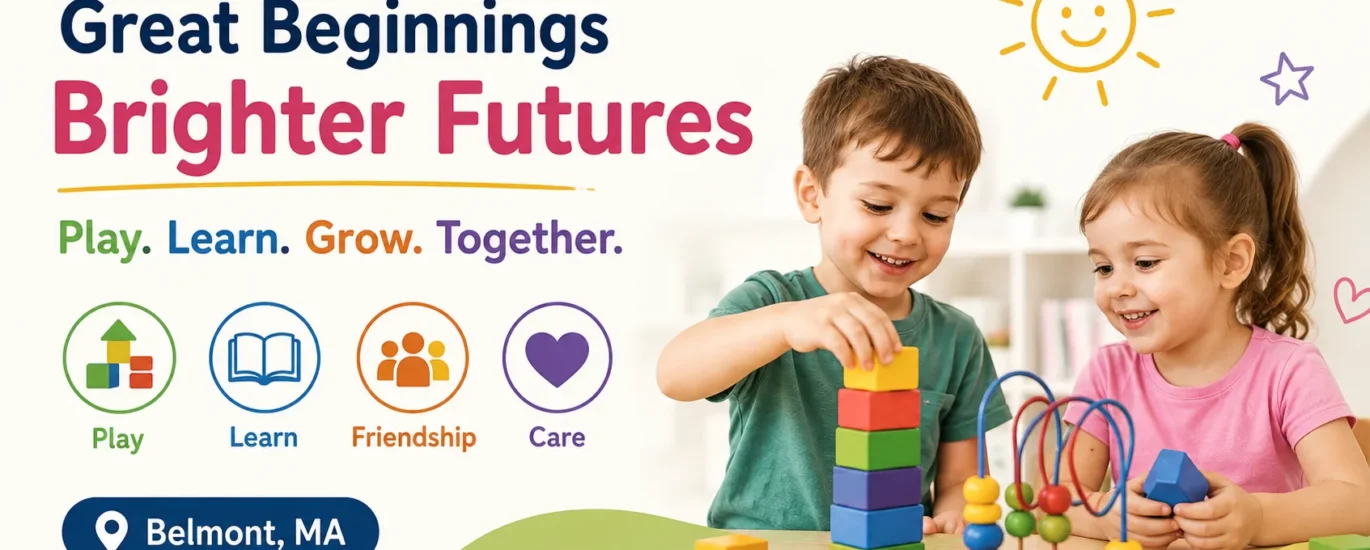
Consider a block-building activity.
A child building a tower may be practicing:
- Balance
- Spatial awareness
- Problem-solving
- Counting
- Fine motor skills
- Planning
- Communication
- Cooperation
Similarly, pretend cooking can involve:
- Vocabulary
- Social interaction
- Sequencing
- Imagination
- Counting
- Role-playing
Massachusetts guidance supports integrating child-initiated and adult-directed activities with guided play and learning experiences.
5. Social-Emotional Development
Parents sometimes focus heavily on academics.
But a child also needs to learn:
- How to make friends
- How to communicate
- How to wait
- How to take turns
- How to manage disappointment
- How to ask for help
- How to solve simple conflicts
- How to recognize feelings
A great play school intentionally supports these skills.
Ask:
“How do you help children who are struggling socially?”
And:
“How do teachers handle conflicts between children?”
The answer can reveal a lot about the program’s philosophy.
6. Language-Rich Environment
Young children learn language through interaction.
Look for teachers who:
- Ask open-ended questions
- Read stories
- Talk with children
- Encourage children to explain ideas
- Introduce new vocabulary
- Sing songs
- Encourage storytelling
- Listen carefully
A classroom where children are constantly hearing and using meaningful language can support communication development.
Belmont’s public Integrated Preschool Program, for example, describes its curriculum as including developmentally appropriate, language-rich activities supporting communication, social, emotional, cognitive, and motor development.
7. Indoor and Outdoor Learning
Children need movement.
A great play school shouldn’t keep children indoors all day unless circumstances genuinely require it.
Ask:
“How often do children go outside?”
Then ask:
“What kinds of activities do they do outdoors?”
Outdoor learning can include:
- Running
- Climbing
- Balancing
- Nature exploration
- Gardening
- Group games
- Observation
- Sand and water play
- Movement activities
Outdoor time supports physical development while also creating opportunities for curiosity and discovery.
8. A Thoughtfully Designed Classroom
Look at the classroom from a child’s perspective.
Can children reach appropriate materials?
Are there:
- Books?
- Blocks?
- Puzzles?
- Art supplies?
- Pretend-play materials?
- Manipulatives?
- Sensory materials?
- Building materials?
- Writing materials?
Are there quiet areas?
Is there enough space to move?
Is the room overcrowded?
A great play school doesn’t necessarily need an expensive interior.
It needs an environment designed around children’s needs.
9. Appropriate Educator-to-Child Ratios
Ask about the number of educators in your child’s classroom.
Then ask:
“What happens when a teacher is absent?”
Ratios influence how much individual attention children can receive.
Massachusetts EEC requires licensed group and school-age childcare programs to maintain appropriate educator-to-child ratios. EEC also requires relevant training and background record checks for licensed programs.
Parents should ask specifically about the classroom their child will actually attend.
10. Strong Parent Communication
Parents should know what their children are experiencing.
Ask:
- How are daily updates provided?
- Are parents contacted about incidents?
- Are there parent-teacher conferences?
- How can parents ask questions?
- How are developmental concerns communicated?
Communication doesn’t need to mean receiving dozens of photographs every day.
The important thing is that parents can communicate easily and receive meaningful information.
11. Consistent Daily Routine
Young children often benefit from predictable routines.
A day might include:
Arrival → Free Play → Group Activity → Snack → Outdoor Play → Learning Centers → Lunch → Rest → Afternoon Activities → Pickup
The exact schedule will vary.
What matters is that children know what generally happens next.
Predictability can make transitions easier.
12. Family Fit
The best play school for one child may not be the best one for another.
Consider:
- Your child’s personality
- Your child’s age
- Your work schedule
- Transportation
- Family preferences
- Educational philosophy
- Budget
- Required hours
- Dietary needs
- Developmental needs
Massachusetts EEC specifically notes that choosing childcare is a personal decision and that the best program should match the child’s temperament, interests, health, behavior, and the family’s philosophy and schedule while providing a safe, fun, educational, and nurturing environment.
Play-Based Learning vs. Traditional Academic Learning
One of the most common questions parents ask is:
“Will my child learn enough if they spend so much time playing?”
The answer depends on what “playing” means.
High-quality play-based learning isn’t random.
Teachers can intentionally create environments that encourage:
- Counting
- Vocabulary
- Problem-solving
- Collaboration
- Creativity
- Early literacy
- Science
- Motor development
For example, a teacher might provide different-sized blocks and ask:
“Which tower is taller?”
That simple question can introduce:
- Comparison
- Measurement
- Vocabulary
- Observation
This is learning through play.
Why Play Is So Important for Young Children
Children naturally learn by interacting with their environment.
Through play, children can:
- Experiment
- Repeat actions
- Make mistakes
- Try again
- Develop theories
- Test ideas
- Communicate
- Collaborate
Massachusetts’ preschool guidance states that children learn by exploring and engaging with others and describes rich, multisensory environments as important to development.
Different Types of Play
A great play school should offer multiple types of play.
Free Play
Children choose activities based on their interests.
Guided Play
Teachers set up an environment or activity with a learning objective while allowing children meaningful choice.
Dramatic Play
Children pretend to be:
- Doctors
- Parents
- Chefs
- Teachers
- Store owners
- Firefighters
Constructive Play
Children build with:
- Blocks
- Magnetic tiles
- Cardboard
- Legos or similar materials
- Natural materials
Sensory Play
Children explore:
- Sand
- Water
- Clay
- Rice
- Textures
- Safe sensory materials
Physical Play
Children:
- Run
- Jump
- Climb
- Dance
- Balance
- Throw
Each type supports different aspects of development.
What Should a Play School Curriculum Include?
A strong early childhood curriculum may incorporate:
Language and Literacy
- Stories
- Rhymes
- Conversation
- Vocabulary
- Name recognition
- Early writing
Mathematics
- Counting
- Sorting
- Patterns
- Shapes
- Measurement
- Quantity
Science
- Nature
- Animals
- Plants
- Weather
- Water
- Observation
- Cause and effect
Social Studies
- Family
- Community
- Different cultures
- Roles and occupations
Arts
- Drawing
- Painting
- Music
- Dance
- Dramatic play
Physical Development
- Fine motor activities
- Gross motor activities
- Outdoor movement
Massachusetts’ preschool/kindergarten learning guidance includes areas such as mathematics, science and technology/engineering, history and social science, and other developmental and learning domains.
Early Literacy at a Belmont Play School
Parents should look for more than alphabet worksheets.
Early literacy can involve:
- Daily reading
- Storytelling
- Rhyming
- Songs
- Vocabulary
- Picture discussions
- Letter exploration
- Name recognition
- Drawing
- Emergent writing
Ask:
“How much time do teachers spend reading and talking with children?”
This is often more informative than asking whether the program “teaches reading.”
Early Math at a Play School
Young children can learn mathematics through everyday experiences.
For example:
Snack
“How many crackers do you have?”
Blocks
“Can you make the tower taller?”
Cleanup
“Can you put all the red blocks together?”
Calendar
“What comes after Tuesday?”
Cooking
“How many cups do we need?”
These activities can develop mathematical thinking naturally.
Science Through Play
Science for young children is about curiosity.
A teacher might ask:
“What do you think will happen if we put this object in water?”
Children can:
- Make a prediction.
- Test it.
- Observe.
- Discuss.
- Try another object.
That’s scientific thinking.
Art and Creativity
A good play school should not expect every child to create identical artwork.
If every child’s painting looks exactly the same, ask why.
Children should have opportunities to:
- Experiment
- Choose colors
- Create shapes
- Mix materials
- Make decisions
- Express ideas
The goal is not perfection.
The goal is creative development.
Music and Movement
Music can support:
- Rhythm
- Listening
- Memory
- Language
- Coordination
- Confidence
Movement can support:
- Balance
- Strength
- Coordination
- Body awareness
Ask whether the program incorporates:
- Songs
- Dance
- Instruments
- Movement games
- Rhythmic activities
Sensory Learning
Young children often learn through their senses.
Sensory activities may involve:
- Water
- Sand
- Clay
- Textures
- Safe natural materials
- Dough
- Paint
These activities can support:
- Fine motor skills
- Exploration
- Language
- Creativity
- Problem-solving
For younger children, programs should also consider age-appropriate safety and supervision when providing sensory materials.
Fine Motor Development
Fine motor skills involve smaller movements.
Activities may include:
- Drawing
- Coloring
- Cutting
- Puzzles
- Threading
- Building
- Play dough
- Manipulating small age-appropriate objects
These skills can eventually support tasks such as writing, using utensils, and managing clothing.
Gross Motor Development
Gross motor activities use larger muscle groups.
Children should have opportunities to:
- Run
- Jump
- Climb
- Dance
- Balance
- Throw
- Catch
Outdoor play is particularly valuable.
Social Skills: What Should a Great Play School Teach?
Children should gradually learn:
- Taking turns
- Sharing
- Cooperating
- Listening
- Expressing needs
- Respecting boundaries
- Solving disagreements
Teachers should help children develop these skills rather than simply punishing undesirable behavior.
Emotional Development
Ask how educators respond when a child:
- Cries
- Gets frustrated
- Refuses an activity
- Becomes angry
- Misses their parent
- Has difficulty sharing
A strong program should have a thoughtful approach.
Positive Behavior Guidance
Parents should ask:
“How do you handle challenging behavior?”
Look for answers involving:
- Redirection
- Clear expectations
- Consistent routines
- Emotional support
- Modeling
- Problem-solving
- Appropriate boundaries
Be cautious if the program cannot clearly explain its approach.
Independence and Self-Help Skills
A great play school should gradually encourage children to do things for themselves.
Depending on age, this might include:
- Putting toys away
- Washing hands
- Carrying belongings
- Opening containers
- Choosing activities
- Cleaning up
- Asking for help
Teachers should support independence without expecting too much too quickly.
What Does a Typical Day at a Play School Look Like?
Every program is different, but an example might look like:
8:00–9:00 — Arrival and Free Play
Children enter, greet teachers, and choose activities.
9:00–9:20 — Morning Meeting
Songs, stories, discussion, and introduction to the day’s activities.
9:20–10:15 — Learning Through Play
Children choose centers such as:
- Blocks
- Art
- Dramatic play
- Books
- Puzzles
10:15–10:30 — Snack
10:30–11:15 — Outdoor Play
11:15–12:00 — Small Group Activities
Teacher-guided literacy, mathematics, science, or art.
12:00–1:00 — Lunch and Rest
Afternoon
Additional play, music, art, outdoor activity, stories, and small-group experiences.
This is only an example.
Parents should ask each provider for its actual schedule.
How Important Is Outdoor Play?
Very important.
Ask:
“How often do children go outside?”
And:
“What happens during outdoor time?”
A strong outdoor environment can provide opportunities for:
- Physical activity
- Nature exploration
- Social interaction
- Imagination
- Risk assessment
- Motor development
For infants and toddlers, Massachusetts’ early learning guidance also emphasizes opportunities for safe exploration, independence, sensory experiences, and active play.
Does a Great Play School Need a Huge Playground?
No.
A smaller space can still be thoughtfully designed.
Look for:
- Safe equipment
- Adequate supervision
- Opportunities for movement
- Age-appropriate materials
- Variety
- Nature where possible
The quality of the experience matters more than square footage alone.
How Important Is the Classroom Environment?
Very.
A classroom can communicate what the program believes about children.
Look for environments where children can:
- Make choices
- Access materials
- Display their work
- Explore
- Move
- Rest
- Interact
Children’s artwork should ideally be visible.
Books should be accessible.
Materials should be organized.
What About Technology and Screen Time?
Ask:
“How much screen time do children receive?”
Then ask:
“Why is screen time used?”
For preschool-age children, technology should not replace:
- Human interaction
- Conversation
- Hands-on exploration
- Physical activity
- Creative play
A strong program should be able to explain how technology fits into its overall educational philosophy.
Teacher Qualifications Matter
Ask:
- What training do teachers have?
- What early childhood education experience do they have?
- What professional development do they receive?
- Are they CPR and First Aid certified?
- How long have they worked at the school?
Massachusetts EEC says licensed group and school-age programs must meet educator training requirements, including First Aid and CPR certification, child development and curriculum implementation training, and background record check requirements.
Staff Stability Is Worth Asking About
Frequent teacher turnover can be disruptive for young children.
Ask:
“How long do teachers typically stay with the program?”
You don’t necessarily need a program where every employee has worked there for 20 years.
But if staff members are constantly changing, ask why.
Stable relationships can help children feel secure.
How to Check Licensing in Belmont, MA
Parents researching a play school in Belmont, MA can use Massachusetts EEC’s online search system.
EEC provides a geographic search tool that allows families to search licensed childcare programs by location and program type. EEC also says parents can contact the agency to learn about license history, non-compliance findings, and current restrictions.
The official Massachusetts Child Care Search includes both Belmont and Arlington among searchable communities.
Massachusetts EEC Child Care Search
This is an important step before enrolling.
Does Licensing Guarantee a Great Play School?
No.
Licensing is important, but it is not the same as saying:
“This is the best school for your child.”
Licensing helps establish baseline standards.
Parents should still evaluate:
- Teachers
- Classroom environment
- Philosophy
- Curriculum
- Communication
- Schedule
- Child experience
- Family fit
Think of licensing as an important starting point, not the entire decision.
Belmont, MA: Local Early Childhood Considerations
Families searching for play school in Belmont, MA have several types of programs to consider.
These may include:
- Private preschools
- Nursery schools
- Childcare centers
- Family childcare
- Preschool programs
- Public-school early childhood programs
- Early learning centers
One local example is the Belmont Integrated Preschool Program operated through Belmont Public Schools.
The district describes the program as serving children ages 3–5 who require special education programming while also enrolling typically developing neighborhood children as peer models. The district states that classrooms enroll up to 15 children and that the curriculum aligns with Massachusetts Early Childhood Program Learning Standards.
This particular program has its own eligibility, enrollment, schedule, and tuition structure, so parents should review the current information directly rather than assuming it is equivalent to a private play school.
Belmont Public Schools
Public Preschool vs. Private Play School in Belmont
There are important differences between public and private programs.
Public programs
May involve:
- District eligibility
- Specific enrollment procedures
- Integrated education
- Special education services
- School-year schedules
Private programs
May offer:
- Different educational philosophies
- Different schedules
- Different tuition structures
- Extended care
- Full-day options
- Montessori or other specialized approaches
Neither category is automatically better.
The right choice depends on your child and family.
Considering Arlington, MA?
If you live near Belmont or commute through Arlington, it can make sense to expand your search.
Parents shouldn’t choose a program solely because it is technically inside their town.
Consider:
- Home-to-school distance
- Work commute
- Traffic
- Pickup time
- Backup transportation
- Family support
- Program availability
A play school in Arlington may be practical for a Belmont family if it fits naturally into the family’s daily route.
Belmont vs. Arlington Play School Search
When comparing programs in Belmont and Arlington, create a simple table.
| Factor | Belmont Program | Arlington Program |
|---|---|---|
| Distance from home | ___ | ___ |
| Commute | ___ | ___ |
| Hours | ___ | ___ |
| Age range | ___ | ___ |
| Curriculum | ___ | ___ |
| Play-based learning | ___ | ___ |
| Outdoor play | ___ | ___ |
| Class size | ___ | ___ |
| Educator-child ratio | ___ | ___ |
| Teacher experience | ___ | ___ |
| Tuition | ___ | ___ |
| Extended care | ___ | ___ |
| Summer availability | ___ | ___ |
| Parent communication | ___ | ___ |
| Availability | ___ | ___ |
| Overall fit | ___ | ___ |
Don’t Choose a Play School Based Only on Distance
Convenience matters.
But don’t automatically choose the closest program.
Imagine:
School A: 5 minutes away but poor schedule and weak fit.
School B: 12 minutes away with excellent teachers, appropriate hours, and an environment your child loves.
The extra seven minutes may be worth it.
Of course, every family’s circumstances are different.
What About Tuition?
Tuition is an important consideration.
But parents should compare the complete cost, not just the advertised monthly price.
Ask about:
- Registration fee
- Enrollment fee
- Deposit
- Tuition
- Meals
- Extended care
- Summer programs
- Holiday coverage
- Late pickup fees
- Materials
- Field trips
- Additional activities
Two schools may have similar tuition but very different total costs.
Part-Time vs. Full-Time Play School
Part-Time
May be appropriate for families who:
- Don’t need full-day childcare
- Want gradual socialization
- Prefer a shorter schedule
- Have flexible work arrangements
Full-Time
May be more suitable for families who:
- Work full-time
- Need extended childcare
- Want education and care in one place
- Need consistent weekday coverage
Ask exactly what “full-day” means.
What Age Should a Child Start Play School?
There isn’t one universal starting age.
Programs have different eligibility requirements.
Some may accept younger toddlers.
Others begin around age three.
Some programs primarily serve four-year-olds.
Therefore, parents should first identify:
“What age group does this specific play school serve?”
Then determine whether your child is developmentally and emotionally ready.
Signs Your Child May Be Ready
Potential signs include:
- Interest in other children
- Ability to separate briefly from parents
- Interest in exploring new environments
- Beginning communication skills
- Ability to participate in simple routines
- Curiosity about activities
- Growing independence
But readiness is not a checklist that every child must perfectly satisfy.
Children develop differently.
What If My Child Is Shy?
Being shy does not automatically mean a child isn’t ready for play school.
A good program can provide gradual opportunities for:
- Small-group interaction
- Teacher relationships
- Parallel play
- Cooperative play
- Communication
Ask teachers how they support children who take longer to warm up.
What If My Child Has Separation Anxiety?
Separation anxiety is common among young children.
Ask the school:
“How do you handle difficult drop-offs?”
Look for a consistent process.
For example:
- Parent says goodbye.
- Teacher acknowledges feelings.
- Teacher redirects the child to a familiar activity.
- Parent leaves consistently.
- Teacher updates parent if necessary.
The exact approach will differ by school.
What If My Child Needs Additional Support?
Ask how the program works with:
- Speech concerns
- Developmental differences
- Social challenges
- Motor challenges
- Behavioral needs
- Learning differences
Belmont’s public Integrated Preschool Program, for example, includes a multidisciplinary team with professionals such as special education teachers, speech/language pathologists, occupational therapists, physical therapists, school psychologists, and an early childhood director.
Parents should investigate each program’s actual support structure rather than assuming all preschools offer the same services.
How Important Is Inclusion?
An inclusive environment can give children opportunities to interact with peers who have different abilities, backgrounds, interests, and ways of communicating.
Ask:
“How do you support children with different developmental needs?”
The answer can tell you whether the program has a thoughtful approach to inclusion.
Questions to Ask a Play School in Belmont, MA
Before enrolling, ask at least these questions.
About the Program
- What ages do you serve?
- What is your educational philosophy?
- Is your program licensed?
- How long have you been operating?
- What curriculum or learning framework do you use?
About Teachers
- What qualifications do teachers have?
- How much experience do they have?
- What training do teachers receive?
- What is staff turnover like?
- What is the educator-to-child ratio?
About Learning
- How much time is devoted to free play?
- How much guided play is provided?
- How do you teach early literacy?
- How do you teach early math?
- How do you support social-emotional development?
About Daily Life
- What is a typical day?
- How much outdoor time do children receive?
- Is there a nap or rest period?
- Are meals provided?
- Is screen time used?
About Safety
- How are children supervised?
- What are your emergency procedures?
- How do you handle allergies?
- What is your illness policy?
- Who can pick up my child?
About Parents
- How do you communicate with parents?
- How do you report incidents?
- Are parent conferences provided?
- How do you communicate developmental concerns?
About Cost
- What is the complete tuition?
- Are there registration fees?
- Is there a deposit?
- What are your refund policies?
- Are extended hours available?
What to Look for During a School Tour
Don’t simply listen to the director.
Observe.
Watch the children.
Do they appear:
- Comfortable?
- Interested?
- Engaged?
- Curious?
- Relaxed?
Watch the teachers.
Do they:
- Interact with children?
- Listen?
- Encourage?
- Comfort?
- Ask questions?
Look at the materials.
Are there:
- Books?
- Blocks?
- Art?
- Puzzles?
- Pretend-play materials?
- Manipulatives?
Listen to the classroom.
Does it sound:
- Active?
- Happy?
- Organized?
A preschool classroom doesn’t need to be silent.
Young children are supposed to talk, laugh, move, and explore.
Red Flags When Choosing a Play School
Parents should investigate further if they notice:
1. Teachers rarely interact with children
2. Children spend most of the day passively watching screens
3. No clear curriculum or learning philosophy
4. Staff cannot explain classroom routines
5. Safety policies are unclear
6. High staff turnover with no explanation
7. Poor classroom supervision
8. Very little outdoor activity
9. Excessive academic pressure
10. Teachers speak disrespectfully to children
11. Parents are discouraged from asking questions
12. Tuition or policies are unclear
13. The program promises unrealistic academic outcomes
14. The classroom environment appears unsafe or poorly maintained
15. The school pressures you to enroll immediately
One red flag doesn’t necessarily mean a program is unsuitable.
But multiple concerns deserve serious consideration.
Green Flags of a Great Play School
Positive signs include:
- Teachers know children’s names
- Teachers speak respectfully
- Children are engaged
- Classrooms contain varied learning materials
- Children have opportunities to choose activities
- Teachers use open-ended questions
- Outdoor play is part of the routine
- Children have opportunities to create
- The school explains its curriculum clearly
- Parents receive meaningful communication
- Safety policies are transparent
- Teachers understand child development
- The environment feels warm and welcoming
How to Evaluate a Play School’s Philosophy
Ask:
“What do you believe young children need most?”
Listen carefully.
A strong philosophy might mention:
- Relationships
- Play
- Exploration
- Curiosity
- Social-emotional development
- Independence
- Developmentally appropriate learning
If the entire answer focuses only on:
- Reading
- Writing
- Numbers
- Worksheets
you may want to ask additional questions about play and whole-child development.
Play School and Kindergarten Readiness
A great play school should prepare children for the next stage of learning without turning preschool into elementary school.
Kindergarten readiness can involve:
Social
- Playing with peers
- Participating in groups
Emotional
- Managing simple frustrations
- Asking for help
Language
- Communicating ideas
- Listening to stories
Cognitive
- Solving problems
- Exploring patterns
Physical
- Running
- Climbing
- Fine motor activities
Independence
- Managing simple routines
- Caring for belongings
Massachusetts’ preschool/kindergarten guidance emphasizes multiple interconnected domains and development of the whole child.
Should a Play School Teach Reading?
A good program can support early literacy without pushing children into developmentally inappropriate formal academics.
Children can develop:
- Vocabulary
- Phonological awareness
- Book knowledge
- Letter awareness
- Story comprehension
- Emergent writing
Ask how these skills are developed.
Should a Play School Teach Math?
Yes, but math can look different from elementary school.
Children can learn through:
- Counting toys
- Sorting objects
- Comparing sizes
- Creating patterns
- Identifying shapes
- Measuring ingredients
- Building towers
The Massachusetts preschool/kindergarten learning guidance includes mathematics as an area for preschool and kindergarten learning experiences.
Should Parents Choose a Montessori Play School?
Montessori can be an excellent choice for some families.
But ask specific questions.
- Are teachers Montessori-trained?
- What materials are used?
- How much choice do children have?
- How is independence encouraged?
- How is the classroom organized?
- How does the school handle group activities?
Don’t select a program solely because the word “Montessori” appears in the marketing.
What About Nature-Based Play Schools?
A nature-oriented program may emphasize:
- Outdoor exploration
- Nature walks
- Plants
- Animals
- Weather
- Seasonal changes
- Natural materials
This can be attractive to children who love being outdoors.
But again, investigate the complete program.
What About Religious or Faith-Based Play Schools?
If you’re considering one, ask:
- What role does faith play in the daily schedule?
- What values are emphasized?
- Are families required to participate in religious activities?
- How does the program approach cultural diversity?
The right choice depends on your family’s preferences.
Play School vs. Day Care
Parents often use these terms interchangeably, but they aren’t necessarily identical.
A play school or preschool may focus more strongly on:
- Early learning
- Preschool curriculum
- Social development
- Kindergarten preparation
A day care may place greater emphasis on:
- Full-day care
- Flexible schedules
- Infant and toddler care
- Year-round childcare
But many childcare centers combine both.
The individual program matters more than the label.
Play School vs. Preschool
These terms may describe very similar programs.
“Play school” often emphasizes the method of learning.
“Preschool” describes the stage of education.
A preschool can be highly play-based.
A play school can have a structured curriculum.
Ask the provider what they actually mean by the term.
Play School vs. Nursery School
Nursery school may traditionally refer to programs serving young children before kindergarten, often with shorter schedules.
However, terminology varies by provider.
Always check:
- Ages
- Hours
- Curriculum
- Services
- Enrollment requirements
How Location Affects Your Decision
A convenient location can make daily life much easier.
Consider:
- Morning commute
- Afternoon pickup
- Traffic
- Parking
- Public transportation
- Emergency pickup
- Work schedule
If you live in Belmont but work in Arlington, an Arlington program might be practical.
If you live near the Belmont-Cambridge area, Cambridge options may also be worth investigating.
Local search should follow your real daily route, not just your postal address.
Building a Belmont + Arlington Shortlist
Instead of visiting ten programs randomly, build a shortlist of five or six.
Step 1
Search licensed programs.
Step 2
Filter by age.
Step 3
Filter by schedule.
Step 4
Check location.
Step 5
Review the educational philosophy.
Step 6
Check availability.
Step 7
Schedule tours.
Step 8
Compare using the same checklist.
This makes the process much easier.
A 10-Point Play School Scorecard
Give each school a score from 1–10.
| Category | Score |
|---|---|
| Safety | /10 |
| Teachers | /10 |
| Teacher-child ratio | /10 |
| Play-based learning | /10 |
| Curriculum | /10 |
| Outdoor play | /10 |
| Social-emotional support | /10 |
| Parent communication | /10 |
| Schedule | /10 |
| Location | /10 |
Then add:
Total: /100
Don’t let the numerical score completely replace your judgment, but it can make comparisons easier.
What Makes a Play School “Great” for a Toddler?
Toddlers need:
- Safe exploration
- Movement
- Language
- Sensory experiences
- Predictable routines
- Responsive adults
- Opportunities for independence
Massachusetts’ infant/toddler guidance emphasizes consistency and predictability, safe exploration and independence, sensory activities, preparation for transitions, and active play.
Ask toddler programs specifically about:
- Diapering
- Meals
- Naps
- Transitions
- Outdoor time
- Ratios
- Separation anxiety
What Makes a Play School Great for a 3-Year-Old?
A three-year-old may benefit from:
- More peer interaction
- Storytelling
- Pretend play
- Art
- Early math
- Early literacy
- Outdoor activities
- Group experiences
But play should remain central.
What Makes a Play School Great for a 4-Year-Old?
A four-year-old may be ready for:
- More complex problem-solving
- Early writing
- Story comprehension
- Pattern recognition
- Group projects
- Greater independence
- More sophisticated social interaction
Again, development varies.
What Makes a Play School Great for a 5-Year-Old?
Older preschoolers may benefit from:
- Kindergarten transition activities
- Early literacy
- Early math
- Classroom routines
- Social problem-solving
- Independent work
- Group participation
The goal should be confidence and readiness, not academic pressure.
How Parents Can Support Learning at Home
Choosing a great play school is only one part of the equation.
At home, you can support your child’s development through simple activities.
Read Together
Ask:
“What do you think happens next?”
Cook Together
Count ingredients.
Go Outside
Look for:
- Leaves
- Birds
- Rocks
- Clouds
Build
Use blocks and ask questions.
Draw
Let your child create freely.
Talk
Ask about their day.
These simple interactions can extend learning beyond the classroom.
The Importance of Parent-Teacher Partnership
The strongest early education experiences often involve collaboration between:
Child + Family + Teacher
Parents know their child.
Teachers observe the child in a group environment.
When both communicate effectively, they can better understand:
- Interests
- Strengths
- Challenges
- Progress
- Social relationships
Ask how the school encourages parent involvement.
How to Make the Final Decision
After visiting several programs, ask yourself:
Question 1
Would my child feel safe here?
Question 2
Would my child enjoy coming here?
Question 3
Do teachers genuinely seem to like working with children?
Question 4
Is play actually part of the learning model?
Question 5
Does the program support the whole child?
Question 6
Does the schedule work?
Question 7
Can we afford the complete cost?
Question 8
Does the location make sense?
Question 9
Can I communicate comfortably with staff?
Question 10
Does this feel like the right environment for my child?
If the answers are mostly yes, you’ve probably found a strong candidate.
Frequently Asked Questions About Play Schools in Belmont, MA
1. What is a play school?
A play school is generally an early childhood program where young children learn through play, exploration, social interaction, stories, art, movement, and hands-on experiences. Depending on the provider, it may also be called a preschool, nursery school, or early learning program.
2. What makes a good play school in Belmont, MA?
A good play school should provide a safe and nurturing environment, responsive teachers, developmentally appropriate learning, meaningful play, social-emotional support, language development, physical activity, parent communication, and a schedule that fits the family.
3. Is play-based learning effective for preschool children?
Play can provide meaningful opportunities for children to develop language, problem-solving, social skills, creativity, motor skills, and early academic concepts. Massachusetts’ early childhood guidance supports integrating guided play and learning with child-initiated and adult-directed experiences.
4. What age do children start play school in Belmont, MA?
There is no single age for every program. Age eligibility varies by provider. Parents should check each program’s enrollment requirements.
5. Is play school the same as preschool?
Not necessarily, although the terms can overlap. A play school generally emphasizes play-based experiences, while preschool refers more broadly to early education before kindergarten.
6. Is play school the same as daycare?
No. Daycare primarily refers to childcare, although many daycare programs also provide preschool education and play-based learning.
7. How can I find a licensed play school in Belmont, MA?
Use Massachusetts EEC’s child care search system to identify licensed programs by geographic area and program type. EEC also provides information about license history and compliance when requested.
8. Does Massachusetts license play schools?
Whether a particular program requires EEC licensing depends on its program type and circumstances. Massachusetts EEC licenses or approves applicable family, group, school-age, and other childcare programs. Parents should verify the specific program’s licensing status.
9. What should parents ask during a play school tour?
Ask about teacher qualifications, educator-to-child ratios, curriculum, play, outdoor activities, safety, meals, naps, behavior guidance, communication, tuition, hours, and enrollment.
10. How important are teacher-child ratios?
They are important because staffing levels affect supervision and the amount of individual attention available to children. Massachusetts EEC licensing requirements include educator-to-child ratio standards for applicable licensed programs.
11. Should a play school teach ABCs and numbers?
Early literacy and mathematics can be part of a strong play-based curriculum. However, young children can learn these concepts through stories, songs, games, counting objects, patterns, building, and other hands-on activities.
12. How much outdoor play should a play school provide?
Ask each program about its actual outdoor schedule. Outdoor play provides opportunities for physical activity, exploration, social interaction, and motor development.
13. Is a Montessori play school better?
Not automatically. Montessori may be an excellent fit for some children and families, but parents should evaluate teacher preparation, classroom structure, philosophy, schedule, and the actual experience provided.
14. Should I choose a play school close to home?
Location is important, but it should be considered alongside safety, teachers, curriculum, schedule, cost, and overall fit.
15. Should Belmont parents consider play schools in Arlington, MA?
Yes, if Arlington fits your commute and family routine. Nearby communities can expand the number of practical options available to families.
16. What is the difference between preschool and play school?
Preschool is a broad term for education before kindergarten. Play school generally emphasizes learning through play and hands-on experiences.
17. What does a play-based preschool day look like?
A typical day may include arrival, free play, group activities, stories, art, snack, outdoor play, teacher-guided activities, lunch, rest, and additional play or learning centers.
18. How can I tell if children are happy at a play school?
During a tour, look for children who appear comfortable, engaged, curious, and connected with teachers. Remember that children may naturally experience occasional frustration or sadness.
19. What are red flags when choosing a play school?
Potential concerns include poor supervision, unclear safety policies, high staff turnover, little teacher-child interaction, excessive screen use, lack of outdoor activity, unclear curriculum, and disrespectful adult-child interactions.
20. Does a play school prepare children for kindergarten?
A quality play school can support many areas of kindergarten readiness, including communication, social skills, independence, early literacy, mathematics, problem-solving, and participation in group routines.
21. Can a shy child attend play school?
Yes. A supportive program can help shy children gradually develop relationships and confidence through small-group activities, familiar routines, and responsive teachers.
22. How much does a play school in Belmont, MA cost?
Costs vary by provider, age, schedule, hours, and services. Parents should request a current tuition and fee schedule and ask about registration fees, deposits, extended care, meals, and other charges.
23. What qualifications should play school teachers have?
Requirements vary by program and role. Massachusetts EEC states that licensed group and school-age programs must meet applicable educator training requirements, including First Aid and CPR certification and training related to child development and curriculum implementation.
24. Is licensing enough to determine whether a play school is good?
No. Licensing is an important baseline, but parents should also evaluate teachers, curriculum, relationships, classroom environment, communication, schedule, and family fit.
25. What is the most important thing to look for in a play school?
Look at the relationships between children and educators. A great play school should be safe, nurturing, developmentally appropriate, engaging, and genuinely supportive of children’s curiosity and growth.
Play School Selection Checklist for Belmont Parents
Before enrolling, make sure you’ve checked:
Safety
☐ Licensing verified
☐ Emergency procedures explained
☐ Pickup procedures clear
☐ Allergy procedures clear
☐ Playground appears safe
Teachers
☐ Teachers are warm
☐ Teachers interact with children
☐ Qualifications explained
☐ Staff turnover discussed
☐ Ratios explained
Learning
☐ Play-based learning
☐ Early literacy
☐ Early math
☐ Science exploration
☐ Art
☐ Music
☐ Social-emotional development
Environment
☐ Books available
☐ Building materials
☐ Art materials
☐ Pretend play
☐ Sensory activities
☐ Quiet spaces
☐ Outdoor opportunities
Family
☐ Schedule works
☐ Location works
☐ Tuition is affordable
☐ Parent communication is good
☐ Policies are clear
A Parent’s 30-Second Test
After touring a play school, ask yourself:
“If my child couldn’t tell me about their day yet, would I still trust this environment to care for them, talk with them, play with them, listen to them, and help them learn?”
If the answer is yes, that’s a strong sign.
Conclusion: Finding the Right Play School in Belmont, MA
Finding the right play school in Belmont, MA isn’t about finding the school with the most impressive brochure, the largest playground, the longest list of activities, or the most academic-looking classroom.
It’s about finding an environment where children can play, explore, communicate, build relationships, develop independence, and feel safe enough to learn.
A great play school should balance:
Care + Learning + Play + Safety + Relationships + Development
Parents should look carefully at the educators because relationships are at the heart of early childhood education.
They should observe the classroom because the physical environment can tell them how children are expected to learn.
They should ask about play because play should be an important part of children’s learning experiences.
They should ask about curriculum because meaningful play should still be intentional and developmentally appropriate.
They should investigate outdoor activities, social-emotional development, language, early mathematics, art, movement, and opportunities for independence.
They should verify applicable licensing information through Massachusetts EEC resources. EEC provides a geographic search for licensed childcare programs and allows families to obtain information about licensing history and compliance.
And they should remember that the best play school is not necessarily the best-known or closest one.
It is the one that fits the child.
For Belmont families, local options can include private early childhood programs, childcare centers, nursery or preschool programs, family childcare, and public-school early childhood programs. Belmont Public Schools’ Integrated Preschool Program is one local example of a specialized integrated early childhood model serving children ages 3–5.
Families can also reasonably expand their search into Arlington, MA when the location fits their commute or daily routine.
Ultimately, choose a program where you can picture your child:
Walking in confidently.
Playing freely.
Asking questions.
Making friends.
Trying new things.
Being comforted when things are difficult.
Learning from mistakes.
Growing more independent.
And looking forward to coming back.
That’s what makes a great play school.