

Summary
Choosing the right day care in Arlington, MA is one of the most important decisions parents make during their child’s early years. A daycare is not simply a place where children stay while parents work. The right early childhood program can provide a safe environment, nurturing relationships, opportunities for play and exploration, social-emotional development, language and early literacy experiences, physical activity, and a strong foundation for future learning.
For families searching for day care in Arlington, MA, the number of options can make the decision feel overwhelming. Parents may compare daycare centers, preschools, family child care programs, school-based programs, and other early education providers. Families who live close to town boundaries may also consider day care in Belmont, MA, Cambridge, Medford, Lexington, or nearby communities depending on their commute and daily schedule.
The most effective way to compare programs is to ask detailed questions rather than choosing a daycare based only on photographs, tuition, online reviews, or proximity to home.
Massachusetts’ Department of Early Education and Care (EEC) recommends considering whether a program fits a child’s temperament, interests, health, behavior, and the family’s philosophy and schedule, while providing a safe, educational, fun, and nurturing environment.
This guide explains the 10 most important questions to ask before choosing day care in Arlington, MA, along with additional questions about licensing, teachers, ratios, curriculum, safety, communication, tuition, schedules, meals, outdoor play, inclusion, and kindergarten readiness.
Quick Answer: What Should You Ask a Daycare Before Enrolling?
Before choosing a daycare, ask:
- Is the program properly licensed and in good standing with Massachusetts EEC?
- What are the teacher-to-child ratios and classroom group sizes?
- What qualifications, training, and background checks do teachers and staff have?
- What does a typical day look like for my child?
- What curriculum or learning approach does the daycare use?
- How does the program support social-emotional development and behavior?
- How does the daycare handle health, illness, allergies, medication, and emergencies?
- How do you communicate with parents about their child’s day and development?
- What are the complete tuition, schedule, enrollment, and cancellation policies?
- How will you support my child’s individual needs and transition to the next stage of learning?
These questions should form the foundation of every daycare tour and comparison.
Introduction: Why Choosing the Right Day Care Matters
Finding the right day care in Arlington, MA involves much more than searching Google for the closest facility.
For many families, daycare becomes one of the most consistent environments in a child’s early life. Children may spend several hours each weekday interacting with educators, playing with other children, eating meals or snacks, participating in activities, developing routines, and learning how to communicate and manage emotions.
That means parents should evaluate daycare from two perspectives:
- Does this program work for our family?
- Is this environment genuinely good for our child?
A daycare may have excellent reviews but unsuitable hours. Another may have a beautiful facility but a curriculum that doesn’t match your family’s expectations. A third may be affordable but have a long commute or limited flexibility.
The Massachusetts EEC emphasizes that choosing child care is personal and that the best program is one that matches the individual child and family’s needs.
Therefore, there is no universal “best daycare.”
There is the best-fit daycare for your child and your family.
Why Parents Should Ask Questions Instead of Just Taking a Tour
A daycare tour can create a strong first impression.
You may see:
- colorful classrooms,
- attractive toys,
- smiling children,
- organized shelves,
- outdoor play areas,
- friendly staff,
- beautiful photographs,
- impressive websites.
All of these things can be positive.
But appearance alone cannot tell you how the program operates every day.
The most useful information often comes from asking specific questions.
For example:
Instead of asking:
“Is your daycare safe?”
Ask:
“What are your procedures for authorized pickup, visitor access, emergency evacuation, medication, allergies, and incident reporting?”
Instead of:
“Do children learn?”
Ask:
“What does your curriculum look like during a typical week, and how do teachers adapt activities to different developmental levels?”
Instead of:
“Are your teachers qualified?”
Ask:
“What education and early-childhood training do the lead teachers have, and how do you support continuing professional development?”
Specific questions produce much more useful answers.
1. Is the Day Care Licensed and in Good Standing?
This should be one of your first questions.
Ask:
“Is your program licensed by the Massachusetts Department of Early Education and Care, and can I review your licensing information?”
Massachusetts EEC provides a geographic search tool that allows families to search for licensed child care programs by location and program type. EEC also says parents can contact the agency to learn about a program’s license history, including non-compliance findings and current restrictions.
The state’s child care system includes different types of programs, including group and school-age child care and family child care. Group and school-age programs can serve infants, toddlers, preschoolers, and school-age children depending on their authorization.
Ask these follow-up questions
- What type of EEC license does the program hold?
- Is the license current?
- Can parents review licensing information?
- Has the program had recent licensing concerns?
- Are there current restrictions?
- How does the program handle complaints?
- Are required inspections and documentation current?
Why licensing matters
Licensing provides an important baseline for health, safety, supervision, staffing, and operational requirements.
It does not, however, automatically tell you whether a program is the best fit for your child.
Think of licensing as the starting point—not the entire evaluation.
2. What Are the Teacher-to-Child Ratios and Classroom Sizes?
This is one of the most important questions parents can ask.
Ask:
“How many children are in my child’s classroom, and how many educators are responsible for them?”
Children need attention, supervision, interaction, and support.
A classroom with too many children for the available staff can make it harder for educators to respond individually to children’s needs.
Massachusetts regulations establish age-specific group sizes and educator-to-child ratios for licensed group and school-age child care programs. For example, the regulations list preschoolers in full-day programs at a maximum group size of 20 with a 1:10 educator-to-child ratio, while half-day preschool programs can have a maximum group size of 24 with a 1:12 ratio. Specific rules can vary depending on program structure and grouping.
Ask more than the advertised ratio
Ask:
- What is the normal classroom size?
- How many educators are physically present?
- What happens when a teacher is absent?
- Are substitute teachers used?
- How frequently do classrooms operate at maximum capacity?
- Do administrators step into classrooms when staffing changes?
- How are transitions handled?
- What happens during meals, bathroom breaks, or outdoor activities?
A useful observation
Don’t only ask about the official ratio.
Observe whether teachers actually interact with children.
A strong classroom should show educators:
- talking with children,
- listening,
- asking questions,
- helping children solve problems,
- supporting peer interactions,
- encouraging independence,
- responding calmly to emotional needs.
3. What Qualifications and Background Checks Do Teachers Have?
The people caring for your child matter more than the furniture.
Ask:
“What qualifications and experience do your teachers and caregivers have?”
Then ask:
“What ongoing professional development do your educators receive?”
High-quality early education depends heavily on adult-child interactions. Massachusetts EEC identifies positive relationships between adults and children as a major part of program quality.
Ask about experience
Consider asking:
- How long has the lead teacher worked in early childhood education?
- How long has the teacher been at this daycare?
- What certifications or degrees do educators have?
- Do teachers receive CPR and first-aid training?
- What professional development do staff complete?
- How does the program train new employees?
- What is the staff turnover rate?
- How long do teachers typically stay?
Ask about background checks
Safety should also include staff screening.
Massachusetts EEC’s Background Record Check system includes checks such as CORI, DCF child-welfare records, SORI, and fingerprint-based state and national criminal-history checks, with additional checks where applicable.
For group and school-age child care and funded programs, EEC states that all staff must complete a required background record check.
A parent does not need to request private personnel records.
Instead, ask:
“Does your program ensure that all staff meet applicable Massachusetts EEC background-check requirements before working with children?”
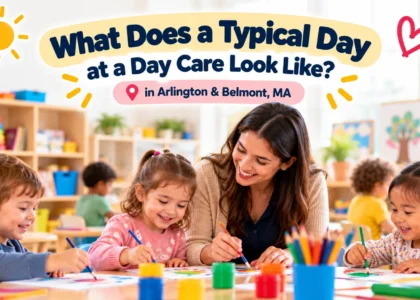
4. What Does a Typical Day Look Like?
Never choose a daycare without understanding what your child’s day will actually look like.
Ask:
“Can you walk me through a typical day for children in this age group?”
You want to understand the balance between:
- free play,
- guided activities,
- outdoor time,
- meals,
- snacks,
- rest,
- stories,
- music,
- movement,
- art,
- sensory play,
- social interaction,
- individual activities,
- transitions.
A strong early childhood program should not necessarily resemble an elementary-school classroom.
Young children learn through active experiences, relationships, exploration, play, movement, language, and hands-on activities.
Massachusetts preschool guidance emphasizes that young children learn by doing and that developmental areas are interconnected.
Ask for the actual schedule
For example:
| Part of Day | What to Ask |
|---|---|
| Arrival | How are children welcomed? |
| Morning | What activities are offered? |
| Outdoor Play | How often do children go outside? |
| Meals | How are meals and allergies handled? |
| Learning | What skills are developed? |
| Rest | Is there quiet/rest time? |
| Afternoon | What activities take place? |
| Pickup | How are children released to parents? |
Don’t be concerned if the schedule changes occasionally.
Young children need flexibility.
The important question is whether the day has a thoughtful structure.
5. What Curriculum or Learning Approach Does the Daycare Use?
Ask:
“What does your curriculum focus on, and how do children learn throughout the day?”
The word “curriculum” can mean different things at different daycare programs.
A strong curriculum for young children should not simply mean worksheets and memorization.
Massachusetts EEC describes high-quality curriculum as developmentally appropriate, evidence-based, hands-on, flexible, play-based, responsive to different interests and abilities, and aligned with Massachusetts early learning guidelines. It also emphasizes assessment and family partnerships.
Ask whether the program supports:
Language development
- Storytelling
- Reading
- Songs
- Conversation
- Vocabulary
- Listening
- Communication
Early literacy
- Books
- Letters
- Sounds
- Drawing
- Writing experiences
- Name recognition
Early mathematics
- Counting
- Sorting
- Patterns
- Shapes
- Measurement
- Problem-solving
Science
- Nature exploration
- Observation
- Cause and effect
- Experiments
- Questions
Creativity
- Art
- Music
- Dance
- Dramatic play
- Imaginative activities
Physical development
- Gross motor movement
- Fine motor activities
- Outdoor play
- Balance
- Coordination
The most important question
Ask:
“How do you adapt activities for children who develop at different rates?”
A strong answer should demonstrate that teachers observe children and adjust activities rather than expecting every child to perform identically.
6. How Does the Daycare Support Social-Emotional Development?
Academic learning is important.
But preschool and daycare are also where children learn how to:
- make friends,
- communicate,
- wait,
- share,
- cooperate,
- handle frustration,
- identify emotions,
- solve disagreements,
- ask for help,
- become more independent.
Massachusetts early learning guidance emphasizes social-emotional development and approaches to play and learning as important areas of early childhood development.
Ask:
“How do teachers help children manage emotions and solve conflicts?”
Also ask:
- What happens when a child hits or bites?
- How do you respond to tantrums?
- How do teachers handle repeated challenging behavior?
- Do you use time-outs?
- How do you teach children appropriate behavior?
- How are parents informed about behavioral concerns?
- How do teachers help children make friends?
Look for positive guidance
A high-quality program should be able to explain how it teaches appropriate behavior rather than simply describing punishment.
Children need boundaries, but they also need adults who understand child development.
7. How Do You Handle Health, Safety, Illness, Allergies and Emergencies?
Safety questions should never feel awkward.
Ask:
“What are your procedures for keeping children safe and responding to emergencies?”
Then ask specifically about:
Illness
- When must a child stay home?
- When can a child return?
- How are sick children separated from the group?
- How are parents notified?
Allergies
- How are food allergies documented?
- Are allergy plans shared with classroom staff?
- How is cross-contact minimized?
- What happens during birthdays or special events?
Medication
- Can staff administer medication?
- What documentation is required?
- Who is authorized to administer it?
- How are medications stored?
Emergencies
- What happens during a fire?
- How are children evacuated?
- What happens during severe weather?
- How are parents contacted?
- How does the center account for every child?
Security
Ask:
- Who can enter the building?
- Are doors secured?
- How is visitor access controlled?
- How are children released during pickup?
- What happens if someone other than a parent arrives?
Massachusetts EEC licensing requirements are designed around health and safety standards, and the state publishes regulations and licensing policies for child care programs.
8. How Will You Communicate With Parents?
A daycare should not feel like a black box.
Parents should understand what happens during their child’s day.
Ask:
“How do you communicate with families?”
Communication may include:
- mobile apps,
- daily reports,
- email,
- phone calls,
- parent meetings,
- classroom updates,
- developmental observations,
- photos,
- newsletters,
- scheduled conferences.
Ask about communication frequency
Questions to ask:
- Will I know when my child eats?
- Will I know about naps?
- Will I be informed about incidents?
- How will developmental progress be communicated?
- Who should I contact if I have a concern?
- How quickly does the director typically respond?
- Are parent-teacher conferences offered?
- How are major developmental concerns discussed?
Massachusetts EEC specifically identifies family and community partnerships as a program-quality area and emphasizes communication, collaboration, respect, and active family involvement.
A good sign
A strong daycare should be comfortable with reasonable parent questions.
You should not feel like you’re “bothering” staff by asking about your child.
9. What Is the Complete Cost of Day Care?
Tuition is obviously important.
But don’t ask only:
“How much is daycare?”
Ask:
“What is the complete cost of enrollment, and are there any additional or occasional fees?”
Ask about:
- Weekly tuition
- Monthly tuition
- Registration fee
- Enrollment fee
- Deposit
- Materials fee
- Activity fee
- Meal fee
- Late pickup fee
- Early drop-off fee
- Extended-care fee
- Vacation policy
- Holiday closures
- Summer tuition
- Withdrawal notice
- Refund policy
- Payment schedule
- Returned-payment fees
Ask about part-time care
If you don’t need full-time care, ask:
- Is part-time enrollment available?
- Which days are available?
- Is the tuition prorated?
- Can schedules change?
- Is there a minimum number of days?
Ask about financial assistance
Massachusetts Child Care Financial Assistance programs can help eligible families pay for child care and out-of-school-time programs. Eligibility depends on factors including family circumstances and income.
Massachusetts also launched MyChildCareMA for child care financial assistance applications and waitlist management in 2026.
Don’t assume you are ineligible.
Ask the daycare:
“Do you accept families using Massachusetts child care financial assistance?”
10. How Will You Support My Child’s Individual Needs?
This may be the most important question of all.
Ask:
“How do you individualize care and learning for each child?”
Every child is different.
One child may be highly social.
Another may need time before joining a group.
One may love books.
Another may prefer building.
One may transition easily.
Another may need additional preparation.
A quality daycare should recognize these differences.
Massachusetts preschool guidance explicitly recognizes individual differences in children’s development and emphasizes knowledge of child development when designing and implementing programs.
Ask about:
- Developmental differences
- Speech and language needs
- Social-emotional needs
- Sensory preferences
- Dietary requirements
- Cultural background
- Home language
- Toilet learning
- Separation anxiety
- Sleep/rest preferences
- Learning differences
- Special education services
- Individualized support
Ask this important question
“What happens if you notice that my child may need additional support?”
The answer can tell you a lot about the program.
A strong program should have a process for observation, documentation, communication with parents, and referral or collaboration with appropriate professionals when needed.
Additional Questions Parents Should Ask Before Choosing Day Care in Arlington, MA
The 10 questions above cover the essentials, but parents comparing several programs should go deeper.
Questions About Teachers
Ask:
- Who will be my child’s primary teacher?
- How long has the teacher worked here?
- What is staff turnover like?
- Are teachers trained in early childhood development?
- Are substitute teachers regularly used?
- How are new teachers trained?
- Do teachers receive ongoing professional development?
- Are classroom assistants permanent or rotating?
Why staff stability matters
Children build relationships through repeated interactions.
A constantly changing classroom can make routines and relationships more difficult.
Staff retention is therefore worth discussing during your tour.
Questions About Outdoor Play
Ask:
“How much outdoor time do children receive on a typical day?”
Then ask:
- Is outdoor play daily?
- Is there an outdoor playground?
- Is there access to a park or other outdoor space?
- What happens during bad weather?
- How much physical activity happens indoors?
- Are children allowed to choose among activities?
Outdoor play can support:
- gross motor development,
- coordination,
- social interaction,
- exploration,
- imagination,
- confidence,
- physical activity.
Questions About Meals and Snacks
If meals are provided, ask:
- What meals are served?
- Are snacks included?
- Is the menu shared with parents?
- How are food allergies handled?
- Can children bring food from home?
- How are dietary restrictions handled?
- Are children encouraged to try food without being forced?
- Is drinking water available?
- How are choking risks addressed?
Food policies should be clear before enrollment.
Questions About Nap and Rest Time
For younger children, rest can be an important part of the daily schedule.
Ask:
- Is there a nap period?
- How long is rest time?
- What happens if my child does not sleep?
- Can children participate in quiet activities?
- What are the sleeping arrangements?
- How are sleep areas supervised?
A daycare should have a thoughtful approach that balances children’s individual needs with classroom routines.
Questions About Toilet Learning
If your child is approaching or beginning toilet learning, ask:
- Do teachers assist with toilet learning?
- Is there a specific policy?
- Do children need to be toilet trained before enrollment?
- What happens when accidents occur?
- What supplies should parents provide?
- How do teachers communicate progress?
Avoid choosing a program without understanding its expectations.
Questions About Screen Time
Ask:
“Do children use screens during the day?”
If yes, ask:
- How often?
- For how long?
- What content?
- Is it educational?
- Is it optional?
- Is it used as a reward?
- What alternatives are available?
For many parents, limited or no screen use may be a preference.
The important thing is to understand the policy before enrollment.
Questions About Inclusion and Special Needs
Parents should ask whether the program can support children with different developmental, physical, behavioral, communication, or learning needs.
Ask:
- How do you support children with developmental differences?
- Do you work with speech therapists?
- Do you coordinate with early intervention providers?
- How do you support children with IEPs or other plans when applicable?
- Can classroom activities be adapted?
- How are individual accommodations communicated to staff?
Don’t wait until there is a problem to ask.
Questions About Family Communication
Ask:
- How frequently do parents receive updates?
- Are parents invited to classroom events?
- Are there parent conferences?
- How are concerns communicated?
- Can parents request a meeting?
- How does the director handle complaints?
- Is there a parent handbook?
A strong relationship between parents and educators can make the child’s experience much better.
What Should Parents Look for During a Daycare Tour?
Don’t spend the entire tour listening.
Observe.
Look at the environment.
Watch the teachers
Are teachers:
- engaged?
- calm?
- attentive?
- speaking respectfully?
- getting down to children’s level?
- responding to questions?
- helping children solve problems?
Watch the children
Do children appear:
- comfortable?
- engaged?
- curious?
- active?
- relaxed?
- appropriately supervised?
No classroom will look perfect every second.
Children cry.
Children disagree.
Children make messes.
That’s normal.
What matters is how adults respond.
What Does a High-Quality Daycare Environment Look Like?
Massachusetts EEC identifies several characteristics of high-quality early education and care, including warm and supportive interactions, safe opportunities for play and exploration, intentional curriculum, appropriate physical environments, and strong family partnerships.
During your visit, look for:
1. Warm adult-child interactions
Teachers should appear genuinely interested in children.
2. Accessible learning materials
Children should be able to interact with developmentally appropriate materials.
3. Organized but flexible classrooms
A classroom doesn’t need to look perfectly clean.
It needs to be safe, usable, and intentionally organized.
4. Books and language
Look for:
- books,
- storytelling,
- conversations,
- songs,
- writing materials.
5. Hands-on learning
Children should have opportunities to:
- build,
- draw,
- explore,
- sort,
- create,
- move,
- pretend,
- investigate.
Day Care vs. Preschool: What’s the Difference?
Parents often search for both day care in Arlington, MA and preschool in Arlington, MA.
The terms overlap, but they are not always identical.
Daycare
Usually emphasizes:
- care and supervision,
- flexible schedules,
- full-day coverage,
- routines,
- meals,
- rest,
- play,
- early learning.
Preschool
Usually places stronger emphasis on:
- early education,
- school readiness,
- curriculum,
- social development,
- language,
- early literacy,
- early math,
- classroom routines.
However, many modern child care programs combine both.
A daycare can provide a strong educational experience, while a preschool may also provide extensive care hours.
Massachusetts EEC describes group and school-age child care as encompassing several forms of early education and care, including preschool programs.
So don’t choose based solely on the label.
Ask what the program actually provides.
How to Evaluate Day Care in Arlington, MA Based on Your Family’s Lifestyle
The best daycare is not necessarily the one with the fanciest building.
Consider your family’s practical needs.
If both parents work full-time
Prioritize:
- reliable hours,
- early drop-off,
- late pickup,
- holiday schedule,
- emergency closure policy,
- vacation policy.
If you work remotely
Consider:
- commute,
- drop-off flexibility,
- part-time options,
- predictable schedules.
If you have multiple children
Ask:
- Can siblings attend the same program?
- Are sibling discounts available?
- Can schedules be coordinated?
- What happens when one child moves to another classroom?
If your family lives near Belmont
Don’t automatically restrict your search to Arlington.
A family living near the Arlington-Belmont area may find that a program in Belmont, MA fits better with their work commute, school plans, or daily route.
The Massachusetts EEC search system allows families to search by geographic area and program type, making it useful for comparing options across nearby communities.
Arlington, MA Daycare Considerations for Local Families
Families searching for day care in Arlington, MA should consider both private/community-based child care and school-connected early education options.
Arlington Public Schools operates Menotomy Preschool, and its enrollment for the 2026–2027 school year is currently listed as closed with a waitlist option.
That illustrates an important point:
A school-based preschool and a traditional daycare are not necessarily interchangeable.
Parents should compare:
- eligibility,
- hours,
- age requirements,
- enrollment process,
- tuition,
- transportation,
- before/after care,
- summer coverage,
- and whether the program meets the family’s full child-care needs.
Don’t assume that a preschool program automatically provides the same schedule as a full-day daycare.
What About Day Care in Belmont, MA?
Families who live or work around Arlington may also search for day care in Belmont, MA.
Belmont Public Schools operates an Integrated Preschool Program for children ages 3–5, with classrooms that include children requiring special education programming and typically developing peer models. The district states that the curriculum aligns with Massachusetts Early Childhood Program Learning Standards and includes language-rich activities supporting communication, social, emotional, cognitive, and motor development.
Again, this is an example of why parents should look beyond the word “preschool.”
A public integrated preschool may have a different purpose, eligibility structure, schedule, and enrollment process from a private full-day daycare.
When comparing Arlington vs. Belmont child care, compare the actual program rather than the city name.
Arlington vs. Belmont: How Should Parents Compare Daycare?
If your family could reasonably use either town, create a side-by-side comparison.
| Factor | Arlington | Belmont |
|---|---|---|
| Distance from home | ___ | ___ |
| Distance from work | ___ | ___ |
| Daily hours | ___ | ___ |
| Tuition | ___ | ___ |
| Registration fee | ___ | ___ |
| Teacher-child ratio | ___ | ___ |
| Group size | ___ | ___ |
| Outdoor play | ___ | ___ |
| Curriculum | ___ | ___ |
| Meals | ___ | ___ |
| Nap/rest | ___ | ___ |
| Parent communication | ___ | ___ |
| EEC licensing | ___ | ___ |
| Staff stability | ___ | ___ |
| Special-needs support | ___ | ___ |
| Before/after care | ___ | ___ |
| Summer care | ___ | ___ |
| Overall fit | ___ | ___ |
This approach prevents parents from choosing emotionally based on one impressive feature.
How to Check a Daycare Before Enrolling
Use a three-step process.
Step 1: Search
Use the Massachusetts EEC child care search system to identify programs in Arlington, Belmont, and surrounding areas.
Step 2: Verify
Check:
- licensing,
- program type,
- location,
- age groups served,
- license history,
- available information about compliance.
EEC says families can contact the agency regarding license history, non-compliance findings, and current restrictions.
Step 3: Visit
Never make your final decision based entirely on online information.
Visit the program.
Talk to teachers.
Observe classrooms.
Ask questions.
Trust evidence over marketing.
Red Flags to Watch for During a Daycare Tour
No program is perfect, but some warning signs deserve attention.
Red Flag #1: Staff avoid your questions
A quality program should be able to explain its policies.
Red Flag #2: High staff turnover
Constant staff changes may make it harder for children to develop consistent relationships.
Red Flag #3: Children appear consistently disengaged
One moment doesn’t tell you much.
Repeated disengagement deserves investigation.
Red Flag #4: Teachers seem disconnected
If adults spend most of their time talking to each other rather than interacting with children, ask why.
Red Flag #5: Vague safety policies
If staff cannot clearly explain emergency, pickup, illness, or allergy procedures, take that seriously.
Red Flag #6: No clear curriculum explanation
“Children just play all day” may indicate a misunderstanding of intentional play-based learning.
Play is valuable, but high-quality programs intentionally use play and interaction to support development.
Red Flag #7: Unexpected fees
Always request complete tuition and fee information in writing.
Red Flag #8: Pressure to enroll immediately
You should have enough information to make a thoughtful decision.
How to Compare Two or Three Daycare Programs
Create a simple scoring system.
Give each program a score from 1 to 5.
| Category | Weight | Program A | Program B | Program C |
|---|---|---|---|---|
| Safety | 10 | /10 | /10 | /10 |
| Teachers | 10 | /10 | /10 | /10 |
| Ratio & group size | 10 | /10 | /10 | /10 |
| Curriculum | 10 | /10 | /10 | /10 |
| Communication | 10 | /10 | /10 | /10 |
| Schedule | 10 | /10 | /10 | /10 |
| Tuition/value | 10 | /10 | /10 | /10 |
| Outdoor play | 5 | /5 | /5 | /5 |
| Environment | 5 | /5 | /5 | /5 |
| Individual support | 10 | /10 | /10 | /10 |
| Location | 5 | /5 | /5 | /5 |
| Family fit | 5 | /5 | /5 | /5 |
| Total | 100 | /100 | /100 | /100 |
This is particularly useful when comparing day care in Arlington, MA with options in Belmont or nearby communities.
The 10 Questions You Should Never Skip
If you only have five minutes with a daycare director, ask these:
1. Are you licensed by Massachusetts EEC?
2. What is the teacher-to-child ratio?
3. How large is my child’s classroom?
4. What qualifications and training do teachers have?
5. What does a typical day look like?
6. What curriculum or learning approach do you use?
7. How do you handle challenging behavior?
8. What are your illness, allergy and emergency policies?
9. What is the complete cost, including additional fees?
10. How do you communicate with parents about development and concerns?
These questions give you a surprisingly comprehensive picture of a program.
What a Strong Daycare Answer Should Sound Like
Parents should pay attention not only to what a daycare says, but how specifically it answers.
Weak answer
“We take very good care of children.”
Stronger answer
“Our classroom follows a predictable daily routine with arrival, small-group activities, free-choice play, outdoor time, meals, rest, and teacher-guided experiences. Teachers observe children’s interests and adjust activities accordingly.”
The second answer provides evidence of intentional planning.
How Far in Advance Should You Look for Day Care?
Start earlier than you think you need to.
Some programs have:
- waiting lists,
- enrollment windows,
- limited classroom capacity,
- age-specific openings,
- annual registration periods,
- priority rules,
- lottery-based enrollment.
Public and school-based programs may have completely different enrollment systems from private daycare providers.
For example, Arlington’s Menotomy Preschool currently states that new-family enrollment is determined through a lottery and that the 2026–2027 lottery is closed with a waitlist option.
Therefore, parents should not wait until the last minute.
What Makes a Daycare “High Quality”?
A high-quality daycare is not defined by one feature.
It is a combination of:
Safe environment
Children are supervised and safety procedures are clear.
Caring educators
Adults build warm, responsive relationships with children.
Intentional curriculum
Children learn through developmentally appropriate experiences.
Play-based learning
Children have opportunities to explore, imagine, create, experiment, and solve problems.
Strong communication
Parents understand what is happening with their child.
Individual attention
Teachers recognize that children develop differently.
Family partnership
Parents are treated as important partners.
Stable operations
The program has organized policies, staffing, communication, and enrollment procedures.
Massachusetts EEC’s quality framework similarly emphasizes adult-child interactions, curriculum and assessment, physical environment, family partnerships, leadership, professional learning, and strong program operations.
Should You Choose a Daycare Based on Online Reviews?
Reviews can be useful.
But they should not be your only deciding factor.
A review may reflect:
- one family,
- one teacher,
- one incident,
- one billing dispute,
- one particular child’s experience,
- or expectations that differ from yours.
Instead, use reviews to identify questions.
For example:
If several parents mention communication problems, ask the director:
“How does your program communicate daily updates and handle parent concerns?”
If parents frequently mention staff turnover:
“What is your current staff retention like?”
Reviews should generate questions—not replace research.
What Does “Play-Based” Really Mean?
Some parents hear “play-based” and assume that children are simply playing without learning.
That’s not necessarily true.
High-quality play-based learning can involve:
- mathematics,
- language,
- science,
- social development,
- problem-solving,
- physical development,
- creativity,
- executive functioning.
For example, building a tower can involve:
- counting blocks,
- understanding balance,
- predicting outcomes,
- communicating with peers,
- solving problems,
- developing fine motor skills.
Massachusetts EEC specifically describes high-quality curriculum as developmentally appropriate, hands-on, flexible, and play-based.
Questions to Ask Your Child After the Tour
If your child is old enough to communicate about the visit, ask:
- Did you like the classroom?
- What was your favorite activity?
- Did you like the teacher?
- Did you see any books?
- Did you play outside?
- Did you make a friend?
- Was anything scary?
- Would you like to come back?
Children may not provide a formal evaluation, but their reactions can provide valuable information.
A Simple Daycare Decision Checklist
Before enrolling, make sure you can answer “yes” to most of these:
Safety
- The program is properly licensed where required.
- Safety procedures are clearly explained.
- Pickup authorization is secure.
- Emergency procedures are documented.
- Allergy and medication policies are clear.
Teachers
- Teachers are warm and attentive.
- Qualifications are appropriate.
- Staff turnover appears manageable.
- Background-check requirements are followed.
- Professional development is encouraged.
Learning
- The curriculum is developmentally appropriate.
- Children have meaningful play opportunities.
- Books and language activities are present.
- Children have creative experiences.
- Outdoor and physical activity are included.
Family
- Communication is clear.
- Parents can contact leadership.
- Policies are provided in writing.
- Families are treated as partners.
Practical fit
- Hours match your schedule.
- Location is convenient.
- Tuition fits your budget.
- Additional fees are understood.
- Vacation and closure policies work for your family.
Frequently Asked Questions About Day Care in Arlington, MA
1. How do I choose the best day care in Arlington, MA?
Start by defining your family’s requirements for age, schedule, location, tuition, educational approach, meals, outdoor play, communication, and individual support. Then verify licensing information, visit several programs, ask detailed questions, and compare them using a written checklist.
The “best” daycare is the one that provides a safe, nurturing and developmentally appropriate environment while fitting your child’s needs and your family’s schedule.
2. How can I verify whether a daycare in Arlington, MA is licensed?
Massachusetts EEC provides a child care search tool that allows families to search by geographic location and program type. EEC also says families can contact the agency for information about a program’s license history, non-compliance findings, and current restrictions.
3. What should I look for during a daycare tour?
Look at teacher-child interactions, classroom cleanliness and organization, supervision, learning materials, children’s engagement, outdoor spaces, safety procedures, and the overall atmosphere.
Also pay attention to how staff respond when children are upset or need assistance.
4. What teacher-to-child ratio should I look for?
Ratios depend on the children’s ages and the type of program. Massachusetts regulations specify different ratios and group sizes for infants, toddlers, preschoolers, kindergarten, and school-age children. For example, current EEC regulations list a 1:10 ratio for preschoolers in full-day fixed-age groups, with a maximum group size of 20, while half-day preschool has different limits.
Ask the specific daycare what ratio applies to your child’s classroom and what the actual day-to-day staffing looks like.
5. Is daycare the same as preschool?
Not necessarily.
Daycare generally emphasizes care and supervision while also potentially providing early education. Preschool typically places greater emphasis on early learning and school readiness. However, many programs combine both functions.
Always compare the actual services, schedule and curriculum instead of relying on the label.
6. What age do children start daycare or preschool?
There is no single age that applies to every program.
Some daycare programs accept infants, while others begin with toddlers or preschool-age children. Age requirements, birth-date cutoffs and enrollment policies vary.
Ask each program for its exact age range and cutoff date.
7. What should I ask about daycare curriculum?
Ask:
- What curriculum is used?
- Is it play-based?
- How are language and literacy developed?
- How are early math skills introduced?
- How is social-emotional development supported?
- How much outdoor play is included?
- How are activities adapted for individual children?
Massachusetts EEC describes quality curriculum as developmentally appropriate, evidence-based, hands-on, flexible, play-based, and responsive to children’s interests, abilities, cultures and languages.
8. Should I consider day care in Belmont, MA if I live in Arlington?
Yes, if the location works for your family.
Families near Arlington and Belmont may reasonably compare programs across town boundaries based on commuting patterns, availability, tuition, hours and program philosophy.
The EEC child care search system can help families investigate licensed programs geographically.
9. Are there public preschool options in Belmont?
Yes. Belmont Public Schools operates an Integrated Preschool Program for children ages 3–5, with special education programming and typically developing peer models. The program states that its curriculum aligns with Massachusetts Early Childhood Program Learning Standards.
However, a public integrated preschool may not provide the same schedule or services as a full-day private daycare, so parents should compare the details carefully.
10. Does Arlington have public preschool options?
Arlington Public Schools operates Menotomy Preschool. Its current information indicates that new-family enrollment is determined through a lottery, and its 2026–2027 lottery is listed as closed with a waitlist option.
Parents should check current eligibility, schedule and enrollment information directly with the program.
11. What should I ask about staff background checks?
Ask whether the program complies with Massachusetts EEC background-check requirements.
EEC’s BRC process includes multiple checks, including criminal-history, child-welfare, sex-offender registry and fingerprint-based checks, with additional checks where applicable.
12. Can families receive financial help with daycare costs?
Potentially.
Massachusetts Child Care Financial Assistance can help eligible families pay for child care and out-of-school-time programs. Eligibility depends on factors including family circumstances and income.
Ask the daycare whether it accepts applicable assistance and review current eligibility information through Massachusetts EEC.
13. How important is daycare staff stability?
Very important.
Young children benefit from predictable relationships and familiar caregivers. Ask how long teachers typically stay, whether your child’s classroom has experienced recent turnover, and how substitute coverage works.
14. What should I ask about discipline?
Ask exactly how teachers respond to:
- tantrums,
- hitting,
- biting,
- refusing instructions,
- conflicts,
- separation anxiety,
- repeated challenging behavior.
Look for an approach based on teaching, guidance, consistency and developmentally appropriate expectations.
15. Should I choose a daycare based on price?
Price matters, but it should not be your only factor.
Compare the complete value:
- hours,
- teacher-child ratio,
- curriculum,
- meals,
- outdoor play,
- staff stability,
- communication,
- flexibility,
- safety,
- and additional fees.
The cheapest option may not be the best fit, while the most expensive option isn’t automatically the highest quality.
Final Conclusion: Choosing the Right Day Care in Arlington, MA
Choosing day care in Arlington, MA is ultimately about finding a balance between safety, quality, learning, relationships, convenience, and affordability.
The right daycare should make you feel confident that your child is:
- safe,
- respected,
- cared for,
- appropriately challenged,
- encouraged to explore,
- supported emotionally,
- given opportunities to play,
- surrounded by responsive adults,
- and treated as an individual.
Start with the 10 essential questions:
- Is the program properly licensed?
- What are the teacher-child ratios?
- Who will care for my child?
- What does a typical day look like?
- What curriculum is used?
- How is social-emotional development supported?
- How are health and safety handled?
- How will parents receive updates?
- What is the complete cost?
- How will the program support my child’s individual needs?
Then go one step further.
Visit the daycare.
Observe the classrooms.
Talk to educators.
Ask uncomfortable questions.
Read policies.
Compare programs.
Verify licensing information.
And consider nearby options—including day care in Belmont, MA—if they make sense for your family’s commute and schedule.
Massachusetts EEC’s own guidance emphasizes that child care is personal and that the strongest choice is one that matches the individual child and family’s needs while providing a safe, educational and nurturing environment.
Ultimately, don’t ask only:
“Is this a good daycare?”
Ask:
“Is this the right environment for my child, and does it work for our family?”
That is the question that can lead you to the right decision.