

Summary
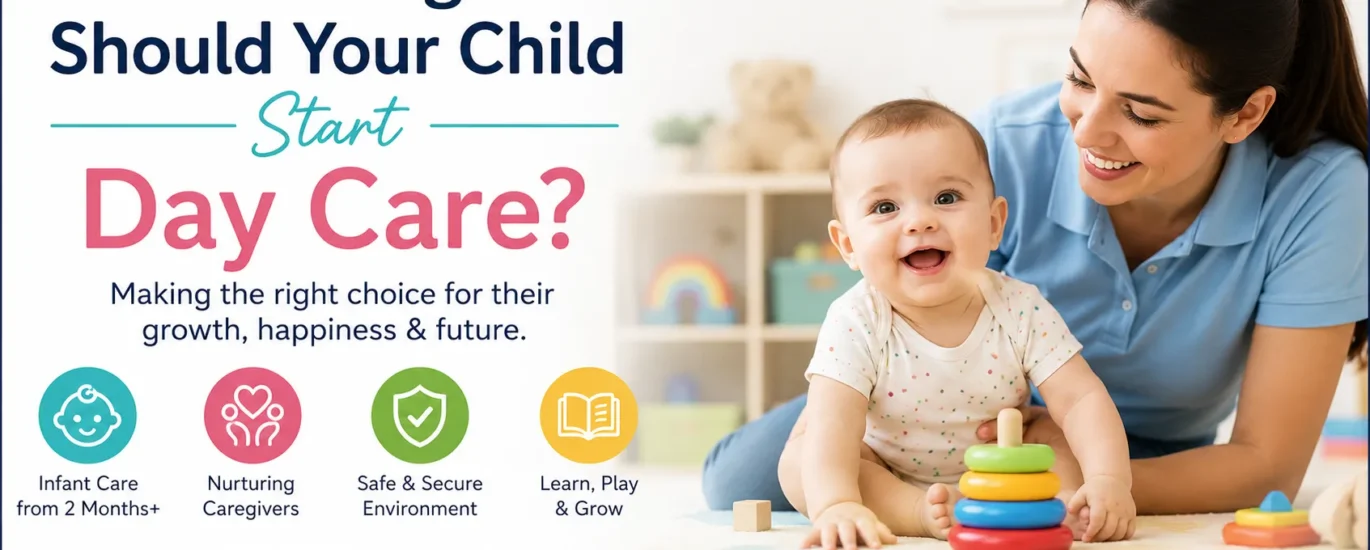
Choosing when your child should start day care is one of the most important decisions parents make during the early years. There is no single age that is perfect for every child or every family. Some babies begin infant day care in Belmont, MA when they are only a few months old because parents return to work, while other families wait until their child is closer to toddler or preschool age.
In Massachusetts, licensed child care programs commonly organize care according to age groups. The Massachusetts Department of Early Education and Care (EEC) identifies infants as children from birth to 15 months, toddlers as children from 15 months to under 33 months, and preschool-age children as beginning around 33 months through kindergarten.
For parents searching for day care in Belmont, MA, the most important question is therefore not simply, “What is the best age to start daycare?” Instead, parents should ask:
- Is my child developmentally ready for a group-care environment?
- Is the daycare licensed and appropriate for my child’s age?
- Does the program accept infants at my child’s current age?
- Are caregivers experienced with babies?
- What are the infant-to-caregiver ratios?
- How does the center handle feeding, naps, diapering, and soothing?
- Is the location convenient for our daily routine?
- Does the schedule work with our work and family commitments?
- How does the daycare communicate with parents?
- Does the environment feel safe, nurturing, clean, and welcoming?
Massachusetts EEC recommends that families consider their child’s temperament, interests, health, behavior, and the family’s schedule and philosophy when selecting a child care program.
This guide explains when children can start day care, what age may work best, how infant daycare differs from toddler care, what Belmont and Arlington parents should look for, and how to prepare a baby for the transition.
Introduction: When Is the Right Age to Start Day Care?
For new parents, deciding when a baby should start daycare can feel overwhelming.
You may be asking:
“Is my baby too young for daycare?”
“Should I wait until six months?”
“Is starting daycare at three months okay?”
“Would it be better to wait until my child is one year old?”
“How do I know if my baby is ready?”
These are very common questions.
The reality is that there is no universal perfect age for starting day care. Families have different employment schedules, financial circumstances, parental leave arrangements, support systems, and childcare needs.
Some parents need infant day care in Belmont, MA shortly after parental leave ends. Others have grandparents or family members available and choose to delay formal childcare. Some children start in a family childcare home, while others begin in a larger center.
The goal should not be to identify one magical age.
Instead, the goal is to find a safe, developmentally appropriate, nurturing childcare environment that matches your child’s needs and your family’s circumstances.
Massachusetts has an established licensing system through the Department of Early Education and Care (EEC). EEC licenses or approves family child care, group child care, and school-age programs and establishes health, safety, supervision, and training requirements.
That makes the quality of the individual program extremely important.
What Is the Typical Age to Start Day Care?
Children can begin childcare at very different ages.
For many families, the starting age is determined primarily by:
- Parental leave
- Return-to-work date
- Family support
- Childcare availability
- Financial considerations
- Child’s temperament
- Parents’ preferences
- The type of childcare available
A baby might start childcare at:
- 6 weeks
- 2 months
- 3 months
- 4 months
- 6 months
- 9 months
- 12 months
- 15 months
- 18 months
- 2 years
- 3 years or later
There is no requirement that every child begin daycare at the same age.
However, the daycare itself determines the minimum and maximum ages it accepts, so parents should ask about enrollment age before assuming that a particular program is suitable.
Understanding Infant Day Care in Massachusetts
One of the most important things for parents searching for infant day care in Belmont, MA is understanding how Massachusetts defines age groups.
According to Massachusetts EEC information, an infant is generally classified as birth through 15 months, while a toddler is at least 15 months but younger than 33 months.
This distinction matters because infant care has different requirements and responsibilities from toddler or preschool care.
Infants may require:
- Bottle or breast milk feeding
- Frequent diaper changes
- Individualized nap schedules
- Soothing and comforting
- Close supervision
- Developmentally appropriate floor play
- Tummy time
- Safe sleep practices
- Careful monitoring
- Communication with parents
- Support during transitions
- Individual feeding routines
Therefore, a daycare that is excellent for preschool children may not necessarily be the best choice for a young infant.
Parents should specifically evaluate the infant classroom or infant-care area, rather than judging the entire facility based only on its preschool program.
Is There a “Best” Age to Start Day Care?
The short answer: No.
There is no single age that is automatically best for every child.
The ideal starting age depends on the child and family.
A three-month-old baby may thrive in a high-quality infant program with responsive caregivers.
Another family may prefer to wait until the child is 12 or 18 months old.
Both can be reasonable choices.
Instead of focusing entirely on age, consider three major factors:
1. Your child’s needs
Consider:
- Temperament
- Feeding routine
- Sleep routine
- Ability to adapt to new caregivers
- Comfort with new environments
- Medical or developmental needs
- Separation reactions
2. Your family’s needs
Consider:
- Work schedule
- Commute
- Parental leave
- Available family support
- Budget
- Preferred childcare hours
- Backup childcare arrangements
3. The quality of the daycare
This may be the most important factor.
A high-quality, appropriately licensed childcare program with responsive caregivers can provide a nurturing environment for children while parents work or manage other responsibilities.
Starting Day Care Before 6 Months
Some families need childcare when their baby is only a few months old.
This can happen after parental leave ends or when parents return to work.
Starting daycare during early infancy means parents should pay particular attention to:
Feeding
Ask:
- Does the program accept breast milk?
- How should bottles be labeled?
- How are bottles stored?
- Can caregivers follow the baby’s feeding schedule?
- How are feeding updates communicated?
- What happens if the baby is hungry earlier than expected?
Sleep
Ask:
- Where do infants sleep?
- How are sleeping babies monitored?
- What is the program’s safe-sleep procedure?
- Can caregivers accommodate individual sleep schedules?
- How are nap times communicated to parents?
Diapering
Ask:
- How frequently are diapers checked?
- Do parents provide diapers and wipes?
- How are diaper changes documented?
Soothing
Every baby is different.
Ask caregivers:
“What do you do when a baby is crying and cannot be immediately soothed?”
A good conversation about infant care can tell parents a great deal about the program’s philosophy.
Starting Day Care Around 6 Months
Around six months, some babies become increasingly interested in their surroundings.
They may begin:
- Rolling
- Reaching for objects
- Sitting with support
- Exploring toys
- Responding more strongly to familiar people
- Developing predictable feeding patterns
However, babies develop at different rates.
Parents should not expect every six-month-old to have identical skills.
A quality daycare should accommodate individual development rather than forcing every child into the same routine.
Starting Day Care Between 6 and 12 Months
This is another common period for beginning childcare.
At this stage, some babies may:
- Sit independently
- Crawl
- Pull themselves up
- Explore their environment
- Become more mobile
- Develop stronger preferences for familiar caregivers
Parents may notice increased separation anxiety during parts of the first year.
That does not necessarily mean daycare is inappropriate.
Instead, it means the transition may require additional patience and consistency.
A gradual introduction can help.
Starting Day Care Around 12 Months
Around one year, many children are becoming more mobile and socially interactive.
They may:
- Crawl or walk
- Explore actively
- Imitate adults
- Use gestures
- Respond to familiar routines
- Show strong preferences
- Become increasingly independent
For some families, this is a convenient time to transition into daycare.
But again, 12 months is not a universal starting point.
The best decision depends on the child, family, and childcare provider.
Starting Day Care After 15 Months
Massachusetts EEC generally places children at least 15 months old into the toddler age category.
Toddler care is significantly different from infant care.
Toddlers may need:
- More active play
- Movement opportunities
- Language development
- Social interaction
- Simple routines
- Opportunities for independence
- Age-appropriate sensory activities
- Support with emerging communication skills
Parents searching for day care in Belmont, MA should therefore ask whether their chosen program transitions children between infant, toddler, and preschool classrooms.
A strong transition system can make moving between age groups easier for children.
Starting Day Care Around Age 2
Two-year-olds are usually much more mobile and independent than infants.
They may be developing:
- Vocabulary
- Social skills
- Self-help skills
- Problem-solving
- Emotional regulation
- Pretend play
- Early independence
At this age, parents should evaluate whether the daycare offers an environment that supports both learning and active play.
The program should not simply function as supervision.
Children benefit from age-appropriate opportunities to explore, communicate, create, move, and interact with caregivers and peers.
Starting Day Care at Age 3 or Later
Some parents wait until their child is around three years old or older.
At this stage, childcare may increasingly incorporate preschool-style learning.
Parents may want to evaluate:
- Language development
- Early literacy
- Early math concepts
- Social-emotional learning
- Art
- Music
- Outdoor play
- Group activities
- Independent routines
- School-readiness skills
However, daycare and preschool are not necessarily identical.
Ask the provider exactly what the program offers.
What Age Is Best for Infant Day Care in Belmont, MA?
For parents specifically searching for infant day care in Belmont, MA, the answer depends heavily on your circumstances.
A practical framework is:
| Child’s Age | What Parents Should Focus On |
|---|---|
| 0–3 months | Feeding, safe sleep, close supervision, caregiver responsiveness |
| 3–6 months | Feeding, sleep, tummy time, individualized routines |
| 6–9 months | Mobility, exploration, feeding, separation support |
| 9–12 months | Active movement, communication, routines, social interaction |
| 12–15 months | Mobility, independence, language, transition planning |
| 15–24 months | Toddler routines, language, active play, social development |
| 2–3 years | Communication, independence, social-emotional development |
| 3+ years | Preschool learning, social skills, school readiness |
These are broad developmental categories—not deadlines.
Signs Your Baby May Be Ready for Day Care
Parents sometimes ask whether their baby is “ready.”
A baby does not necessarily need to reach a particular developmental milestone before starting childcare.
Instead, parents can consider whether:
Your family has a workable routine
You know:
- Feeding requirements
- Sleep preferences
- Medication instructions if applicable
- Comforting strategies
- Emergency contacts
- Pickup arrangements
You have found an appropriate childcare program
The program:
- Accepts your child’s age
- Has appropriate licensing
- Has trained caregivers
- Maintains appropriate supervision
- Communicates with parents
- Has clear health and safety procedures
Your child can gradually adapt
Your child may initially cry during drop-off.
That does not automatically mean the daycare is unsuitable.
Many children need time to become familiar with new caregivers and surroundings.
Signs You Should Take More Time Before Choosing a Daycare
The issue may not be the child’s age.
The issue may be the daycare itself.
Parents should be cautious if a provider:
- Cannot clearly explain licensing
- Avoids questions about safety
- Cannot explain infant sleep practices
- Does not provide clear policies
- Has poor communication
- Does not allow parents to understand the daily routine
- Has unclear caregiver responsibilities
- Cannot explain emergency procedures
- Makes parents uncomfortable during a tour
Massachusetts EEC provides a search system for licensed childcare programs and notes that parents can contact EEC for information about a program’s license history, including non-compliance findings and current restrictions.
Why Licensing Matters When Choosing Day Care in Belmont, MA
When comparing childcare programs, licensing should be one of the first things parents verify.
Massachusetts EEC licenses or approves family, group, and school-age childcare programs.
Licensed programs must meet applicable requirements involving areas such as:
- Health
- Safety
- Supervision
- Training
- Facility standards
- Background checks
- Program operations
For group and school-age programs, Massachusetts states that administrators and educators must meet training requirements and be First Aid and CPR certified, among other requirements.
Licensing does not mean every licensed daycare is identical.
It establishes a regulatory baseline.
Parents should still compare individual programs carefully.
Infant-to-Caregiver Ratio: Why It Matters
One of the most important questions to ask an infant daycare in Belmont, MA is:
“How many infants does each caregiver supervise?”
Infants require significantly more individualized attention than older children.
Massachusetts EEC data and regulations identify infant care as a distinct age category, and state planning materials have historically reflected an infant ratio of approximately 1 educator to 3 infants, with additional staffing requirements as group size increases. Parents should verify the current requirements applicable to the specific license type and program.
Do not judge a daycare based solely on its advertised overall teacher-to-child ratio.
Ask specifically about:
Infant classroom ratio.
Also ask what happens when:
- A caregiver takes a break
- A caregiver is absent
- A child needs individual attention
- Multiple children cry simultaneously
- Staff members are changing rooms
What Should Parents Look for in an Infant Daycare?
1. Responsive caregivers
Caregivers should notice and respond to babies’ needs.
Look for adults who:
- Speak calmly
- Comfort children
- Respond to crying
- Engage babies during play
- Observe individual cues
- Treat children respectfully
2. Clean environment
Look at:
- Floors
- Toys
- Changing areas
- Sleeping areas
- Bathrooms
- Food preparation areas
- Handwashing facilities
Do not be afraid to ask how frequently high-touch surfaces and toys are cleaned.
3. Safe sleep arrangements
Ask exactly how infants sleep.
Do not accept vague answers.
Ask:
“Can you walk me through your infant sleep policy?”
A professional childcare provider should be able to explain its procedures clearly.
4. Individualized feeding
Babies have different feeding schedules.
Ask whether the daycare can accommodate:
- Breast milk
- Formula
- Bottles
- Parent-provided food
- Individual feeding schedules
5. Developmentally appropriate activities
Even very young infants benefit from interaction and age-appropriate experiences.
Activities may include:
- Talking
- Singing
- Reading
- Tummy time
- Sensory exploration
- Reaching activities
- Music
- Floor play
- Visual stimulation
How Important Is the Daycare Location?
Location matters more than many parents initially realize.
A daycare can be excellent, but if it adds a significant amount of time to your daily commute, the routine may become stressful.
For families living or working around Belmont and Arlington, MA, consider:
- Distance from home
- Distance from work
- Morning traffic
- Afternoon traffic
- Pickup flexibility
- Parking
- Public transportation
- Emergency pickup time
- Backup transportation
A daycare that is convenient to your daily route can make a major difference over the course of a year.
Day Care in Belmont, MA vs. Arlington, MA
Families searching for childcare in Belmont do not necessarily need to limit their search strictly to Belmont.
Arlington, MA can also be worth considering, especially for families who:
- Live near the Belmont-Arlington area
- Work in Arlington
- Commute through both communities
- Have family nearby
- Want additional childcare choices
However, convenience should remain a major factor.
If two programs are similarly strong, the one that fits your daily route may be more practical.
Questions to Ask During a Daycare Tour
Before choosing a day care in Belmont, MA, create a checklist.
Basic questions
- What ages do you accept?
- What is the minimum enrollment age?
- Do you provide infant care?
- How many children are in the infant classroom?
- How many caregivers are assigned to infants?
- What are your hours?
- Do you offer full-time care?
- Do you offer part-time care?
- What is your holiday schedule?
- How far in advance should parents apply?
Infant-specific questions
- How do you handle bottle feeding?
- Can you accommodate breast milk?
- How are bottles stored?
- What is your nap routine?
- Where do babies sleep?
- How do you handle crying?
- How frequently are diapers changed?
- Do caregivers provide tummy time?
- How do you communicate daily updates?
- How do you handle separation anxiety?
Safety questions
- Is the program licensed by Massachusetts EEC?
- Can I review the program’s policies?
- How are emergencies handled?
- What happens if a child becomes sick?
- What are the pickup authorization procedures?
- What training do caregivers receive?
- How is staff coverage handled when someone is absent?
How Early Should You Start Looking for Infant Day Care?
If you need infant day care in Belmont, MA, do not wait until the last minute.
Infant classrooms can have limited capacity, and families may need to contact multiple programs before finding a suitable opening.
A practical approach is to begin researching months before your intended start date.
Start by:
Step 1: Determine your target start date
For example:
“We need childcare beginning in January.”
Step 2: Determine your child’s expected age
Calculate how old your baby will be at the start date.
Step 3: Create a shortlist
Look for several licensed programs rather than relying on only one.
Step 4: Schedule tours
Visit the programs in person whenever possible.
Step 5: Compare infant-specific care
Do not compare only tuition and location.
Step 6: Ask about availability
A great daycare does not help if there is no space.
Step 7: Understand enrollment requirements
Ask about:
- Application
- Registration
- Deposit
- Required documents
- Health records
- Emergency contacts
- Immunization requirements
- Start dates
Should You Choose a Daycare Close to Home or Work?
There is no universal answer.
Daycare close to home
Advantages may include:
- Easier morning routine
- Easier emergency pickup
- Convenient for both parents
- Useful when working from home
- Less dependence on work location
Daycare close to work
Advantages may include:
- Easier pickup after work
- Convenient for parents with long commutes
- Potentially easier emergency access
Think about your entire daily route, not just the daycare’s address.
What Does a Good Infant Daycare Environment Look Like?
During your tour, observe the atmosphere.
Ask yourself:
Do caregivers seem engaged?
Are they interacting with children or primarily performing administrative tasks?
Do babies appear comfortable?
Some crying is completely normal.
The question is whether caregivers respond appropriately.
Is the environment organized?
Look for:
- Clean areas
- Organized supplies
- Safe furniture
- Clearly defined activity spaces
- Appropriate infant equipment
Do caregivers know the children’s routines?
Ask staff questions about how they individualize care.
What About Separation Anxiety?
Separation anxiety is a normal part of childhood development.
A baby may cry when a parent leaves.
This does not necessarily mean:
- The daycare is bad
- Your child is unhappy all day
- You made the wrong choice
- Your child is not ready
The transition may simply take time.
A consistent goodbye routine can help.
For example:
Hug → short goodbye → reassurance → leave.
Avoid extending goodbye indefinitely if the childcare staff recommends a consistent routine.
How Parents Can Help a Baby Adjust to Day Care
1. Start gradually if possible
If the daycare allows it, begin with shorter visits or shorter days.
2. Establish a consistent routine
Try to keep:
- Wake-up
- Feeding
- Drop-off
- Pickup
- Bedtime
as predictable as practical.
3. Share your baby’s routine
Provide caregivers with useful information about:
- Feeding
- Sleeping
- Comforting
- Preferences
- Typical behavior
4. Bring familiar comfort items when permitted
Ask the program about its policies before sending personal items.
5. Stay calm during drop-off
Babies can pick up on emotional cues.
A calm and confident goodbye can help.
What Should You Send With Your Infant?
Depending on the daycare’s policies, parents may need to provide:
- Bottles
- Breast milk or formula
- Diapers
- Wipes
- Extra clothing
- Weather-appropriate clothing
- Pacifier if used
- Approved comfort items
- Feeding supplies
- Medication when permitted and properly documented
Always ask the individual provider for its current supply checklist.
How Much Does Infant Day Care Cost in Belmont, MA?
Cost is an important consideration, but parents should avoid choosing solely on price.
Infant care can be more expensive than care for older children because babies generally require more individualized supervision and staffing.
The actual cost can vary based on:
- Program type
- Full-time vs. part-time care
- Infant vs. toddler classroom
- Hours
- Meals
- Location
- Enrollment fees
- Additional services
- Program structure
Massachusetts’ public EEC childcare search provides provider-specific information, including age groups and, where reported, tuition and schedule information.
When comparing prices, calculate the total annual cost, not just the weekly or monthly tuition.
Don’t Compare Daycares Based Only on Tuition
Suppose:
Daycare A: Lower tuition but long commute
Daycare B: Slightly higher tuition but closer to home and offers a schedule that fits your workday
The cheaper option may not actually be cheaper once you consider:
- Transportation
- Time
- Gas
- Parking
- Additional backup care
- Late pickup fees
- Schedule conflicts
Think about overall value, not just the advertised tuition.
Family Child Care vs. Center-Based Day Care
Parents in Belmont and Arlington may encounter several types of childcare.
Massachusetts EEC recognizes licensed Family Child Care as care provided in a provider’s home. Family childcare programs are generally smaller than center-based programs.
Family Child Care
Potential advantages:
- Smaller setting
- More home-like environment
- Potentially smaller group
- May feel more personal
Potential considerations:
- Provider availability
- Backup staffing
- Limited classroom transitions
- Home environment
Center-Based Child Care
Potential advantages:
- Multiple caregivers
- Dedicated classrooms
- Structured age-group environments
- Potential classroom progression
- Broader staff resources
Potential considerations:
- Larger groups
- More formal policies
- Different classroom structures
Neither is automatically better.
The right choice depends on your child and family.
How to Check a Daycare’s Licensing and Inspection History
This is one of the most important steps for parents.
Massachusetts EEC provides an online geographic search tool for licensed child care programs. EEC also states that parents can contact the department for information regarding licensing history, non-compliance findings, and current restrictions.
When evaluating a program, verify:
- Current licensing status
- Program type
- Ages served
- Capacity
- Inspection information
- Relevant compliance information
Do not rely only on Google reviews or social media.
Online reviews can be useful, but official licensing information provides a different and important perspective.
Why Reviews Should Not Be Your Only Decision Factor
Online reviews can help you identify patterns.
However, one family’s experience may not match another family’s experience.
A daycare might receive:
- Excellent reviews for preschool
- Mixed reviews about communication
- Positive reviews about infant care
- Negative reviews from families whose schedules did not match the center
Use reviews as one source of information, not the final decision.
How to Compare Two Daycares
Use a simple scoring system.
| Factor | Daycare A | Daycare B |
|---|---|---|
| Infant availability | ⭐⭐⭐⭐⭐ | ⭐⭐⭐ |
| Location | ⭐⭐⭐⭐ | ⭐⭐⭐⭐⭐ |
| Infant ratio | ⭐⭐⭐⭐⭐ | ⭐⭐⭐⭐ |
| Staff interaction | ⭐⭐⭐⭐⭐ | ⭐⭐⭐⭐ |
| Safety | ⭐⭐⭐⭐⭐ | ⭐⭐⭐⭐⭐ |
| Communication | ⭐⭐⭐⭐ | ⭐⭐⭐⭐⭐ |
| Schedule | ⭐⭐⭐ | ⭐⭐⭐⭐⭐ |
| Cost | ⭐⭐⭐ | ⭐⭐⭐⭐ |
| Overall fit | ⭐⭐⭐⭐⭐ | ⭐⭐⭐⭐ |
This prevents parents from choosing based on one factor.
Red Flags to Watch for During a Daycare Tour
Parents should take concerns seriously if:
- Staff cannot answer basic safety questions
- Caregivers appear consistently disengaged
- The facility appears poorly maintained
- Policies are unclear
- The provider avoids licensing questions
- Staff turnover appears unusually high
- Parents are not given clear communication procedures
- Infant sleeping arrangements are unclear
- The center cannot explain emergency procedures
- The environment feels chaotic without appropriate supervision
One concern does not automatically mean a program is unsafe.
However, multiple unexplained concerns deserve careful consideration.
Green Flags of a High-Quality Daycare
Positive signs include:
- Warm caregiver-child interactions
- Clear communication
- Organized routines
- Clean facilities
- Age-appropriate activities
- Clear safety procedures
- Transparent policies
- Appropriate supervision
- Staff who know the children’s routines
- Parents who receive regular updates
- A welcoming attitude toward questions
A good daycare should not make you feel uncomfortable for asking questions.
How Important Is Staff Experience With Infants?
Very important.
Caring for an infant is different from caring for a preschooler.
Infant caregivers should understand:
- Feeding cues
- Sleep patterns
- Developmental differences
- Safe handling
- Communication
- Soothing
- Diapering
- Infant movement
- Parent communication
Massachusetts EEC also maintains professional certification pathways specifically addressing infant-toddler experience and training.
When touring a daycare, ask:
“How much experience does your infant-care staff have?”
You can also ask:
“How long have your current infant teachers been with the program?”
What If Your Baby Has a Different Schedule?
A good childcare provider should understand that babies are individuals.
One baby may:
- Nap frequently
- Eat smaller amounts more often
- Need additional soothing
Another baby may have a different pattern.
Ask how much flexibility the program provides while still maintaining safe and appropriate routines.
Daycare and Your Child’s Development
High-quality early childhood environments can provide opportunities for:
Social development
Children gradually learn:
- Interaction
- Turn-taking
- Communication
- Emotional expression
- Relationships
Cognitive development
Activities can support:
- Exploration
- Problem-solving
- Cause and effect
- Memory
- Early concepts
Language development
Caregivers can support language through:
- Talking
- Reading
- Singing
- Naming objects
- Responding to sounds and gestures
Physical development
Infants benefit from opportunities for:
- Reaching
- Rolling
- Crawling
- Moving
- Exploring
The exact activities should be appropriate for the child’s developmental stage.
How Daycare Can Fit Into a Working Parent’s Routine
A daycare decision should consider the entire household.
Think about:
Morning
- Wake up
- Feed baby
- Prepare bottles
- Dress child
- Travel
- Drop off
Workday
- Work
- Receive updates
- Handle emergencies if necessary
Evening
- Pickup
- Dinner
- Family time
- Bath
- Bedtime
If a daycare closes too early for your work schedule, it may create significant stress even if the program itself is excellent.
What If Your Child Gets Sick?
Children in group childcare can encounter common illnesses.
Before enrolling, ask:
- What is your illness policy?
- When must children stay home?
- When can they return?
- How are parents notified?
- What happens if a child develops symptoms during the day?
- Is there an isolation or quiet area?
- Who contacts the parent?
Always follow the daycare’s written health policies and your pediatrician’s guidance.
What If Your Child Has Allergies or Special Needs?
If your child has specific medical, developmental, behavioral, dietary, or communication needs, discuss them with the daycare before enrollment.
Ask:
- Can staff accommodate the need?
- What documentation is required?
- What training do caregivers receive?
- How are emergencies handled?
- What information must parents provide?
- What accommodations are available?
Do not wait until the first day to discuss important needs.
Daycare Transition From Infant to Toddler
If your child starts as an infant, ask how the program handles classroom transitions.
A transition can be easier when:
- Parents receive advance notice
- Children visit the next classroom
- Caregivers communicate with one another
- Parents know what changes
- Sleeping and feeding routines are adjusted gradually
Ask:
“At what age do children typically move from the infant classroom to the toddler classroom?”
Remember that Massachusetts age categories provide a useful regulatory framework, but each program may structure classrooms somewhat differently within its licensing requirements.
Daycare in Belmont, MA for Families Near Arlington, MA
Parents living near the Belmont-Arlington area may reasonably consider childcare options in both communities.
For local SEO purposes, it is important to understand the geographic relationship without forcing keywords unnaturally into the content.
A family might live in:
- Belmont
- Arlington
- East Arlington
- Arlington Heights
- Belmont Center area
- Nearby Cambridge or Watertown areas
and commute through another community.
Therefore, when comparing day care in Belmont, MA and childcare options near Arlington, MA, consider your actual daily route.
A Practical Daycare Decision Checklist for Belmont Parents
Before making your final decision, check:
Licensing
☐ Is the provider appropriately licensed?
☐ Have you reviewed available licensing information?
Age
☐ Does the program accept your child’s age?
☐ What happens when your child moves into the next age group?
Staff
☐ Are caregivers experienced?
☐ Does the infant classroom have appropriate staffing?
Safety
☐ Are emergency procedures clearly explained?
☐ Are sleep arrangements clearly explained?
Environment
☐ Is the environment clean?
☐ Is it welcoming?
☐ Are activities age appropriate?
Communication
☐ Do parents receive regular updates?
☐ Can parents easily contact staff?
Schedule
☐ Does the schedule match your work?
☐ Is there flexibility?
Cost
☐ Is tuition affordable for your family?
☐ Are there registration or additional fees?
Location
☐ Is it convenient?
☐ Is pickup practical?
Overall feeling
☐ Would you feel comfortable leaving your child here every day?
The “Gut Feeling” Matters—But Verify It With Facts
Parents often have an immediate emotional response when they visit a daycare.
That feeling is worth considering.
But combine it with objective information.
For example:
Gut feeling: “The caregivers seem warm.”
Verify: Ask about training, ratios, policies, and experience.
Gut feeling: “The building looks beautiful.”
Verify: Check licensing, safety procedures, staffing, and daily routines.
Gut feeling: “The price is affordable.”
Verify: Understand exactly what tuition includes.
The strongest decision combines emotion + observation + research + practical considerations.
When Should You Start Contacting Daycares?
If you know you will need infant care, start researching early.
A useful timeline could look like:
Several months before starting
- Research local programs
- Check licensing
- Compare locations
- Read reviews
- Contact providers
After creating a shortlist
- Schedule tours
- Ask questions
- Compare infant classrooms
- Confirm availability
Before enrollment
- Review contract
- Confirm tuition
- Review policies
- Submit required documents
Before the first day
- Prepare supplies
- Establish routines
- Discuss feeding
- Discuss sleep
- Create an emergency contact plan
What Parents Should Never Ignore
There are certain questions you should never be embarrassed to ask.
You are trusting another person with your child.
Ask about:
- Safety
- Licensing
- Staff
- Ratios
- Sleep
- Feeding
- Illness
- Emergencies
- Communication
- Pickup
- Discipline
- Transition between classrooms
If a provider becomes defensive about reasonable safety questions, that is useful information for parents.
Is Starting Day Care Early Bad for a Baby?
Starting daycare early is not automatically bad.
The quality and suitability of the care environment are more important than simply saying a child is “too young.”
A very young infant has specific needs, so parents should carefully evaluate whether the daycare has:
- Infant-specific care
- Appropriate staffing
- Safe sleep procedures
- Feeding support
- Responsive caregivers
- Strong communication
- Appropriate licensing
The Massachusetts EEC specifically encourages families to select childcare based on the child’s characteristics and the family’s needs, including temperament, health, interests, behavior, schedule, and family philosophy.
Is It Better to Wait Until 1 Year Old?
Not necessarily.
Some families prefer waiting.
Others cannot realistically wait because parental leave ends earlier.
There is no universal rule that a baby must reach one year old before starting daycare.
Instead, evaluate:
Child + Family + Provider.
If those three factors align, the starting age may be appropriate.
Is 6 Months a Good Age to Start Daycare?
It can be.
Six months may work well for families whose parental leave ends around that time.
But the question should be:
“Is this specific daycare prepared to provide excellent care for my six-month-old?”
That question is more useful than asking whether six months is universally ideal.
Is 12 Months a Good Age to Start Daycare?
It can also be a reasonable time.
At approximately one year, many children are becoming increasingly mobile and interactive, although individual development varies.
Parents should still evaluate the quality of care and the child’s individual needs.
What Is the Best Age for a Child to Start Daycare?
The most accurate answer:
The best age is the age that works for your family while providing your child with safe, nurturing, developmentally appropriate care.
There is no universal “perfect daycare age.”
For some families, that may be early infancy.
For others, it may be around one year.
For others, it may be closer to two or three years.
The important thing is to choose the right childcare environment for the age and developmental stage of your child.
15 Questions to Ask Before Enrolling in Infant Day Care in Belmont, MA
Here is a condensed list you can take with you on a tour:
- What is the youngest age you accept?
- How many infants are enrolled?
- What is the infant-to-caregiver ratio?
- How experienced are your infant caregivers?
- How do you handle bottles and breast milk?
- How do you handle naps and safe sleep?
- How do you comfort a crying baby?
- How frequently are diapers changed?
- How do you communicate with parents?
- What happens if my child becomes sick?
- What is your emergency procedure?
- How do you handle staff absences?
- How do classroom transitions work?
- What are your hours and holidays?
- What are the complete enrollment and tuition costs?
Frequently Asked Questions About Day Care in Belmont, MA
1. What age can a baby start daycare in Belmont, MA?
There is no single universal starting age for every daycare. Individual providers determine which ages they accept. Massachusetts EEC categorizes infants generally as children from birth through 15 months, so licensed programs may offer infant care, but parents should confirm the specific program’s minimum enrollment age and availability.
2. What is the best age to start infant daycare in Belmont, MA?
There is no universally best age. Some children begin during early infancy, while others begin closer to their first birthday or later. The decision should consider the child’s needs, family’s circumstances, and quality of the childcare program.
3. Is 3 months too young for daycare?
Not necessarily. Some families begin childcare around three months because of work or parental leave schedules. When starting at this age, parents should pay particular attention to infant staffing, feeding, safe sleep, supervision, and caregiver experience.
4. Is 6 months a good age to start daycare?
Six months can be a suitable starting point for some families. However, readiness depends on the child and the quality of the childcare environment rather than age alone.
5. Is 1 year too late to start daycare?
No. Children can begin childcare at many different ages. A one-year-old may transition into infant or toddler care depending on the program’s classroom structure and applicable age classifications.
6. What age is considered an infant in Massachusetts daycare?
Massachusetts EEC generally defines an infant as a child from birth through 15 months for childcare age-group purposes. A toddler is generally at least 15 months but younger than 33 months.
7. How do I find licensed day care in Belmont, MA?
Massachusetts EEC provides a geographic search tool that allows families to search for licensed childcare programs by location and program type. Parents can also contact EEC regarding licensing history and relevant compliance information.
8. Should I choose a daycare in Belmont or Arlington?
The best location depends on your family’s home, workplace, commute, and pickup needs. Families near the Belmont-Arlington area may reasonably compare programs in both communities.
9. What should I look for in infant daycare?
Look for appropriate infant staffing, responsive caregivers, safe and clean facilities, clear feeding and sleep procedures, parent communication, licensing, experienced staff, and developmentally appropriate activities.
10. What is the infant-to-caregiver ratio in Massachusetts?
Applicable ratios depend on the license type and age grouping. Massachusetts materials identify infant care as a distinct category, and state childcare standards include specific staffing requirements for infants. Parents should ask each program for its current applicable ratio and verify it against current EEC requirements.
11. Should I tour a daycare before enrolling?
Yes. A tour allows you to observe caregiver interactions, ask questions, inspect the environment, understand daily routines, and evaluate whether the program feels appropriate for your child.
12. How early should I start looking for infant daycare?
It is wise to start researching well before your desired start date. Infant spaces can be limited, so contacting providers early gives families more time to compare programs and understand enrollment procedures.
13. Is family daycare better than a daycare center?
Neither is automatically better. Licensed family childcare may offer a smaller, home-based environment, while center-based programs may offer dedicated classrooms and larger staffing structures. The best choice depends on your family’s needs and the individual provider.
14. What questions should I ask an infant daycare?
Ask about minimum age, infant ratios, caregiver experience, feeding, sleep, diapering, safety, emergencies, illness policies, communication, schedules, tuition, and classroom transitions.
15. What if my baby cries during daycare drop-off?
Crying during separation can be normal. Give your child time to adjust and maintain a consistent drop-off routine. Ask the daycare how your child behaves after you leave and how caregivers comfort them.
16. Can babies receive breast milk at daycare?
Many childcare programs accommodate breast milk, but policies vary. Ask the specific provider about labeling, storage, feeding procedures, and required supplies.
17. How can I help my baby adjust to daycare?
Start with consistent routines, communicate your baby’s habits to caregivers, maintain a predictable goodbye routine, and use gradual transitions when the provider offers them.
18. Does daycare help with child development?
A quality early childhood program can provide age-appropriate opportunities for social interaction, communication, movement, exploration, and learning. The quality of the environment and caregiver interactions matters greatly.
19. What should I do if I am unhappy with my daycare?
First, discuss specific concerns with the provider when appropriate. Review the program’s policies and documentation. If concerns involve licensing, health, or safety, Massachusetts EEC provides resources for childcare licensing and complaints.
20. How do I choose the best day care in Belmont, MA?
Start with licensed providers, compare infant-specific care, tour multiple programs, evaluate staffing and safety, consider location and schedule, understand the complete cost, and select the program that best fits your child’s needs and your family’s circumstances.
Final Daycare Checklist for Belmont & Arlington Parents
Before making your final decision, make sure you can answer yes to most of these questions:
Your child
- Is the program appropriate for my child’s age?
- Does it understand my child’s routine?
- Can it accommodate my child’s individual needs?
Safety
- Is the program appropriately licensed?
- Have I checked available licensing information?
- Are safety procedures clear?
- Are infant sleep procedures clearly explained?
Staff
- Are caregivers experienced?
- Are they responsive?
- Is staffing appropriate for the children being served?
Environment
- Is the facility clean?
- Does it feel welcoming?
- Are activities age appropriate?
- Are children supervised appropriately?
Communication
- Will I receive regular updates?
- Can I easily communicate with caregivers?
- Does the provider answer questions openly?
Convenience
- Does the location fit my commute?
- Are the hours appropriate?
- Does the pickup schedule work?
Financial
- Can we comfortably afford the total cost?
- Are there registration or additional fees?
- Do we understand the payment policy?
Most importantly
- Do I trust these caregivers with my child?
If the answer is yes after careful research, observation, and comparison, you are much more likely to feel confident about your decision.
Conclusion: Choosing the Right Age for Day Care in Belmont, MA
There is no single age when every child should start daycare.
For some families, infant day care in Belmont, MA may begin during the first few months of a baby’s life. For others, childcare may begin at six months, one year, 15 months, two years, or later.
The important point is that age should be only one part of the decision.
Parents should consider:
- Their child’s developmental stage
- Temperament
- Feeding and sleeping routines
- Family schedule
- Work commitments
- Budget
- Location
- Program availability
- Caregiver experience
- Infant staffing
- Safety procedures
- Licensing
- Communication
- Classroom environment
Massachusetts EEC provides families with tools to locate licensed childcare programs and recommends considering the child’s characteristics as well as the family’s schedule, philosophy, and needs when choosing care.
For families in Belmont, MA, it can also make sense to compare suitable childcare options in nearby Arlington, MA, particularly when the location fits the family’s daily commute.
Ultimately, the best daycare is not necessarily the one with the highest price, the biggest facility, or the most impressive website.
It is the program where your child can receive safe, responsive, nurturing, age-appropriate care while the arrangement works realistically for your family.
Start your search early, visit multiple programs, ask detailed questions, verify licensing information, and trust your observations.
When you find a daycare where the caregivers understand your child’s needs and you feel confident leaving your child there, you have found something much more valuable than simply a convenient childcare location—you have found a childcare partner for your family.